Shrimp Move into Greenhouses: Yields Quadruple
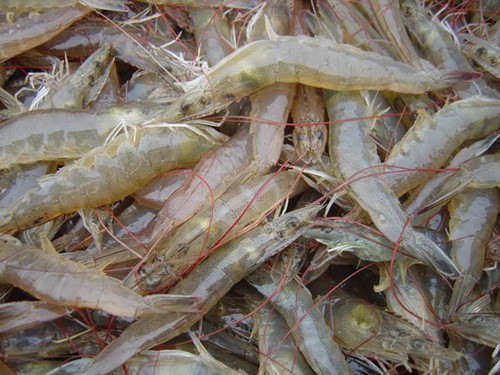
Many people in Sanmen County farm whiteleg shrimp (Penaeus vannamei), and the vast majority do so in open-air ponds, producing only one crop a year. But in Xitouyang Village, Shaliu Town, whiteleg shrimp not only live in greenhouses, they can also be raised for three crops a year, with obvious increases in both output and value. On September 20, a reporter went to experience firsthand the wonders of umbrella-style greenhouse farming of whiteleg shrimp.
At noon that day, the reporter braved the scorching sun to reach the farming base of Sanmen Huiwang Aquatic Products Co., Ltd. in Xitouyang Village. Ponds were packed densely side by side, each lined at the bottom with a layer of black plastic sheeting but no soil, with a concrete pillar standing in the middle and dozens of steel wires connected to the pillar, forming the shape of an open umbrella. Several aerators floated on the surface; the water was clear, and the whiteleg shrimp could be seen distinctly.
“You came a bit early, so you can't see the whole greenhouse. We're about to lay three layers of netting over the steel wires, and that will make it a greenhouse, so the white shrimp won't have to endure wind and rain anymore.” Dong Lihui, the company's person in charge, told the reporter that the company began building the ponds in May this year, and the facilities are still being improved, though shrimp can already be farmed.
Dong Lihui said whiteleg shrimp have high water-temperature requirements and must grow in an environment above 18°C, so open-air farming generally involves releasing fry in May and harvesting from the end of August, allowing only 1 crop a year. But umbrella-style greenhouse farming can provide insulation and enable off-season sales, allowing three crops a year.
The reporter also learned that whiteleg shrimp have relatively high water-quality requirements. In traditional farming, because water quality cannot be controlled, there are more diseases and pests, and yields are not particularly high, with yields per mu between 500 jin and 1000 jin, but umbrella-style greenhouses can strictly control water quality.
The reporter noticed that although the water here also comes directly from seawater, pebbles and fine sand are laid outside the intake pond. Seawater from outside the pond must pass through these two purification steps and seep into the intake pond. Comparing the water in the intake pond with the seawater outside the pond, one is emerald clear and the other is yellowish. Then from the intake pond to the storage pond, through disinfection with bleaching powder and aeration with jet aerators, the pathogens affecting farming and the water quality are well controlled.
“Because the farming time is extended and water temperature and quality are ensured, the yield of whiteleg shrimp in umbrella-style greenhouses has increased markedly, with yields per mu reaching more than 3000 jin.” Dong Lihui explained that because off-season sales are possible, whiteleg shrimp average about 20 yuan per market jin, considerably higher than the current market price of 12 yuan.
Dong Lihui said he had always been engaged in wholesale of whiteleg shrimp and noticed that shrimp sell in large volumes in Jiangsu and Zhejiang, but after November they face a supply gap, with a very large shortfall, so goods can only be shipped from places like Guangdong; but that way the shrimp survival rate is low, so he began pondering greenhouse farming. After inspections in Guangdong and other places, he contracted more than 200 mu of farming ponds in Shaliu and hired aquaculture experts from Guangdong to tackle technical problems, and has already invested more than 11 million yuan. Although the investment is large, because output value is high, profits are good, and sales are not a concern, he estimates costs can be recovered next year.