New Chinese cabbage variety looks strikingly like a yellow rose
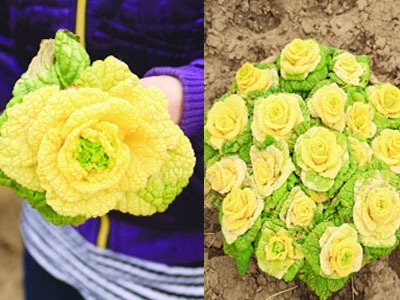
From a distance it is a Chinese cabbage, but up close it looks like an enlarged yellow rose. Experts from the College of Horticulture at Nanjing Agricultural University have successfully selected a Chinese cabbage that looks like a yellow rose, and more than 100 plants have been propagated at the Nanjing Jiangpu farm, forming a stable population. In a little while it will be ready to reach the dining tables of Nanjing residents.
On the weekend, as usual, Hou Xilin, dean of the College of Horticulture at Nanjing Agricultural University, took his graduate students to the fields to “visit” his precious vegetable seedlings. Arriving at the Nanjing Jiangpu experimental base, before they even got close, a patch of tender yellow Chinese cabbage came into view in the distance. Looking closer, each Chinese cabbage “bloomed” as beautifully as a rose.
According to Hou Xilin, this is one of the newest Chinese cabbage materials selected by Nanjing Agricultural University, and it has been kept “in seclusion” for 5 years. “Growing in whole patches shows that they have become a stable population, and it will not be long before they reach the dining table.” On closer inspection, it does not look much like Chinese cabbage: a tender yellow color, with leaves curling one after another like pretty lace trim, and each leaf also has small serrations. Touching it with your hand, the leaf is slightly firm and thicker than ordinary Chinese cabbage leaves.
The original material of this yellow-rose-shaped Chinese cabbage was introduced from elsewhere, but when it first arrived at Nanjing Agricultural University it did not look like it does now. After repeated selection, experts discovered its “naturally beautiful” side, and only after several rounds of “selfing” did it grow into its current stunning “appearance.”
After 4 years of “selfing,” experts at Nanjing Agricultural University this year mixed and planted more than 100 Chinese cabbage plants for the first time. “We isolated more than 100 seedlings with gauze covers so that they pollinate each other, while also preventing foreign pollen from ‘intruding.’” Hou Xilin said.
Can the delicate rose-shaped Chinese cabbage be eaten? What does it taste like? Hou Xilin said with a smile that it can absolutely be eaten, but because it is prettier than ordinary Chinese cabbage and more ornamental, it can be used in cold dishes and salads.
Besides the pretty “yellow rose” Chinese cabbage, there is “Hanxiao,” which can withstand cold of minus 9.7 degrees, “Shulv,” which resists high temperatures of 39 degrees, and the refreshing and tasty “Aikang No. 6”…… The laboratory where Dean Hou Xilin works has collected 1,986 Chinese cabbage seed resources. After uncovering their excellent genes, experts can carry out molecular design breeding and, according to demand, crossbreed and “customize” new Chinese cabbage varieties.