Raising ducks on ecological beds earns 1.2 yuan more per duck
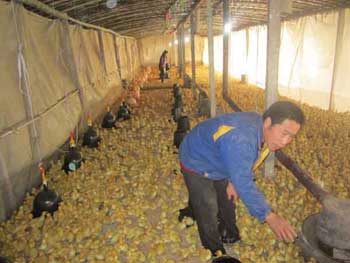
Recently, when a reporter walked into the duck shed of Shi Jinhua, a villager of Dayantuan Village, Liuguanzhuang Town, Ju County, they saw an “ecological bed” laid on the floor of the duck house. Raising ducks with “ecological bed” technology not only achieves zero discharge of duck manure during the breeding process and reduces environmental pollution, but also brings better economic returns. Compared with traditional breeding methods, it earns 1—1.2 yuan more per duck.
In recent years, Ju County has vigorously developed characteristic and efficient breeding, continuously expanded new breeding channels, and introduced new technologies, achieving remarkable results. At present, the area of biological and environmentally friendly duck houses like this in the county has reached 20,000 sq m, more than 20 ecological and environmentally friendly poultry farms have been developed, and more than 420,000 meat ducks are kept. To change the pollution caused by traditional breeding methods to the surrounding environment, the county has actively explored environmentally friendly duck breeding models, mixing raw materials such as rice husks and sawdust with microorganisms for fermentation and then using the mixture as duck shed bedding, and decomposing duck manure through biological lactic acid bacteria fermentation technology. The entire feeding process achieves zero discharge, no odor, and no pollution, realizing the goal of environmentally friendly and green breeding from the source.
Raising ducks this way has the advantages of “three savings, two improvements, one increase, and zero discharge.” First, it saves water. Manure does not need to be washed away. Second, it saves feed. It can provide a comfortable environment for meat ducks, with suitable temperature and fresh air, reducing stress disturbances from cleaning the shed. Meat ducks consume less and feed conversion is high, which can save more than 5%-9% of feed. Large ducks (45 days) can be marketed 4 days earlier, and small ducks (28 days) can be marketed 2 days earlier, and 2-3 more batches can be raised each year. Third, it saves labor. With traditional breeding methods, 1 person raises 3,000 meat ducks, while with environmentally friendly breeding methods, 1 person can raise 8,000-10,000. It saves labor and reduces costs, and can save more than 50% of labor. Fermentation bed duck raising requires no cleaning of the shed. Turning the bedding once every 3—5 days, one person can turn a 4,000 sq m duck bed in one morning, and it is very clean, with no manure or urine present, saving labor and making duck raising easy. Fourth, it improves resistance. Because the strong beneficial bacterial community inhibits the reproduction of harmful microorganisms such as spoilage bacteria, duck diseases are reduced. In addition, the temperature on the surface of the bedding stays at 15-25 degrees Celsius all year round, the temperature is suitable, and the environment is comfortable, so the resistance of meat ducks is enhanced. Fifth, it improves meat quality. Meat ducks basically do not need medication, effectively avoiding drug residues and greatly improving product quality. Sixth, it increases breeding benefits. Each meat duck can save 0.5-1 yuan in medicine costs; the bedding can be used for more than 2 years, and each sq m of bedding only needs 1-2 yuan in maintenance costs. What is especially prominent is that each duck earns more than 1 yuan more than with traditional breeding methods. A duck shed that markets more than 6,000 ducks in one batch earns more than 2,000 yuan more than traditional breeding, and the economic benefits are quite significant. Seventh, zero discharge. Meat duck manure can be fermented by the bacterial community in the bedding, degraded and digested, which can fundamentally solve the pollution caused to the environment during duck raising and directly achieve the goal of zero discharge and zero pollution from the source. In addition, after the bedding is reused for 2-3 years, it becomes high-quality organic fertilizer, which can be used for growing organic vegetables, grain, and fruit and for improving soil, increasing breeding benefits and reducing breeding costs. The promotion of biological and environmentally friendly breeding technology in Ju County has further advanced the transformation of traditional breeding models to modern breeding models, accelerated the pace of environmentally friendly breeding, driven the construction of new rural areas, and realized sound and rapid development of the animal husbandry industry.