What trees can be used to graft roses? You should know these benefits
Rose flowers are elegant and beautiful, with diverse colors and blooms in all four seasons, and are deeply loved by people. We all know that roses can be grafted, so what trees can be used to graft roses, and what are the benefits of grafting roses? Let's take a look together below!

What trees can be grafted with roses
When grafting roses, the main factor affecting survival is the compatibility between the scion and the rootstock. So-called compatibility means the ability of the scion and rootstock to combine with each other because they are the same or similar in internal tissue structure, physiology, and genetics. Roses belong to the Rosaceae family. The best rootstocks for grafting roses are various wild roses, such as Rosa multiflora 'Carnea', Rosa davurica, Rosa banksiae, Rosa macrophylla, etc. These varieties have well-developed root systems, strong disease resistance, and vigorous growth, and can provide sufficient nutrients for the roses to be grafted.

Grafting propagation techniques for roses
Wild roses are commonly used as rootstock for grafting roses, with two methods: bud grafting and branch grafting. Bud grafting has a relatively high survival rate and is generally carried out from August to September. The grafting site should be as close to the ground as possible. The specific method is to use a budding knife to make a "T"-shaped cut in the bark on one side of the rootstock stem or branch, then select a bud from the middle of a well-grown current-year branch of the rose. After inserting the bud into the "T"-shaped cut, tie it with a plastic bag and provide appropriate shade, and after about two weeks it will heal.
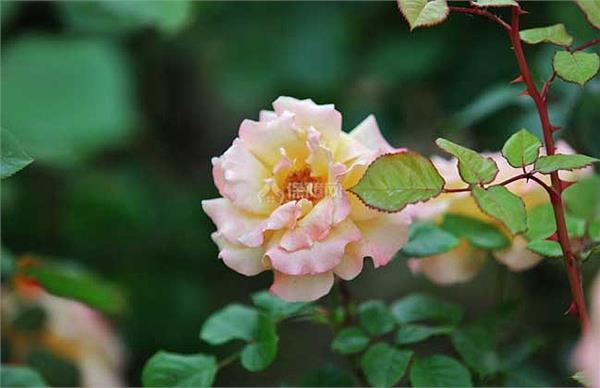
What are the benefits of grafting roses
1. Vigorous growth: The rootstock used for grafting roses is vigorously growing wild rose, so the stems, leaves, and flowers are all noticeably superior to ground planting.
2. Less disease: Grafted roses have branches and leaves higher above the ground, with good ventilation and light transmission, so there is almost no disease.
3. Less space occupied: A traditional three-year-old ground-planted seedling occupies about O.09 sq m, while a grafted rose occupies no more than O.001 sq m.
4. Convenient management: The main stem of the wild rose has no thorns, making it easy to manage, and the grafting height can be controlled, allowing arbitrary layout according to the form of the courtyard.
5. Multiple flowers on one plant: 3 to 5 varieties can be grafted onto one wild rose, and ten plants can reach more than 30 varieties, which is completely enough for courtyard cultivation.

What are the benefits of grafting roses
1. Vigorous growth: The rootstock used for grafting roses is vigorously growing wild rose, so the stems, leaves, and flowers are all noticeably superior to ground planting.
2. Less disease: Grafted roses have branches and leaves higher above the ground, with good ventilation and light transmission, so there is almost no disease.
3. Less space occupied: A traditional three-year-old ground-planted seedling occupies about O.09 sq m, while a grafted rose occupies no more than O.001 sq m.
4. Convenient management: The main stem of the wild rose has no thorns, making it easy to manage, and the grafting height can be controlled, allowing arbitrary layout according to the form of the courtyard.
5. Multiple flowers on one plant: 3 to 5 varieties can be grafted onto one wild rose, and ten plants can reach more than 30 varieties, which is completely enough for courtyard cultivation.
The above is an introduction to what trees can be used to graft roses and the benefits of grafting roses. For more information on plant grafting propagation techniques, welcome to follow Zhuangxiu Baozhangwang to learn more.