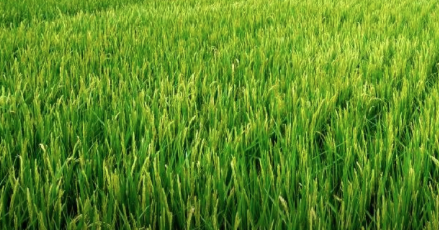
Rice policy promotes first-crop rotation and second-crop conversion to landscape crops to stabilize production and sales
At present, the area of first-crop and second-crop rice paddies in our country is about more than 270,000 hectares. Council of Agriculture Minister Chen Chi-chung said in an interview after a press conference on the 24th that, according to estimates by the Agriculture and Food Agency, the rice paddy area must fall to about 250,000 hectares to stabilize market supply and demand. Therefore, the Council of Agriculture is promoting measures such as the "Industrial Adjustment of First-Crop Rice in Water Resource Competitive-Use Areas" and the "Promotion of Converting Rice Paddies in the Second Crop to Landscape Crops," hoping to reduce the rice cultivation area and stabilize rice production and sales.
The Council of Agriculture promotes first-crop rice rotation
Agriculture and Food Agency Deputy Director-General Chuang Lao-da said that in order to effectively use water resources and establish a regional cultivation system, and in conjunction with incentives for water conservation provided by the Ministry of Economic Affairs, rotation is being promoted in water resource competitive-use areas including Shimen Reservoir, Baoshan Reservoir, Mingde Reservoir, Liyutan Reservoir, and Zengwen and Wushantou Reservoirs.
Huang Chao-hsing, head of the Grain Storage and Transportation Section of the Agriculture and Food Agency, explained that when water sources are insufficient, it is impossible to notify rice farmers before they buy seedlings, causing great trouble for farmers. By promoting rotation in water resource competitive-use areas, farmers can respond in advance. If it is their turn for fallow and they plant incentive crops under the "Green Environmental Payment Program for Land" other than rice, or green manure, landscape crops can receive 45,000 yuan per hectare, plus 42,000 yuan in water conservation incentives from the Ministry of Economic Affairs, for a total of 87,000 yuan in incentives.
Chen Yen-ching, chairman of the Taiwan Rice Cultivation Association, gave an example: one year, many rice seedlings were ordered from the south, but that year there was a water shortage. This year it was originally estimated that the Hsinchu area would have a water shortage, so fewer seedlings were prepared, but then after a rain there was no water shortage again, causing a shortage of seedlings. He hopes that after the policy is promoted, farmers will be able to assess earlier whether to plant rice.
The Council of Agriculture encourages converting the second crop to landscape crops
In addition to promoting first-crop rotation, the Council of Agriculture is also promoting the conversion of rice paddies in the second crop to landscape crops. Chuang Lao-da said that this year pilot programs will be held for the second crop in Taichung City, Changhua County, Yunlin County, Chiayi County, and Tainan City, among other places, providing incentives for cooperative conversion to landscape crop planting, raising the amount from 45,000 yuan to 55,000 yuan per hectare, hoping to create rural landscapes and stimulate waves of rural tourism. Huang Chao-hsing said he hopes the area converted to landscape crops in the second crop will reach 10,000 hectares.