Free-range chickens gain popularity: saying goodbye to 45-day fast-grown chickens, each sells for over 100 yuan
Free-range imperial chickens live a “five-star” life
They grow up eating green vegetables and self-mixed feed, and are not sold until they have been raised for a full 6 months; each sells for over 100 yuan
Morning News reporter Li Baohua
The 45-day fast-grown chickens that were fed large amounts of antibiotics and banned drugs were recently exposed by the media, making many people “turn pale at the mention of chicken.” But at a leisure farm in Datuan Town, Pudong New Area, Han Gang, who quit his job to devote himself to raising chickens, is steadfastly continuing his dream of ecological agriculture: “All the chickens are kept free-range, the feed is mixed by ourselves, Chinese herbal medicine is used to prevent disease in the chickens, and each chicken is raised for at least 6 months before being sold.”
“At first it was because my family and I have relatively high standards for ingredients. Now the hope is to let more people eat truly free-range chickens.”
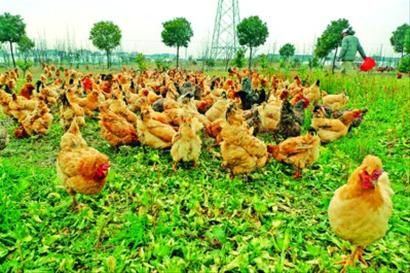
Imperial chickens raised by natural ecological methods forage in the orchard
The cost of a free-range chicken is at least 60 yuan
Han Gang's breeding base is located in the area of Hunan Highway and Nantuan Highway in Pudong. Although it is already winter, the loquat trees and orange trees in the breeding farm are still verdant, and beneath the trees are patches of green vegetables. Imperial yellow chickens with bright plumage forage in twos and threes in the orchard, and the green vegetables on several plots have been eaten down to only some of the roots and stems.
Watching these chickens run around, Han Gang, who only started raising them in his 50s, is very pleased: “A delicious free-range chicken has to live a ‘five-star’ life.” The Chinese imperial chickens he raises are different in appearance from ordinary chickens. In general chicken breeds, the rooster has a comb on its head and red fleshy wattles hanging below its chin, but for the imperial yellow chicken, whether rooster or hen, what grows below the chin is a “beard,” and a tuft of feathers also grows on the feet, making them very easy to identify.
The Chinese imperial yellow chicken is an ancient chicken breed in our country. It not only has a unique appearance, but its meat is also tender, and it was once a chicken used for imperial meals in the Qing Dynasty palace. Therefore, in September last year, Han Gang introduced the first batch of 1,000 Chinese imperial yellow chickens and began exploring free-range raising under fruit trees, while also raising some barred Plymouth Rock chickens for comparison of growth speed and other factors. The imperial yellow chickens enjoy open space in the fruit forest, run around and exercise all day, and peck at green grass and insects. Chicken feed accounts for only half of their food, and the rest is all natural food.
This natural ecological way of raising chickens makes the chickens grow more slowly. Han Gang said that when the Chinese imperial yellow chicken is raised to 2 months, it still weighs only about 2 jin. After being raised for a full 6 months, the rooster can grow to around 4 jin, and the hen about 3 jin. Raised this way for half a year, “the cost of just feed, labor, water and electricity for one chicken is around 60 yuan. Sold on the market at more than 100 yuan each, but some people still complain it is expensive.”
Han Gang's wife, Ms. Ni, strongly supports her husband's business. “Now healthy ingredients have become a kind of luxury. If you spend more than 100 yuan a month to buy one trustworthy free-range chicken to eat with your family, this price should still be acceptable, right!” Every time she makes chicken soup for her own family, Ms. Ni uses chickens raised by her own family. Now the chickens they raise already have a small reputation among their circle of relatives and friends.
Insisting on mixing their own chicken feed
Although there is a lot of ready-made chicken feed on the market, Han Gang still insists on mixing the feed himself. “This is the feed we have mixed, mainly corn (2444, -7.00, -0.29%) powder and rice bran, plus some Chinese herbal medicine powder. After more than 20 hours of fermentation, it is made into pellets and fed to the chickens, and it is very easy for them to absorb.” In the ingredient shed, Han Gang pointed to a bag of Chinese herbal medicine beside him and said: “This contains isatis root, dyers woad leaf and pine needles, as well as some allicin. Mixed into the feed, it can have a preventive effect.” He said that because the chickens can move around in the orchard all day, their physique is very good, and because the Chinese herbal medicine in the feed can prevent disease, these chickens only need two vaccinations a year, for avian influenza and Newcastle disease (commonly known as fowl plague).
In addition to this feed, the main food of these chickens is the green vegetables and grass under the orchard. Early every morning, they are first fed a small amount of feed, then driven into the orchard to find food on their own, and when they return to the coop at night they are given another meal of feed. Han Gang said: “We divide our land into two large plots, rotating vegetables and grass. The chickens eat the vegetables first, and only after the vegetables are eaten do they eat the grass. After the grass is eaten, they will even dig up the grass roots. They can really eat!”