Egg prices have fallen so low that farmers are losing money; farmers say prices may rebound in the second half of the year
Eggs are 5 mao cheaper per jin than a month ago
Consumers call for egg prices to "drop a bit more," while farmers say they are "losing money"
The total cost of one egg in Wuhan is 0.51 yuan
After the Spring Festival, egg prices in Wuhan fell back, dropping more than 4 mao per jin over the past month or so. Some residents hope "egg prices will drop even more sharply," while some farmers say "egg prices have fallen so low that we are losing money." Industry insiders say that in recent years Wuhan's egg prices have been trapped in a cyclical "vicious circle" of rises and falls. This spring, Wuhan residents can eat cheap eggs, but they should be wary of a possible rebound in egg prices in the second half of the year.
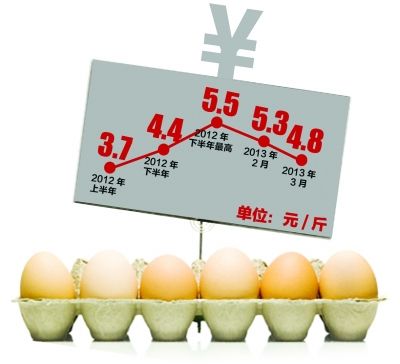
Farmers say egg prices have fallen so low that they are losing money; egg prices may rebound in the second half of the year
Eggs are more than 5 mao cheaper per jin
Consumers still want egg prices to keep falling
"4.8 yuan per jin, 2 mao cheaper than earlier this month." Yesterday, Grandma Gao Xin, who was buying eggs at the Wuli market in Hanyang, said egg prices had dropped recently, and it would be even better if they could keep falling.
In some supermarkets, reporters saw that special-price eggs could be bought for less than 4.5 yuan per jin. More than a month ago, egg prices were basically above 5 yuan. Monitoring data from the Wuhan Price Bureau also showed that last week, the average retail price of improved-breed eggs in the city's farmers' markets was 4.8 yuan/jin, about 10 percent cheaper than 5.33 yuan/jin on February 8.
This round of egg price declines is nationwide. According to monitoring by Xinhua News Agency's national agricultural and sideline products and agricultural input price quotation system, compared with February 11, the national average daily price of eggs on March 23 fell by more than 10 percent. Except for Hainan, egg prices in all other provinces, autonomous regions and municipalities were falling, with Tianjin, Hebei, Shanxi, Liaoning, Heilongjiang, Shandong, Henan, Hunan and Chongqing seeing the largest declines, between 15% and 20%.
Facing falling egg prices, some consumers in Wuhan shouted, "Let it fall even more sharply." Some customers said that in the first half of last year, eggs were cheapest at just 3.7 yuan per jin, and they hoped egg prices this year could also fall to that level.
Egg prices fall below cost
Farmers complain they are going to lose money
"Egg prices started falling after the Spring Festival, and if they fall further, we'll lose everything." Yesterday, Chen Shuangquan, a farmer at the Xinzhou Shuangquan Chicken Farming Cooperative, complained that the wholesale price of eggs is now 3.55 yuan to 3.6 yuan per jin, and there is no profit left.
Counting on his fingers, Chen Shuangquan calculated that a chicken eats 2.5 to 3 liang of feed a day, and currently a ton of feed costs 3,000-3,100 yuan. The feed cost per egg is about 0.45 yuan. Calculating 7 eggs per jin, plus labor, water, electricity and other farming costs, eggs must sell for at least about 3.6 yuan to break even, and the total cost per egg is 0.51 yuan. "The current selling price of eggs is right around the break-even line, and some farmers have already started losing money." Chen Shuangquan was very helpless.
"The drop in egg prices is mainly caused by market supply exceeding demand." Chen Haiqing, general manager of Wuhan Mulan Township Poultry and Egg Company, said that in the second half of last year, the wholesale price of eggs once rose to 4.4 yuan/jin. Seeing high profits, many farmers increased their breeding volume. Now this batch of laying hens is producing eggs in large quantities, while the period after the Spring Festival is the off-season for egg consumption, causing egg prices to fall.
Chen Shuangquan said that the chicken farming cooperative he belongs to has six or seven farming households. Last year, the inventory of laying hens was about 60,000, and now it is nearly 100,000. "The market was so good in the second half of last year that everyone wanted to raise more chickens to make money." Chen Shuangquan said he had not expected egg prices to now fall so low that they would cause losses.
Experts say people can eat cheap eggs this spring
Beware of an egg price rebound in the second half of the year
In the first half of last year, the retail price of eggs in the Wuhan market was as low as about 3.7 yuan per jin; but in the second half of last year, egg prices rebounded strongly, selling for as high as about 5.5 yuan per jin. Going back further, in the first half of 2011, eggs in Jiangcheng were once as cheap as about 4.2 yuan per jin, then rose all the way, approaching 5.5 yuan at the highest in September and October of that year.
"After a big drop comes a big rise, and after a big rise comes another big drop." Chen Haiqing said that in recent years Wuhan's egg price trajectory has been a cyclical "vicious circle" of rises and falls, and the current sharp drop in egg prices may not necessarily be a good thing.
Many farmers in Wuhan follow the trend in farming. From rearing to laying, the cycle for laying hens is only about 150 days. When the market is good, egg prices are high and there is money to be made, farmers rush in together and buy large numbers of chicks to raise. Conversely, they also rush out together and reduce farming. In the end, the rise and fall of egg prices is determined by market supply and demand. Farmers following the trend makes it easy for the supply-demand relationship in the market to become one-sided at a certain period, leading to alternating big rises and big drops.