Poultry farmers suffer as bird flu fears drive prices down, farmer treats guests to duck to weather the "four-month winter"
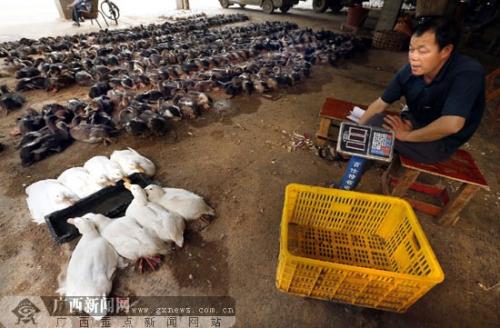
Mr. Wei of the duck section at Liuyong farmers' market said he brought 1000 ducks on the 18th, and by around 5 pm more than 400 were still unsold, whereas normally they sell out quickly. Photo by reporter Yan Huang
On April 19, the average transaction price at the duck section of Liuzhou's Liuyong farmers' market was 3.1 yuan per jin, with the closing price dropping as low as 2.7 yuan per jin. Duck farmer Qin Zhijia in Luoman town, Liujiang county, after receiving a market price call from a fellow farmer, looked at the 8000 ducks in the reservoir that were just one week from being ready for market, and chain-smoked three cigarettes in one go.
Welcome to eat one of my ducks
"To break even on raising water ducks, you need to sell at around 4.7 yuan per jin. At the current low price, I lose about 10 yuan on every duck I sell. With 8000 ducks, I'll lose 80,000 yuan." Qin Zhijia said that raising ducks follows a certain cycle, and when the time comes they must go to market, otherwise the ducks stop growing and at the same time waste feed for nothing. "The biggest cost in raising ducks is feed. Out of 4.7 yuan per jin for a duck, 3.8 yuan goes to feed. For 8000 ducks, one day's feed requires 60 bags, each bag costs 115 yuan, so one day's feed costs 6900 yuan. Every day I delay selling, I lose another 6900 yuan. Duck farmers can't afford to wait."
Since the outbreak of H7N9 bird flu in the country, Qin Zhijia had never paid such close attention to media reports about poultry on any day as he did now. He stressed that every duck he raised was vaccinated against flu about ten days after being brought in, and the vaccine was obtained free of charge from the town's animal health department. "The ducks I'm raising now are just as safe as before!" For this reason, every time someone came to the duck farm to buy ducks, he would kill a duck and eat it together with the guest. He hoped in this way to prove the safety of the ducks. But this small effort still could not help him improve his current situation. "I can only hope that when the ducks go to market in a week, the price will be a little higher and I'll lose a little less."
Market prices keep falling
Facing the same plight as Qin Zhijia was Ma Yongqiang, a farmer in Luorong town. After just selling off his 4300 ducks in several batches, he temporarily stopped buying ducklings and instead came to browse the farmers' market every morning. "The lowest price was only 2.4 yuan per jin for the first batch, and the highest was only 3.1 yuan per jin. In total I lost more than 60,000 yuan." Ma Yongqiang, who came from Zhejiang to Liuzhou in 1990 to raise ducks, considered himself a veteran, but seeing new bird flu reports every day made it even harder for him and his peers to see a timetable for the duck market to recover, leaving them only hoping the situation would not worsen.
Speaking of the impact of H7N9 bird flu on the duck market, Ms. Wu, who sells ducks on commission at Liuyong farmers' market, felt it just as deeply. She took out a ledger she carried with her, which recorded the opening price, closing price and average price over the recent period: "Since Qingming, duck prices have kept falling, dropping to as low as 2.4 yuan per jin. But at the end of last year, the average price for ducks could reach 6.5 yuan per jin." She said, "Before, 18 truckloads of ducks (2000 per truck) were brought into the market every day and people scrambled to buy them, but on the 19th only 12 truckloads were brought in, and only 5 truckloads were sold, with the rest going into cold storage. Market trading volume shrank by more than 30%."
Hard to see a single customer at the stalls
Even worse than the sluggish duck market was the pigeon section. "From 3 am today when I arrived at the market to set up my stall, until now at 11 am, I haven't seen a single customer." said Master Huang, who sells pigeons at Liuyong agricultural wholesale market. There were only 7 stalls selling pigeons in the market, and they were gathered in the same corner of the market. "Because of bird flu, passersby now walk around our stalls, let alone come to buy. I haven't made a single sale in a week, and the other few households are about the same, while on a normal day we could sell about 150 pigeons."
"Pigeons are different from other poultry. We buy them from farmers and generally add a profit of one or two yuan, so the price of pigeons has always been 18 yuan each. Otherwise, if we lowered prices like other poultry, we vendors would just be losing money for nothing." Master Huang said that compared with them, the middlemen vendors, the ones losing the most were the farmers. The small farmers who supplied him could no longer hold on and were already preparing to stop raising pigeons.
Compared with the bleak pigeon section, Boss Liu at chicken stall No. 100 had already gradually lowered the price of free-range chickens from 8 yuan per jin before Qingming to 5.5 yuan per jin. Even so, sales that used to stay around 1000 birds had now fallen to just over 200. The reporter saw at the chicken section that some vendors had already put up signs reading "free-range chicken 3 yuan," and signs reading 4 yuan or 5 yuan could also be seen everywhere. At the market exit beside the chicken section, the reporter saw that some small vendors had also begun retailing at such low prices. "Free-range chicken 3 yuan per jin." There was much helplessness in the small vendors' hawking.