H7N9 Devastates Poultry Industry: Farmers Trapped Between Being Unable to Afford to Raise Birds and Unable to Sell Them
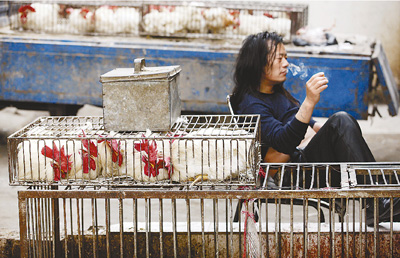
A poultry stall at a vegetable market in Huaibei City, Anhui Province, stands deserted.
Workers at a farm in Longhai City, Zhangzhou, Fujian Province, throw unsold ducklings into an incinerator. Photo by Zhang Bin
Farmers: The current situation is very difficult
Farmers in both epidemic and non-epidemic areas suffer the same fate; large and small operations alike are struggling
At 4 p.m. on April 28, at Wanshouting Farmers Market in downtown Hangzhou, Zhejiang Province. The once bustling live poultry stalls were now completely empty. According to a vendor selling poultry eggs, even before the government ordered closures, traders had been shutting down one after another. "We simply can't keep going!" Although the egg stalls had not been shut down, business was dismal. Auntie Peng, who had been selling eggs for over 20 years, said she used to sell 70 boxes of eggs a day; now she couldn't even sell 20 boxes, and couldn't even cover the stall fee.
Consumer attitudes have always been a bellwether for the market and most directly reflect the impact of the epidemic. A reporter randomly interviewed several citizens at the farmers market. Most said that the steady stream of human infection cases had made them "turn pale at the mention of poultry," and that even after the bird flu passes, they would not immediately buy poultry meat.
Poor sales channels have hit upstream farmers hard. The first to fall were individual farmers with weak risk resistance.
"Comrade reporter, has anyone spoken up for us?" On April 29, the reporter received another phone call from Chen Weichun.
Chen Weichun is a duck farmer from Xiangshan County, Ningbo, Zhejiang Province. In 2001, he and his wife came to Daluodu Village, Wan'an Community, Jiangning District, Nanjing, to raise ducks, and they had been doing so for 12 years. On April 28, when the reporter visited, Chen Weichun and his wife looked as if they had seen a glimmer of light in the gloom. Their dark expressions brightened into smiles as they grabbed the reporter's hand, as if they had endless things to say.
"The current situation is truly very difficult," said Gan Aifang, Chen Weichun's wife. The ducks couldn't be sold, so they had all grown into old ducks. Once they molted, they stopped laying eggs, but the feed couldn't be reduced. "Now we can only rely on selling duck eggs, but the price of duck eggs is also falling," she said. In April alone, they had lost 120,000 yuan. "Tell us, what are we supposed to do now?" Holding a duck feather, Gan Aifang spoke and wept at the same time.
Small operations are struggling, and large ones are not faring well either.
"2.53 million broilers disposed of and sold, normal wholesale price is 12.8 yuan/jin, but now the discounted selling price is only 3.3 yuan/jin; 34,200 jin of egg products disposed of and sold, normal selling price 13.8 yuan/jin, discounted price only 3.3 yuan/jin... Expected losses will reach over 10 million yuan." On April 27, in an interview with reporters, Chen Xihang, deputy general manager of Zhenning Animal Husbandry Co., Ltd. in Ningbo, Zhejiang Province, calculated the losses with a heavy heart. This company, Zhejiang Province's largest quality chicken farming enterprise, had previously marketed 5 million free-range chickens annually, mainly supplying the Shanghai, Hangzhou and Nanjing markets. But after early April, live poultry trading in all three cities was gradually suspended. From April 6 to 25, the company lost 3,116,700 yuan in 17 days, averaging over 180,000 yuan in losses per day.
In Guangdong, where no epidemic had yet been detected, farmers likewise could not escape the same fate.
On a remote hilltop in Yaogu Town, Yunfu City, several chicken farms are scattered about. The owner, Zhao Huoquan, said that due to the H7N9 epidemic, he had already lost several hundred thousand yuan. "I mainly raise 'Sanhuang' chickens. Each chicken costs about 25 yuan. Now I lose 10 yuan on every chicken I sell, but if I don't sell, I lose 25 yuan. The longer I raise them, the higher the cost. It really puts me in a dilemma."
Zheng Huidian, deputy director of the Guangdong Provincial Department of Agriculture, said that the impact of H7N9 bird flu on Guangdong's poultry industry had exceeded that of the 2003 SARS outbreak and the 2004 bird flu period. It is estimated that poultry farms and households in Guangdong Province are losing over 100 million yuan per day.
Government: Stabilize the poultry industry, boost confidence
Support policies introduced one after another, the industry actively rescues itself, but the situation remains grim
Facing the difficult situation in the poultry industry, Zhejiang promptly introduced a series of support policies and actively guided the industry toward self-rescue in production. On April 16, Zhejiang issued the "Notice on Actively Responding to H7N9 Bird Flu to Support the Sustained and Healthy Development of the Poultry Industry." Breeding poultry farms holding a valid "Breeding Livestock and Poultry Production and Operation License" were given production maintenance subsidies at a standard of 15 yuan per bird; poultry farms were given one-time financial subsidies. Subsequently, most cities including Hangzhou and Wenzhou introduced supporting subsidy policies based on their actual conditions. Dai Xuming, deputy director of the Zhejiang Provincial Animal Husbandry and Veterinary Bureau, said that subsidy policies were being actively implemented and were expected to be put in place within 10 or so days after the "May Day" holiday.
In addition to subsidies, the government also encouraged leading enterprises to increase live poultry stockpiling. The Nanjing Municipal Agriculture Commission held a symposium attended by industry associations and 10 leading agricultural enterprises to guide enterprises in increasing stockpiling. On April 17, six processing enterprises in Nanjing connected with 20 large-scale poultry farms in Luhe District and reached an agreement to purchase more than 30,000 meat ducks per day; Wens Company in Lishui District purchased 580,000 broilers from farmers at a purchase price of 10-12 yuan/kg, ensuring reasonable profits for farmers.
Facing the sharp market decline and consumers' lack of confidence, some local government officials also came up with "moves" one after another, acting as poultry promoters. The mayor of Qingyuan City, Guangdong Province, led chicken farming enterprises in a banquet to eat chicken heartily, becoming Guangdong's first prefecture-level city mayor to lead by example in eating chicken to support farmers. Afterward, the market showed some improvement, but the situation was still hard to reverse.
Under the government's active guidance, poultry farming enterprises also began to rescue themselves, with farms and cooperatives moving toward "chilled fresh sales." These played an important role in stabilizing the poultry industry, boosting market confidence and promoting the long-term stable development of the industry.
However, as the epidemic spread, the situation in the poultry farming industry remained far from optimistic. Dai Xuming told reporters that although all of Zhejiang was doing everything possible to fight the epidemic, and the subsidies were larger than ever before, as long as the epidemic was not eliminated, enterprises would only find things more difficult. He did some calculations for the reporter: the average daily feed cost for a chicken or duck was now about 5 mao, and a subsidy of one or two yuan could only sustain them for a few days; for breeding poultry enterprises, which were the focus of policy protection, a subsidy of 15 yuan per bird could help the enterprise hold out for at most one month; Zhejiang's original breeding chicken hatching capacity was 39 million birds, but now only 8 million were still being hatched. "If the epidemic continues for another one or two months, we may not be able to eat live poultry for quite a long time to come."
Jin Liang, deputy researcher of the Animal Husbandry Division of the Zhejiang Provincial Animal Husbandry and Veterinary Bureau, revealed to reporters that in the process of encouraging enterprises to process poultry that could not be sold, Zhejiang exposed the problem of insufficient slaughtering capacity. Affected by citizens' habit of buying live poultry, there were relatively few poultry slaughtering points in the province. In addition, after the bird flu, many workers on the slaughtering lines had resigned. Even if many enterprises wanted to process the unsold chickens and ducks into chilled fresh products, they first had to transport them to slaughterhouses elsewhere, then use refrigerated trucks to bring them back locally, rent cold storage for storage — going back and forth doubled the cost, so they would rather directly dispose of the chickens and ducks in a harmless manner.
Dai Xuming said that from the current stage, although the "responsibility" taken on by leading enterprises had minimized the losses of many farmer households, "only taking in and not selling out" left them facing tremendous financial pressure, which would have a huge impact on the poultry industry's future recovery of production. Now, some small and medium-sized local leading enterprises had already seen their capital chains break.