How can soil be managed in a mango orchard to turn dirt into gold?
In Shiyuetian Town, remote and located in the west of Changjiang Li Autonomous County, there is a beautiful legend of "barren land turned into fertile soil."
Wang Yunqing, the elderly father of Wang Zuchun, a farmer in Baoping Village, Shiyuetian Town, now looks forward every day to the arrival of one person: Shi Xuequn, a PhD holder from Hainan University. In Wang Yunqing's words, Xiao Shi has brought a group of capable people who can "turn dirt into gold" in the mango orchard.
Changjiang has fertile land and has long been known as the "home of mangoes." In the 1990s, mango planting reached 100,000 mu. Baoping Village has more than 6,000 people, and more than half of them rely on mango cultivation for income. But for many years, Changjiang's mango varieties were not improved, management techniques were backward, and cultivation technology could not keep up. In addition, the harvest and market time was always more than 1 month later than that of Sanya and Ledong, so the mangoes could not be sold and rotted in the fields, a heartbreaking sight that the old farmers still remember vividly.
Mangoes are the main source of local agricultural income growth. How can farmers be helped to hold this "golden nugget" steadily in their hands?
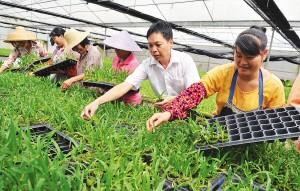
On August 18, at the Meilan Internship Farm of the Provincial Agricultural School, farmers graded and selected orchid seedlings under the guidance of teachers.
After deliberation, the Provincial Department of Education issued a plan to rely on the technical and talent advantages of the province's universities and secondary specialized schools to help farmers implement efficient and distinctive agricultural product projects to increase their income. Soon, under the lead and guidance of the Department of Education, Hainan University's project on research and application of key technologies for safe and efficient mango production in Changjiang "landed" in Baoping Village.
On the afternoon of August 15, Dr. Shi Xuequn and other plant protection experts came to the entrance of Baoping Village. As soon as they got out of the car, they were surrounded by farmers.
"Look, how well the newly grafted buds from last month are growing!" Villager Wang Qianlu enthusiastically took Shi Xuequn by the hand and walked into his family's mango orchard. This mango orchard was very well managed. On the thick branches, tender green leaves were full of vitality.
Villager Fu Enhong said that a few years ago, because the mango trees were aging and production dropped sharply, the villagers were all so anxious they were spinning in circles. Now, with timely technical guidance from experts from Hainan University, everyone felt reassured. The experts suggested grafting new branches onto the mango trees by "crown replacement," that is, cutting off the canopy of the mango trees and grafting high-quality fruit seedlings such as Jinhuang mango and Australian mango.
Wang Qianlu was the first to try crown-replacement seedlings with the experts from Hainan University. He told the reporter: "In July 2011, the trees in the orchard were cut completely bare, and the villagers were 'startled.'" At first, the fruit farmers were half-believing and half-doubting this move, fearing that the fruit trees would be ruined. Unexpectedly, one month later, the grafted new buds grew encouragingly, with a survival rate of 90%. The next year they began to bear fruit, and this year is already the third year. The improved mango trees are loaded with fruit, and the branches are bent down, requiring special racks to support the fruit. Some fruit trees have an annual yield of more than 50 kg per tree. Wang Qianlu contracted 30 mu of land to grow mangoes, and this year's income reached 320,000 yuan.
"My family contracted 120 mu of mango orchard. When the mangoes were only the size of eggs, buyers came to the door and pointed at the trees to order mangoes." said the elderly Wang Yunqing, who rushed over upon hearing the news to visit the experts. "Technology has straightened the backs of us farmers in getting rich!"
Hu Xinwen, vice president of Hainan University, said that this year Hainan University allocated 2.5 million yuan in special funds to promote farmers' income growth, removing worries for experts who go into the fields to do practical things to increase farmers' income.
Farmers in Baoping Township achieving income growth with the help of the Provincial Department of Education and Hainan University is not an isolated case. In Qicha Town of Changjiang County, Nansheng Town and Fanyang Town of Wuzhishan City, Liugong Township of Baoting County... experts helping farmers improve techniques and conduct training can be seen everywhere.
In ancient times barren land became fertile soil; now fertile soil has turned into gold. The experts on the assistance team said: "There is nothing happier than seeing the smiling faces of farmers!"
A bridge of true affection has already been built between villages and institutions. The reporter learned that at present, all higher education institutions in the province with agriculture-related majors and 24 provincial-administered public secondary vocational schools have participated in the practical activities of doing concrete things to increase farmers' income.