Nanning turkeys unsold, farmers anxious as specialty farming hits a sales slump
Guangxi News Network - Nanguo Morning Post reporters Wang Chunnan, He Dingjian, text/photos
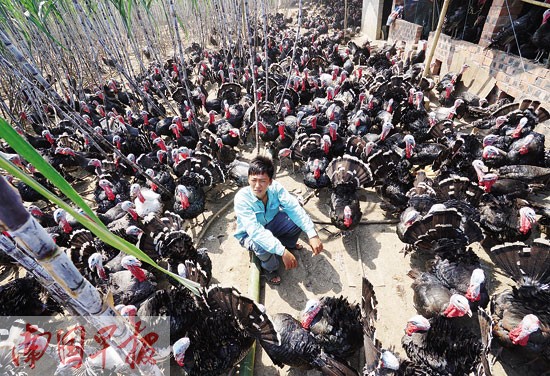
Turkeys are hard to sell, and the farmers are worried.
At the Yunling Wild Boar Breeding Professional Cooperative in Yongning District, free-range wild boars are wandering about and foraging
Recently, farmer Mr. Liang in Wuxu Town, Nanning, ran into the predicament of being unable to sell his turkeys. Such cases are not rare. In recent years, to get rich, some farmers have taken up specialty farming of turkeys, wild boars, snakes and the like. However, due to problems such as poor production-to-sales linkage, cash flow difficulties and inadequate technical support, specialty farming often runs into sales problems. Experts warn: specialty farming carries relatively high risks, and farmers must avoid blind development and rushing in all at once
Predicament:
Specialty farming runs into sales problems
On October 7, farmer Mr. Liang of Yonghong Village, Wuxu Town, spent more than 8,000 yuan on a batch of chicken feed to take home. He raises more than 2,000 turkeys, and this feed was only enough for five or six days. “These turkeys grew up long ago and can be sold, but because no buyers have come to purchase them, I can only keep raising them.” Squatting among a flock of turkeys, Mr. Liang's face was full of worry.
This year, Mr. Liang raised turkeys for the first time. “I have a friend who made money raising turkeys several times in a row, which made me quite envious.” So in April this year, Mr. Liang scraped together tens of thousands of yuan and also set up a farm. From buying turkey chicks to raising them to full size took four or five months. The turkeys grew quickly and had no disease problems, but problems arose at the sales stage. By September this year, the turkeys were ready for market, but for a whole month he had been unable to reach any buyers to come and purchase them.
“In previous years, buyers from Guangdong would come on their own to purchase turkeys, at no less than 5.3 yuan per kilogram, and demand exceeded supply. This year, for some unknown reason, the market situation is abnormal, and demand for turkeys has suddenly dropped.” When Mr. Liang talked with buyers, he only sought to recover his farming costs and had already pushed the price down to the lowest limit, yet still could not close a deal. The turkeys could not be sold, and he still had to spend a large sum every day to keep raising them, losing money with each passing day.
In April this year, the Chen Feng Meat Pigeon Farm in Dahuanghou Village, Chengxiang Town, Wuming County, also ran into a similar predicament. After the avian influenza outbreak, buyers who had previously flocked in from all over the country stopped coming, and the farm was deserted. The farm was forced to take various measures to reduce losses: the pigeons' three meals a day were cut to one meal a day, and mother pigeons were not allowed to hatch squabs…… In just a few months, the farm suffered heavy losses. In that turmoil, Lao Huang, a pigeon farmer in Chengxiang Town, did not escape either. The huge loss left him unable to keep going, and he had to sell his pigeon farm. The original investment of 150,000 yuan ended up selling for only 30,000 yuan.
Cause analysis:
Lack of market assessment ability and risk awareness
“At present, there are not many specialty farmers in Nanning, and the main breeds raised are pigeons, wild boars, turkeys, snakes and so on.” Introduced Huang Qi, deputy section chief of the Animal Husbandry and Feed Section of the Nanning Municipal Bureau of Aquatic Products, Animal Husbandry and Veterinary Medicine. Nanning's specialty farming operations are not large in scale, and many farmers are still in the exploratory stage.
She said that from the perspective of Nanning's specialty farming breeds, they can be divided into two major categories: one is farming targets based on original native breeds or improvements of them. Such as wild boars, snakes, rabbits, bamboo rats and so on. Because wild resources were originally abundant, there was basically no artificial breeding, but later, due to problems such as resource decline, artificial breeding was carried out; the other category is new breeds introduced from other places or from abroad. Before introduction, these breeds were generally proven in their places of origin to have both good growth performance and good farming returns, such as the peacocks, turkeys, crocodiles and so on introduced in recent years.
Huang Qi analyzed that those who choose to engage in specialty farming are mostly young and middle-aged farmers in their prime and eager to get rich. They have a relatively strong pioneering spirit, but inentrepreneurial projectsthey often lack the necessary market assessment ability and risk awareness, and often fall into the trap of blindly chasing hot trends and rushing toward niche ones.
“Raise ××, bring back a treasure; market shortage, get rich quickly; expert teaching, guaranteed buyback……” Huang Qi said that many specialty farming advertisements habitually use similarly exaggerated wording, and some farmers, eager to escape poverty, easily believe them and fall into traps. “Besides whether the breed is easy to raise and whether it is special, you also have to consider whether the natural environment is suitable, whether the local market accepts it, and whether the supply variety and quantity of feed can be guaranteed.” She warned that the farming techniques and disease prevention for many specialty farmed animals are still being explored, and it is very easy to cause a situation where “one disease wipes them all out,” which is also a risk point that cannot be ignored.