Chestnut mushroom cultivation helps mushroom farmers find a new path to prosperity
Original title: Chestnut mushroom cultivation becomes a new path to prosperity for mushroom farmers
White pebbles are laid over the black soil, and gray “flowers” bloom quietly among the pebbles, as two workers carefully pick the large “flowers” and place them into the bamboo baskets beside them.
In the chestnut mushroom greenhouse in Heiwa Village, Baimiaozi Township, Qianxi, Hebei, mushroom farmer Wang Shulan said, “This is the chestnut mushroom, whose scientific name is Grifola frondosa, also known as maitake. It may not look impressive, but its nutritional value is rich indeed.”
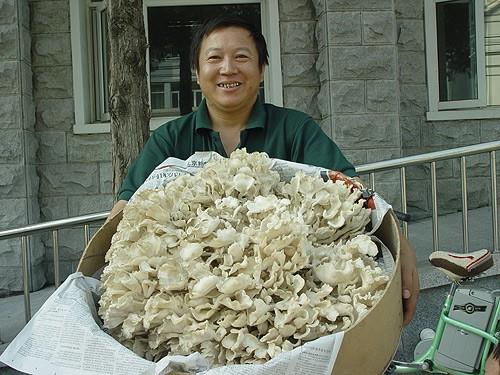
A 24-jin “Chestnut Mushroom King”
Qianxi is the famous “Hometown of Chinese Chestnuts,” with an annual total output value of chestnuts reaching 800 million yuan and a per capita net income from chestnuts of more than 2,000 yuan. In recent years, on the basis of the continued growth of the chestnut industry, farmers began cultivating chestnut mushrooms under the chestnut trees, greatly extending the chestnut industry chain.
It is understood that the chestnut mushroom was originally a wild mushroom species that grew alongside chestnut trees, with rich nutritional value, but because of its small yield it was little known. For many years, the state invested a large amount of manpower and material resources in research on artificial cultivation. Through the unremitting efforts of technicians from the Chinese Academy of Agricultural Sciences, the research result known as the “imitation wild cultivation method for chestnut mushrooms,” which uses discarded chestnut branches as the main raw material, passed technical appraisal, obtained a national patent, and was included in the National Science Commission's “Spark Program” and promoted throughout the country.
Chestnut mushrooms are abundant, with mushrooms weighing more than ten jin commonly seen, and yield per mu reaching 2,000 jin
Chestnut mushroom, also known as Grifola frondosa or maitake, is a medicinal and health-care mushroom rich in amino acids, protein and various trace elements. Moreover, according to testing by the Quality Inspection Center of the Ministry of Agriculture, both the nutrition and taste of cultivated chestnut mushrooms surpass those of the shiitake mushroom, which is known as the “king of mushrooms,” making it an extremely precious high-grade edible mushroom.
The chestnut mushroom planting area in Nuanshuimian Village has reached 200 mu, making it the village with the largest planting area in the entire township. With ample rainfall this year, chestnut mushrooms have had a bumper harvest, with mushrooms weighing more than ten jin commonly seen, and yield per mu reaching 2,000 jin. The sales price of chestnut mushrooms is 14 yuan per kg, and the picking price is 20 yuan per kg. Calculating on the basis of 30% picked and 70% sold, the income per mu is nearly 15,000 yuan. Planting chestnut mushrooms not only enriches the content of folk tourism, but also makes local farmers more prosperous.
Wang Shulan told us that her family now has 24 arched sheds, with each shed yielding an average annual net income of more than 10,000 yuan. Planting chestnut mushrooms has greatly increased the family's income, and life has become very prosperous! “Now, of the 207 households in our village, 70 are engaged in the chestnut mushroom industry, with a cultivation area of more than 300 mu and an annual net income of 4 million yuan.”
At present, the chestnut mushroom has become an important industry for increasing farmers' income in Qianxi. Artificial cultivation of chestnut mushrooms is found throughout the county's 17 townships, including more than 50 characteristic villages and specialized villages, 6 professional cooperatives for chestnut mushrooms, and more than 120 chestnut mushroom cultivation demonstration gardens mainly using models such as small arched sheds, medium-sized arched sheds, off-season solar greenhouse sheds, and forest-mushroom intercropping. The total cultivation volume ranks among the highest in the country, with an annual output of more than 5,000 tons of fresh mushrooms and income of more than 100 million yuan. In 2012, “Qianxi Chestnut Mushroom” obtained national agricultural product geographical indication certification, and not long ago, Qianxi County was awarded the title “Hometown of Chinese Chestnut Mushrooms” by the China Edible Fungi Association. (Li Miaoxia, Fu Wenhao)