Talking about pig farming, let's slowly talk in pig language
Although I am just a second-generation Confucian scholar who has eaten pork but never seen a pig run, my surname is Zhu, which sounds the same as "pig" (zhu), and moreover I resemble a pig in both form and spirit, so I describe myself as "like a pig." Washing away vanity, in a culture that looks down on pigs, in the reality of eating a lot of pork, calmly being a pig, is that not a joy? The reason for today's pig talk is the Ding family pigs, of which we hear four years of pig-farming clamor but can hardly taste a single moment of pork fragrance.
Chinese domestic pigs have come roundly along the path from the Hemudu pottery pig of 7000 years ago, and with an enormous volume of 600 million slaughtered pigs per year, they account for half of the world total; annual production of 50 million tons of pork is 2 times the total of EU countries and 5 times that of the United States, and the average Chinese person consumes nearly 80 jin of pork. A pig-farming power and consumption power that yields to none.
"Pigs and grain secure the realm" has a strong Chinese flavor. Pork is tacitly and generally recognized as a basic means of livelihood second only to the rice bag, ranking above the vegetable basket. Fluctuations in pork prices play a decisive role in the CPI; when the price of Second Senior Brother rises, there is the possibility of a small move producing a great effect and driving the CPI index sharply upward. In other words, if Chinese people cannot get pork when they pick up their bowls, and become irritable when they put their bowls down, this is already the socially default mode. And so, the rise and fall of Second Senior Brother once wore out the hearts of the NDRC, the Ministry of Commerce, the Ministry of Agriculture, the Ministry of Finance, the National Bureau of Statistics, and others. And so, when the price per kilogram of pork and the price per kilogram of corn falls below a ratio of 6 to 1, they provide timely help by purchasing pork, and when it is above 7 or 8, they sell it out again. Such plain buying and selling does not need to be elevated to the height of a national strategy comparable to oil; that would be somewhat boastful. Some economists can even infer the direction of the macroeconomic situation from the rise and fall of Second Senior Brother's price. This does not show the prescience of knowing autumn from one pig, but rather the bias of having one pig block the view.
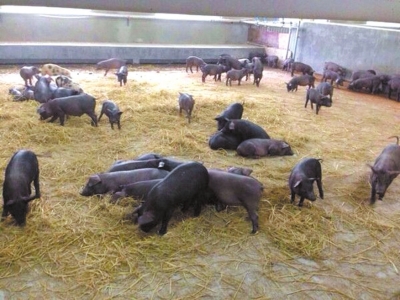
Having spoken grandly and loftily in general terms, let us return to the topic of Ding Lei raising pigs. Some have the intention of the drunken man not being in the pig but in enclosing land or subsidies, but NetEase's pig farming has an attitude, simple and clear: it is to make the world better. On this point one can absolutely believe in Ding Lei's idealism: he does not need to make a name for himself by raising pigs, does not need to get rich by raising pigs, but merely puts out some money that is only a number. The purpose of this money and the weight of this money are roughly comparable in all respects to a woman buying a beautiful skirt, nothing more than letting himself be satisfied and everyone be happy.
Ding Lei raised more than 400 pigs in three years, not enough to satisfy the grand and magnificent expectations of many people, but as of now, the Ding family's pig farming is a firm practitioner of pig humanitarianism, standing in every matter from the pig's perspective and putting itself in the pig's place to think about problems, intending to pull pigs back from the concentration camps of the industrial age into the E era of a mix of thatched huts and apartments. Although the ultimate end of idealism may equal letting things slide and fizzling out, I sincerely hope that the Ding family pigs can first become happy. There is no need to care about how many or how few; what matters is that there is a beginning, there is development, and there is lively pork fragrance.
Ding Lei raising pigs is just dabbling, mostly material for conversation and topics. Even if it flourishes in the future, it is only an ornament and supplement, not enough to command the winds and rains in the contemporary pig world. Just look at other non-Ding-type pig farmers: foreign capital is rushing to the beachhead, Goldman Sachs spent hundreds of millions of US dollars to raise 1.5 million pigs in our country, and Deutsche Bank holds 30% of the shares in a pig farm in Shanghai. Domestic capital is no idler either: a certain large steel group invested heavily in an attempt to build a large-scale pig farm, and a large coal enterprise also officially entered the pig-farming industry. Capital does not ask about its origin; it gathers around pigs simply because all think pigs are in a "value depression."
These transnational and cross-industry capitals coming to play with pigs, I do not think, are more beneficial to the country, the people, and the pigs than Ding Lei raising pigs.
Transnational capital is steady, ruthless, and accurate. Starting from the roots, quite a lot of capital is willing to spend money, beginning with breeding pig stock and creating great-grandparent and grandparent original breeding pig farms. Computers secretly remotely manipulated by hackers without their knowledge are collectively called meat chickens; of course, calling them meat pigs is equally easy to understand. Chinese breeding pigs cannot compare with foreign breeding pigs in growth rate and feed conversion rate. Over time, locally bred breeding pigs become fewer and fewer, and finally are almost about to vanish. This kind of long-term, large-scale introduction of breeding stock has the sorrow of computer meat pigs. Therefore, the domestic meat pig breeding cause has a heavy responsibility and a long road ahead.
Domestic cross-industry real gold and silver hot money is invested because one's own industry has overcapacity, so one seeks another path for profit, and must strike while the iron is hot and demand immediate benefits. Therefore, Ding Lei, who does not seek to make money, if he can take a commanding view and consider the ins and outs of Chinese pigs and work hard on breeding, would truly be using money on the edge of the blade. That would be a more meaningful integration of idealism and reality. After all, what to raise is more important than how to raise it.
Of course, should we also think about whether pigs also have an overcapacity problem? After a river of dead pigs flowed eastward, Zhejiang Province no longer encourages vigorous and fast pig farming and wants to reduce the scale by 4 million pigs. I think this is wise foresight.
Pork has long been the leader in domestic meat foods, and in addition, the UN Food and Agriculture Organization and the OECD predict that within ten years, China is expected to surpass the EU and become the country with the highest per capita pork consumption. It seems the pig-farming situation is excellent, but wait.
First, there is no doubt that the development of China's pig-farming industry was innately deficient. Both breeds and feed rely too much on imports. It looks very big, but is strong on the outside and weak on the inside.
In addition, pig farming on such a huge scale is an unbearable burden for China's environment. Zhejiang's specialized pig farmers, because of policy guidance, want to go out and raise pigs across provinces. In fact, a certain steel group with a budgeted investment of 10 billion yuan should be even more suited to raising pigs transnationally. Made in China can be transformed into made for China.
Furthermore, do you remember Su Dongpo's "Eating Pork": "Huangzhou has good pork, cheap as muck. The rich are unwilling to eat it; the poor do not know how to cook it." Even now, when even Dongpo elbow is not very well regarded, the decline of pork consumption culture is obvious