Family farm grows greenhouse vegetables, sells well everywhere and brings wealth to mountain villages
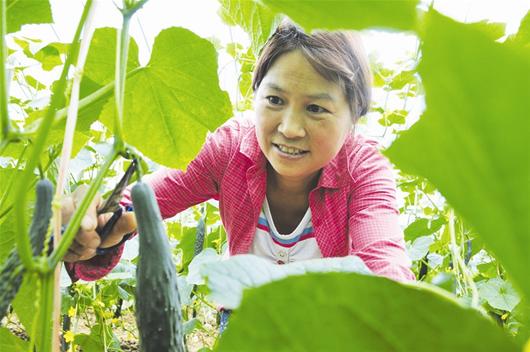
Rural New Newspaper report. Caption: Greenhouse vegetables sell well everywhere. Photo by Huang Hua
Starting from August 27, 2013, Tan Wenchun, then 64 years old and a villager of Jinzilong Village in Qingtaiping Town, officially became a farm owner. That day, he received the business license for "Badong County Yingchun Agriculture and Forestry Science and Technology Planting Family Farm" from the industry and commerce department.
Previously, Tan Wenchun and his two sons, in the form of a professional cooperative and a partnership enterprise, had three families jointly tending 65 mu of orchards and nursery plots, with annual net income reaching hundreds of thousands of yuan. In late autumn, this writer saw at Tan Wenchun's family farm that golden ginkgo hung from the branches, rows of four-season osmanthus gave off a delicate fragrance, and rare flowers, unusual plants and landscape trees swayed green, standing out brightly in the mountain village.
Like Tan Wenchun, new types of agricultural business entities that use family members as the main labor force, engage in large-scale, intensive and commercial agricultural production and operation, and rely on agriculture as the main source of family income are constantly emerging in rural Badong, becoming an important organizational form for farmers to build wealth.
Centered on characteristic agriculture and carrying out intensive operations, a group of moderately scaled family farms has emerged in Badong, showing many features such as broad base coverage, relatively good economic returns and relatively high management levels. Among the 329 farmers' professional cooperatives newly registered this year, returning migrant workers, rural wealth-building capable people, and village and group cadres are the backbone of family farms, with business scope covering traditional advantageous industries such as grain and oil, vegetables, livestock and poultry, tea, flue-cured tobacco and fruit.
Seeing the state's support for family farms, Deng Jiayong, Party branch secretary of Wujiawan Village in Yesanguan Town, returned to his hometown after graduating from university and leased 307 mu of idle land and abandoned land to grow flue-cured tobacco and cultivate shiitake mushrooms in his village. Facing such a large operation, Deng Jiayong mobilized the whole family: his mother was responsible for management of the flue-cured tobacco and shiitake mushroom bases, and also worked part-time recording work points and paying wages; his father and eldest brother worked at the two bases; his second brother was responsible for marketing; and his second sister-in-law was specifically responsible for cooking for the workers. Every month, his mother Zhang Quanzhi regularly held family meetings to report progress, calculate costs and discuss plans, so everyone had a clear idea of production, sales and returns. In 2012, this Deng family-style cooperative achieved income of more than 8 million yuan, and 57 rural laborers "related by kinship or connection" worked at Deng Jiayong's family farm.
As one of the leading industries absorbing the transfer of rural surplus labor, this county implemented four-level joint creation of standardized livestock and poultry breeding. Last year, 2,630 households emerged using the family as the unit under the pig "150" model, goat "1235" model, beef cattle "165" model and under-forest chicken raising model, and 221 family pastures were built. Statistics show that the county achieved a livestock industry output value of 1.365 billion yuan in 2012, benefiting more than 200,000 rural family members engaged in breeding.
(Tan Mingfu, Yan Xiaohong)