In a specialist village, 80% of chicken farmers leave their cages empty, waiting for the market to recover
On February 3, the fourth day of the first lunar month, Wang Xinyu, a chicken farmer from Gouyan Township, Dashiqiao City, Liaoning Province, took his wife and two children early in the morning and boarded a high-speed train to Beijing. "I've raised chickens for eight years, and this is the first Spring Festival with no chickens in the cages over the new year, so I'm taking the chance to show the kids Beijing," Wang Xinyu said. "In past years, all 16 chicken houses were full, 5,000 at the fewest and 12,000 at the most. Feeding them water and feed never stopped needing someone, and even during the New Year there was no time to visit relatives. My father-in-law's family works in Beijing, and I went eight whole years without visiting. Egg prices have been poor these past two years, so I might as well take the laying hens out of the cages early and go out to see if there's another way to make money."
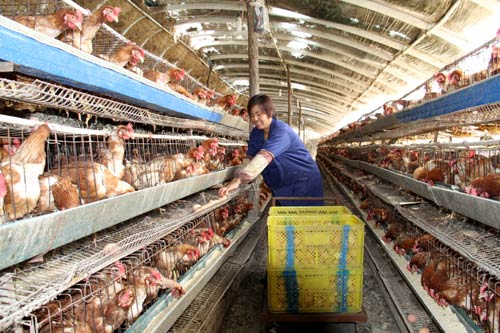
Wang Xinyu is 35 this year and has been raising chickens since 2005. Young as he is, he has already lived through three big swings in egg prices, so choosing empty cages this time was not an impulse. "Before 2008, egg prices were basically high one year and low the next. Even if prices were low and you weren't making money, if you held on for ten months or so, prices would pick up," Wang Xinyu said. But after 2008, that rhythm became impossible to read. First, in 2008 and 2009, eggs stayed at around 2.5 yuan per jin for a long time, and many farmers couldn't hold out and slaughtered their chickens. He held on until 2012 and caught the
high price. With one batch of 5,000 laying hens, he earned nearly 100,000 yuan in 18 months, giving him some relief. He had wanted to go all out while the market was good, but then in the spring of 2013, avian flu hit. After that, egg prices rarely exceeded the break-even price of 4 yuan per jin. At the 2014 Spring Festival, the wholesale price of eggs was only 3.8 yuan per jin, and farmers suffered more than ten consecutive months of low egg prices; after the previous batch of laying hens was culled, they did not dare bring in new chicks.
Wang Xinyu's cousins, the brothers Wang Xinbo and Wang Xindong, also chose empty cages while waiting for the market. Wang Xinbo had not brought in chicks since the spring of 2013, and his cages had been empty for a year; Wang Xindong struggled on until the end of 2013 but still saw no good market. "Normally, culled chickens sell for 3.5 yuan per jin, but when we sold, we happened to hit this wave of avian flu again and sold at 2.7 yuan per jin. The 5,000 chickens were raised for 18 months, and we didn't even earn back the labor."
"The whole village has 96 households in total, and 35 raise chickens. The township calls our village a specialist chicken-raising village, but now only 6 households still have laying hens in their chicken houses, and 80% of the farmers have chosen empty cages," Wang Xinyu said.
"The farmers are watching and waiting for the market, not really giving up. Take me: in these 8 years of raising chickens, all I've earned is 16 chicken houses worth more than 300,000 yuan plus a full set of equipment. If I don't raise chickens, it's just a pile of junk," Wang Xinyu said. "With so many farmers no longer bringing in chicks, demand for eggs hasn't fallen, so a big market move is definitely brewing. As soon as I get back from Beijing, I'll start studying when to bring in chicks."
Rural Mass Daily reporter Liu Xiuping