Guangdong poultry industry losses exceed 10 billion yuan, poultry company boss flees
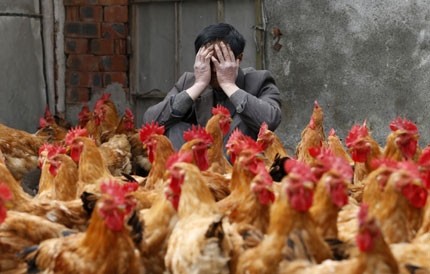
Two rounds of the "H7N9 virus" incidents since last year have dealt a severe blow to the national poultry industry. According to statistics, Guangdong, a major breeding province, has suffered losses exceeding 10 billion yuan, and the losses are expanding at a rate of 1 billion yuan per month. In Kaiping City, there have already been cases of poultry company bosses absconding with funds.
Boss "flees," chicken farmers helpless
When an Economic Information Daily reporter recently arrived at the office building of Kaiping Hezhong Animal Husbandry Co., Ltd. in Chishui Town, Kaiping City, Guangdong, the company's gate was locked tight with no one in sight. Local residents said the boss of Hezhong Animal Husbandry Co., Ltd. had already absconded with the funds, most likely because the company's capital chain had broken.
It is understood that Hezhong Animal Husbandry was established only at the end of June last year, with three shareholders: Zhou Yisheng, Li Yijin and Li Honghai. Farmer Wang Yunlong said that after Zhou Yisheng and Li Yijin disappeared, they "caught" Li Honghai and watched him without letting him out of their sight, "even following him to the toilet, but in the end Li Honghai still got away."
More than 70 farming households are involved with Hezhong Animal Husbandry, and the model adopted is basically the common "company + farmer" model -- the company signs contracts with farmers, farmers raise chickens for the company, the company provides farmers with chicks, feed, medicine and technology, and farmers pay a deposit of 2 or 3 yuan per chick to the company; after the chickens are grown, the company buys them back according to the contract. The company deducts feed and other costs from the payment for the chickens, and generally the farmer's profit is 2 to 3 yuan per chicken.
After the company collapsed, the farmers involved faced a difficult predicament. Some farmers' chickens had already been collected by the company, but they did not receive payment -- deposits and chicken sale payments were all taken. Some farmers paid deposits and took chicks back, but now have no feed to raise them and can only let them starve. Long Shangfang, in his sixties, bought more than 18,000 chicks from Hezhong Animal Husbandry. From January 15, when the company cut off feed supplies, to the 23rd, because he could not afford to buy feed himself, only just over 5,000 chicks survived the starvation.
Farmer Yang Jiebin's wife said with a face full of worry: "Feed is expensive, over 100 yuan per bag. Now we're borrowing money everywhere to buy feed. To raise them to full size will still cost two or three hundred thousand yuan. But where can we get that much money? We hope someone can help us."
Chen Yingfeng, president of the Guangdong Provincial Poultry Industry Association, said there are about 10 million people working in Guangdong's poultry breeding industry, the vast majority of them farmers.
Poultry companies dig into their last reserves to hold on
Successive blows have made it difficult for poultry companies to keep their funds circulating. "From April last year to now, the poultry industry has suffered heavy losses, and most companies are on the verge of a capital chain break," said Lin Min, secretary-general of the Guangdong Provincial Poultry Industry Association.
Guangdong Kaiping Lvhuang Agriculture and Animal Husbandry Development Co., Ltd. had an output value of 420 million yuan last year and marketed 16.8 million chickens, involving 1,020 farming households, with a loss of 30.5 million. On the eve of the Spring Festival, Huang Weilong, the company's general manager who has been engaged in poultry breeding for 8 years, said in an interview with an Economic Information Daily reporter: "All the money we earned before has been lost this time."
Monitoring data provided by Guangdong Wens Foodstuff Group Co., Ltd., a well-known domestic leading agricultural enterprise, show that on April 4, 2013, the average wholesale price of Guangdong yellow chickens was 5.55 yuan per market jin, while on May 1 it fell to a low of 2.22 yuan per market jin.
"At that time the chickens could not be sold, but we could not refuse to take them either. Everyone was trying to save themselves. First, we opened up rural markets, having salespeople drive to rural areas such as Maoming City in western Guangdong to sell chickens in the countryside. Second, for those that really could not be sold, we could only take them back and slaughter them. We had to slaughter seven or eight thousand a day, and even now there are still more than 100,000 piled up in the cold storage," Huang Weilong said.
Starting in August last year, the Guangdong poultry market began to recover, and by October it had basically returned to normal. But the epidemic that broke out again in December plunged the poultry industry into a desperate situation. Huang Yonglu, president of the Kaiping City Poultry Industry Association, said that in the first half of the year companies were all reducing production. In October they had just adjusted production back, but just as the chickens were about to reach market age, they ran into the epidemic again. Now it is a case of neither selling nor not selling being a good option.
Huang Weilong said: "We raise free-range chickens, so the cost is high, about 8.5 yuan per jin. In the past few days the price is about 5 yuan per jin. A chicken weighs about 3 jin, so we lose 9 yuan. We market 50,000 chickens a day, which means I sit in the office and watch more than 100,000 yuan disappear every day."
"After the holiday, the terrible market conditions in the poultry industry are still continuing. Now companies are basically holding on for dear life, all having brought out their previous savings, and those who do not have enough can only rely on old relationships to get some bank loans," Chen Yingfeng said.
Guangdong poultry industry losses exceed 10 billion yuan
Two rounds of "H7N9 virus" incidents that broke out in April and December last year dealt a severe blow to Guangdong's poultry industry, with companies and farmers generally suffering losses. Industry insiders, in interviews with an Economic Information Daily reporter, called it a "devastating" blow. According to statistics from the Guangdong Poultry Industry Association, the two rounds of H7N9 incidents have caused losses of more than 10 billion yuan to Guangdong's poultry industry. Chen Yingfeng said the losses in Guangdong's poultry industry are expanding at a rate of 1 billion yuan per month.
It is reported that Guangdong Province is a major province for poultry production and consumption in China. In 2012, it marketed 1.13 billion poultry, accounting for 10% of the national total and ranking second. Among these, the output of yellow-feathered broilers (referred to as yellow chickens), waterfowl and meat pigeons ranked first in the country, with the output of the most important yellow chickens reaching 700 million.
A report from the Guangdong Provincial Department of Agriculture shows that after successive cases of human infection with the H7N9 virus were reported under the label "bird flu," it caused panic among consumers. Guangdong's meat poultry sales fell sharply, prices plummeted, and poultry breeding companies, farms and farming households all suffered losses across the board.
"Guangdong has a large poultry output, and Guangdong yellow chicken consumption mainly takes the form of live poultry trading. The term 'bird flu' has already made people turn pale at the mention of poultry. Some experts have reminded the public to 'stay away from live poultry,' making Guangdong the province with the heaviest losses," Chen Yingfeng said.