Pig farmers are feeling torn these days, hoping their pigs will grow more slowly
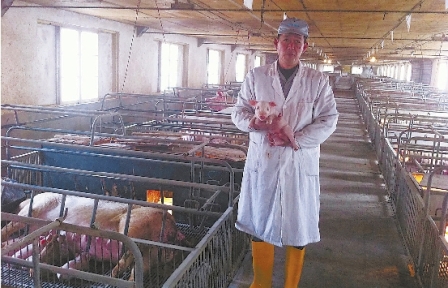
Jin Jiansong holds a piglet, really wishing it would grow more slowly.
Live pig prices continue to hover below the loss line
The state has prepared to launch a pork reserve purchase plan to “support the market”
This year's Spring Festival market has left pig farm owners who gambled on the “holiday effect” nearly heartbroken: live pig prices began falling a month and a half before the Spring Festival, and no reversal in the trend has been seen to date.
“This may be the first time in nearly 10 years that pork prices have fallen below the cost line during the peak demand season before the Spring Festival. It is somewhat abnormal.” a staff member from the Animal Husbandry Division of the Zhejiang Provincial Animal Husbandry and Veterinary Bureau told reporters.
It is understood that farms that breed their own stock now lose 100-200 yuan for every live pig sold. Although prices began to rebound on the last day before the Spring Festival, the losses have still not eased as of now. Among the pig farming enterprises interviewed by reporters, some predicted that 2014 could become the year with the most severe losses for the industry in the past 3 years.
Last week, Xinhua News Agency released a report titled “China prepares to launch a pork reserve purchase plan to ‘support the market’,” making people feel that the pig farming industry is in a bad situation.
Why have prices fallen during the traditional peak season? What should pig farmers do? On February 23, reporters went to a pig farming enterprise in Leigong Village, Xiaoshan, to visit “wounded” pig farmers.
Jin Jiansong, director of Zhejiang Huifeng Farm, wearing a white coat, had just finished inspecting the pig pens. With a worried look, he told reporters that recent live pig market conditions had hurt them badly. “At least in previous years prices rose sharply around the Spring Festival, but in the past three months, which are theoretically the peak season, we have been losing money continuously, let alone in the months ahead.”
After changing into rain boots specially used at the pig farm, Old Jin led me into this sizable pig farm.
“Starting in December last year, we lose more than 100 yuan on every pig sold.” Jin Jiansong said. Huifeng Pig Farm is very large, with a total herd of 47,000 live pigs.
“These are newborn piglets. After they grow for 21 days, they will be placed in specific pens. Piglet feed is the most expensive, about 7,000 yuan per ton, while adult pig feed is about 3,000 yuan per ton.” Jin Jiansong led me into a pen specially used for raising piglets. The temperature inside was much higher than outside and had to be heated by a boiler.
“Generally, a live pig needs to be raised for about 200 days until it reaches about 120 kg for slaughter. The feed cost for one pig is about 1,600-1,700 yuan, and our cost price is 14 yuan/kg.” Jin Jiansong told reporters that a farm of this scale consumes about 70 tons of feed a day. Excluding water and electricity fees and labor costs, counting only feed costs, live pigs must sell for more than 14 yuan/kg to break even.
“We don't need much, 16 yuan-17 yuan per kg would be enough, but now we can only sell for less than 13 yuan/kg.” Jin Jiansong shook his head.
On the morning of the day the reporter visited, Jin Jiansong said 500 live pigs had already been sold. According to him, if each pig loses 150 yuan, then 75,000 yuan was lost in one morning. “Now all our pigs here are sold to Shanghai, where the price is a bit higher.”
Visit
Losing more than 100 yuan on every pig sold
“Losses are expected to last at least until June.” Jin Jiansong said that based on past experience, improvement is unlikely in the coming months.
“With 47,000 live pigs in stock, feed is the biggest cost, accounting for 70%. We have a total of 160 employees, and a couple earns an average of more than 60,000 yuan. The electricity bill for the whole pig farm is also enormous.” He counted on his fingers while walking.
Jin Jiansong also took me to a biogas digester not far from the pig farm. “This biogas digester required an investment of 2 million yuan. One purpose is to treat pig waste harmlessly, and at the same time it can generate electricity for the pig farm.” However, one biogas digester can only supply sewage treatment and electricity for a small portion of the pig pens.
Selling pigs while losing money, is there any solution?
“The only way is to make the pigs grow more slowly.” Jin Jiansong said that half of pig feed is soybean meal and other grains. Reducing the amount fed can, on the one hand, save feed costs, and on the other hand, delay the slaughter period for live pigs.
“This is a last resort. Raising them costs money, and selling them loses money.” For Gao Zhifeng, general manager of Zhejiang Huifeng Breeding Co., Ltd., this farm in Xiaoshan is only one of Huifeng's 12 farms. “Our company has a total herd of more than 200,000 pigs. We sell more than 1,000 head a day. I never expected that during the Spring Festival the price would actually be only 12.8 yuan/kg. In previous years, we waited for the Spring Festival to make money.”
Gao Zhifeng told reporters that in 2012 Huifeng Breeding Company could earn 100 yuan-200 yuan per live pig, and the live pig price once reached as high as 23 yuan/kg when at its peak. Yet in just one year, nationwide losses appeared, and the price fell by nearly half. It is understood that Huifeng Breeding Company has 12 pig farms in various places and sold 65,000 live pigs last year, but Gao Zhifeng told reporters that after several rounds of rises and falls, they hardly made money, and are currently in a net loss.
“I have raised pigs for more than 10 years, and I am used to such price fluctuations.” Gao Zhifeng said that pig price fluctuations may be bearable for large enterprises with strong capital. “Raise them whether making money or losing money; make money one year and lose money the next, and it balances out. But for small-scale farmers, the capital chain can easily break.”
Losses expected to continue until June
This year's Spring Festival was too warm
Fewer people made sausages and ham
Cheaper pork is undoubtedly good news for Hangzhou consumers. Before going to the pig farm for the interview, the reporter learned at Hangzhou Gudang Farmers Market that, taking pork shoulder as an example, the recent price was about 13 yuan/jin, and around 14 yuan/jin on weekends. “In the morning it sells for 13 yuan/jin, and by the time we are about to close up, it may sell for 11 yuan/jin too.” Master Liu at Gudang Farmers Market told reporters that the purchase price of pork belly was more than 8 yuan per jin, and each jin had fallen 0.5 yuan compared with last November.
“
During the 2012 Spring Festival, pork shoulder was priced at 17 yuan/jin, while this year it is only about 12.8 yuan/jin. This year's pork sales volume is generally lower than last year.” Tang, a relevant person in charge of Gudang Farmers Market, told reporters.
Normally, demand for pork is strong during the Spring Festival every year, and pork prices around the Spring Festival always rise noticeably, but price monitoring by the Zhejiang Provincial Animal Husbandry Bureau shows that this year's live pig prices during the Spring Festival ran contrary to the norm.
“Mainly three reasons worked together.” Director Ren of the Animal Husbandry Division of the Zhejiang Provincial Department of Agriculture analyzed that since last year, live pig supply has been more ample than in previous years, and national live pig production capacity is in a saturated state. “In the past two years, the development environment for the live pig industry has been relatively good, large-scale farming has become increasingly mature, and the herd size has also been rising day by day.”
In fact, live pig prices fluctuated sharply in 2013, causing pig farming profits to continue declining throughout last year. “In order to get a good price during the Spring Festival market, farmers concentrated on selling and dumping stock, and at the same time the number brought in from other places also increased, causing consumption to stall.” Director Ren said.
He believes that because temperatures rose abnormally during this year's Spring Festival, it not only affected pork sales on Spring Festival dining tables, but also affected the making of sausages and ham. “So, on the one hand supply was ample, on the other hand consumption decreased, and added to that were some dumping phenomena, causing this year's live pig prices to fall sharply.”
He disclosed that before February 19, for four consecutive weeks, pig farming enterprises in Zhejiang Province suffered obvious losses. “The pig-to-grain price ratio was below 5:1. Each pig lost about 150 yuan.”
The latest monitoring data show that on February 19 the price of live pigs in our province fell 18% compared with New Year's Day, while the market pork price also fell 5% compared with the New Year's Day price.
How can the sometimes rising and sometimes falling live pig prices settle into stable days? He told reporters that among many factors, dumping by small-scale farmers is the human factor triggering greater pig price fluctuations, while large-scale farming can make pig prices more stable. In recent years, the proportion of large-scale farming in Zhejiang Province's animal husbandry has continued to rise, playing a partial role in smoothing pig price fluctuations.
Analysis
China prepares to launch a pork reserve purchase plan to “support the market”
The National Development and Reform Commission announced on the 19th that it is working with relevant departments to closely monitor live pig production and market price conditions, and is actively preparing to launch the central reserve frozen pork purchase and storage work in accordance with regulatory contingency plans, in order to prevent excessive declines in live pig prices, stabilize live pig production, and safeguard the interests of farmers.
The National Development and Reform Commission said that judging from the current situation, live pig production capacity remains on the high side, the coming months are the off-season for consumption, and live pig prices are expected to run at a low level, with pressure for further decline. It advises farmers to continue reasonably adjusting their farming structure according to market price changes, so as to give full play to the combined force of market regulation and government regulation and restore balance between live pig production and the market as soon as possible. According to Xinhua News Agency