Guangdong live chicken sales halved, prices fall to one-third of cost
"The fog is too thick, I can't see clearly!" That is how Liao Qianzhang, a chicken farm owner, described his assessment of the market outlook. He looked at the blurry small hill in the distance and managed a faint, bitter smile.
This is a patch of barren sloping land at the edge of Jinzhu Village, Baini Town, Sanshui District, Foshan City. Liao Qianzhang has raised chickens here for 10 years, but business has been relatively difficult over the past year. With two successive waves of H7N9 avian influenza outbreaks, the broiler market has been sluggish, with prices falling to rock bottom. Liao Qianzhang and several partners lost more than 2 million yuan in one go, and the market has yet to show any clear sign of recovery. Just like the Pearl River Delta entering March, not only has there been no warm spring and blooming flowers, but instead one cloudy day after another, with hazy smog covering everything.
Like Liao Qianzhang's chicken farm, "fog" also hangs over more than 3,000 poultry farms large and small in Sanshui and even the entire Guangdong chicken industry. A reporter's investigation found that since March last year, live chicken sales across Guangdong have generally shrunk by more than half, and ex-farm prices once fell to 1/3 of cost. Industry insiders have lamented one after another that "the chicken industry may be experiencing its biggest industry crisis since 1997," with almost no company or chicken farmer avoiding losses, and in some places poultry companies have even gone bankrupt.
Two waves of impact: chicken companies lose heavily, cannot sell, and workers are unwilling to come
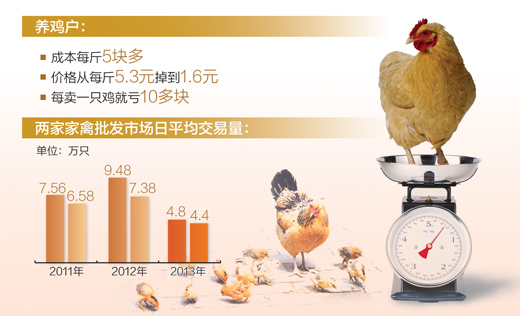
In Liao Qianzhang's ledger, daily prices and shipment volumes are recorded in detail. Pinching two thick, cracked fingers, he turned the pages of the ledger one by one to show the reporter: "The cost of raising a chicken comes to a little more than 5 yuan per jin, and even now we still cannot break even; in previous years at this time, when migrant workers returned to the cities, prices were at their highest and the chickens sold best."
Sanshui is an important broiler breeding base in the Pearl River Delta. Liao Qianzhang's chicken farm covers more than 150 mu and has an annual slaughter volume of 700,000 to 800,000 birds, sold to Guangzhou, Shenzhen, Dongguan and local Foshan markets. Business had been doing quite well, but when avian influenza broke out at the end of March last year, prices suddenly fell from 5.3 or 5.4 yuan per jin to 1.6 yuan. "Every chicken sold meant a loss of more than 10 yuan."
Liao Qianzhang and his "old partners" gritted their teeth and endured. Just as the market gradually regained strength and prices rose bit by bit, and by September they began making money, the second wave of impact came surging in as Guangdong and other places successively detected positive human cases of H7N9 infection in August and September. "I had just strained my back, and before it healed completely, I strained it again. Prices fell back to more than 2 yuan." He said helplessly.
The more they sold, the more they lost, so Liao Qianzhang had to cut back production. Behind him was a neat row of chicken sheds that looked tall and impressive. But when the curtains were lifted and one walked in, several sheds were found to be empty, except for a layer of disinfecting white lime scattered on the ground. "We have 58 sheds in total, and now only 6 have chickens, all newly caught chicks, and by May there will be no adult chickens to sell." One partner let out a long sigh. The more than 40,000 chickens that had been raised for just over 40 days were all buried in a pit. "It hurts, but there was no choice. One chicken eats 0.3 yuan of feed a day, and 40,000 chickens eat 12,000 yuan a day. Keeping them longer would mean losing even more."
Liao Qianzhang joked that raising chickens now is a "three-no" state: big losses, no money; unable to sell, no market; panicked people, no workers. His chicken farm used to hire 20 workers, but now has fewer than 10. "They are afraid of catching avian influenza from raising chickens." For the first batch this year, Liao Qianzhang planned to raise only 100,000 chickens, just half of a normal year.
This is in fact a microcosm of Guangdong's entire chicken industry. Poultry industry analyst Li Jianxiong summarized the average daily trading volumes over the past 3 years at the two poultry wholesale markets of Jiangcun and Taihe in Guangzhou: in 2011 they were 75,600 and 65,800 birds respectively, in 2012 they were 94,800 and 73,800 birds, and by 2013 they had fallen to 48,000 and 44,000 birds. "The industry is in an overall loss-making state and showing a chain reaction." Chen Yingfeng, president of the Guangdong Poultry Industry Association, said that because broiler consumption fell sharply, sales incurred losses; this led to a decline in chick sales, and supply incurred losses; the loss effect was then transmitted to parent-stock and grandparent-stock breeding enterprises.
Wen Pengcheng, chairman of Guangdong Wens Foodstuff Group Co., Ltd., one of the country's largest poultry breeding enterprises, revealed that since last year the group's chicken business has suffered huge losses of 1 billion yuan. Such losses have an even stronger impact on small companies and breeding farmers. "Many people never even dreamed they would encounter such a big crisis." Wen Pengcheng said.
Cut production to reduce market supply, do a good job in disease prevention to ensure the safety of marketed chickens
In Yunfu, where Wens Group is located, chicken farmer Mr. Lian spent a frightened and uneasy Spring Festival with the more than 40,000 chickens his family was raising. Now, these chickens have already passed the normal 120-day breeding period. Because Wens Group was forced by market conditions to delay collecting the chickens, Mr. Lian calculated his losses every day, yet he had no choice but to keep waiting.
Last December, Wens held an emergency seminar on the H7N9 avian influenza incident, requiring its subordinate chicken companies to strictly implement production-reduction plans, slaughter broilers and put them into storage, humanely destroy chicks and take other measures to greatly reduce market supply and proactively respond to the impact of shrinking consumer demand. The production-reduction plan started in January this year, and the current number of chickens raised has already been reduced by about 20% from usual.
Wens has 160 subsidiaries, and its production of Sanhuang chickens accounts for about 1/5 of the country's total. Despite its large scale, it is still treading on thin ice. The days are even harder for the vast number of small and medium-sized enterprises and breeding farmers. To get through the crisis, Guangdong's chicken industry is actively responding.
Huang Yonglu, president of the Kaiping Poultry Association and deputy general manager of Canhuang Group, introduced that Kaiping mainly adopted two methods: first, lowering prices to sell to markets less sensitive to avian influenza; second, reducing production, with many farmers directly slaughtering chickens they had raised for 50 to 60 days.
In addition to reducing production, they are doing disease prevention work to a higher standard to ensure the quality and safety of marketed chickens. "To forge iron, one must be strong oneself." Liao Qianzhang said the chicken farm has whole-process epidemic monitoring methods: as soon as chicks arrive, a complete set of immunization procedures for fowl plague, influenza and others must be completed; normally the chicken houses must be disinfected regularly and sprayed with disinfectant; after a batch of chickens is sent to market, the entire chicken house must be cleaned again, and only after white lime is spread for disinfection can new chickens be brought in. "After so many years of raising chickens, the people have been fine, and the chickens have been fine."
Huang Tiande, deputy director of the Sanshui District Agriculture, Forestry and Fisheries Bureau, introduced that they regularly send people to inspect and sample each chicken farm, and blood samples are sent directly to Foshan for unified monitoring; especially when chickens are sent to market, origin quarantine is done well, and all chickens enter the market with inspection certificates, ensuring that problem chickens are not allowed on the market. "Sanshui has an annual market volume of 40 million birds, and no problems have been found so far."
The government has also provided corresponding subsidy measures. Last year, in addition to relevant subsidies issued by the central and Guangdong provincial finance authorities, municipal agriculture bureaus in various places also submitted applications to municipal governments for subsidies to the local poultry breeding industry. A reporter learned from the Guangdong Provincial Department of Agriculture that Guangdong will arrange more than 100 million yuan in subsidy funds, mainly for maintenance subsidies for breeding poultry farms, subsidies for enterprises newly purchasing and storing poultry products, and interest discounts on related loans for poultry breeding enterprises.
Restore consumer confidence, strengthen popular science publicity, and in the long run the breeding industry still needs to improve its level
"After February 18, market conditions improved somewhat, and both sales and prices rebounded somewhat." Huang Yonglu said, "At the worst time, selling one chicken meant losing 12 to 16 yuan. Now the selling price has recovered somewhat, and losses have decreased accordingly."