Taiwan loach develops rapidly, and the farming area in Guangdong has reached 10,000 mu
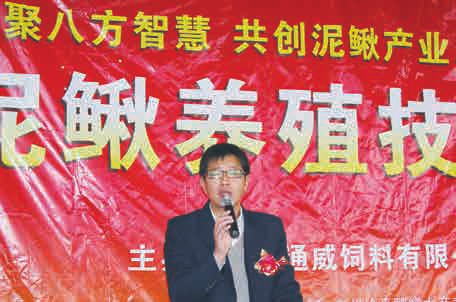 LoachFarming Technology Exchange Meeting" />
——A record of the "Taiwan Loach Farming Technology Exchange Meeting (Guangzhou Station)"
Text/Photos by Cheng Chunming
"At present, the Taiwan loach farming water area in the Guangdong region has reached 10,000 mu. More and more people are now paying attention to this species, and I believe more people will join in next," said Li Jie, the planner of this event.
On March 10, 2014, the "Taiwan Loach Farming Technology Exchange Meeting," planned by Yingjie Aquatic Products Business Department of Longkou Town, Heshan City, and hosted by Guangdong Tongwei Feed Co., Ltd., was held at Zhenzhen Feie Farm in Xiashi Village, Jianggao Town, Baiyun District, Guangzhou. This exchange meeting specially invited representatives from the Agriculture Bureau, aquatic product extension stations, fry enterprises, feed enterprises, and circulation enterprises, as well as professional farmers, to discuss Taiwan loach farming technology and the prospects for industrial development.
At the meeting, Hu Xiaozhen, purchasing department manager of Guangdong Heshui Aquatic Products Co., Ltd. (hereinafter referred to as "Heshui Aquatic Products"), as a guest attendee, introduced the current circulation status of Taiwan loach in the Guangdong region and analyzed future circulation development trends. She said that the main problems currently existing in Taiwan loach circulation are, on the one hand, the high cost of Taiwan loach fry and the low survival rate of fry, the lack of Taiwan loach farming technology, and the increase in diseases during the farming process, resulting in relatively high farming costs; on the other hand, adult fish are sold as mixed lots, and existing buyers purchase mixed lots, lacking a path for graded circulation, which hinders the maximization of product profits, and the size that farmers expect to sell is far larger than market demand, creating a contradiction between supply and demand; prices are inverted, with pond-side prices higher than market wholesale prices, lacking intermediate circulation value, falling into the predicament of not being able to sell much pond-side fish while the existing circulation volume is extremely small.
"This is also the fundamental reason why Heshui Aquatic Products has not yet started a loach purchasing business," she said. Therefore, to solve the circulation problem of Taiwan loach, the first step is to improve Taiwan loach farming technology and reduce farming costs; improve graded sales of loach to meet market demand in different regions; upgrade the business philosophy of Taiwan loach farmers, take customer demand as the guide, change the fish output size, and improve turnover efficiency; take market demand as the guide, establish a reasonable purchasing price system, promote circulation sales, and build a win-win platform.
At the exchange meeting, Fang Fuchuan, general manager of the Jiangxi market of Yuyuyu Aquatic Products Service Co., Ltd., described related farming technologies from aspects such as the farming conditions, water quality requirements, and disease prevention and control of Taiwan loach. His proposed mosquito-killing lamp insect prevention method aroused great interest among the farmers present. Yang Song, service director of Tongwei Co., Ltd.'s Guangdong region, then explained related feeding technologies in detail from the perspective of feed, and helped farmers understand the advantages of Tongwei loach feed in feeding Taiwan loach.
Although the three-hour exchange did not solve the problems existing in Taiwan loach farming, it gave farmers some guidance on the direction for solving the problems. Farmer Boss Zhang, who attended the meeting, said that the biggest gain from this exchange meeting was that it let him know that farming technology is crucial, and also what size of loach to farm to meet market demand.
Li Jie introduced that in order to promote the healthy development of the Taiwan loach farming industry in the Guangdong region, similar farming technology exchange meetings will be held successively, and the next stop of the meeting is expected to be in Foshan.