Water spinach planted on Taihu Lake in Wuxi; officials say it purifies the water
Someone has started growing vegetables in Taihu Lake! Yesterday, upon hearing the news, the reporter rushed to the waters near the Three Kingdoms City in Meiliang Lake of Taihu Lake, where dozens of “green” floating beds were drifting on the lake surface, covered with water spinach. After asking around, the reporter learned that this was an ecological floating bed water purification project carried out here by the Jiangsu Provincial Taihu Fishery Management Office.
Floating beds covered with water spinach have appeared on the lake
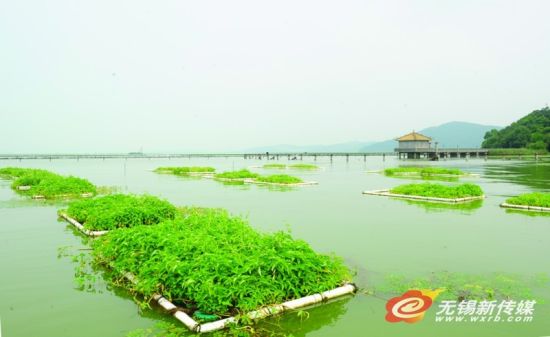
In the waters near the Three Kingdoms City in Meiliang Lake, floating beds planted with water spinach look like green islands. (Photo by Chen Dachun)
At 10 a.m. yesterday, the reporter followed staff from the Jiangsu Provincial Taihu Fishery Management Office by boat to the floating “vegetable garden” in the waters near the Three Kingdoms City in Meiliang Lake. “The floating beds drifting on the lake are hydroponic water spinach. Since this is still at the experimental stage, there is currently only nearly 10 mu of water area.” Following the direction the staff member pointed, the reporter saw that each floating bed was covered with lush water spinach, the tallest reaching half a meter high. It is understood that, based on the current growth, one floating bed can produce one to two hundred jin of water spinach per harvest.
A burly male staff member, 1.75 m tall, struggled for nearly a minute to pull up a handful of water spinach by the roots, sweating profusely: “Look, this vegetable absorbs such good nutrients here that its root system is very developed.” Upon close observation, the reporter found that the roots of the water spinach were all intertwined with one another, forming a tight and firm net-like structure, with the longest roots reaching more than 30 cm. Compared with the soil-grown water spinach bought in vegetable markets, the stems and leaves of this hydroponic water spinach looked no different to the naked eye.
Three models are currently being test-grown for comparison
With no replicable experience to draw on, everything can only be explored step by step. “These floating beds were all designed and built by our own scientific and technical staff.” The staff member said that three different planting models have currently been chosen: foam float, plastic basket, and direct net-style planting. The plan is to choose, through comparative test growing, the model most suitable for planting on Taihu Lake, such as which one is more conducive to the growth of water spinach and whether it can withstand typhoons. The reporter noticed that at the bottom of the plastic basket-style floating beds, plastic baskets that looked like flower baskets had been placed one by one, and the water spinach was planted in each basket.
“We bought this water spinach from the Mashan vegetable market on June 18.” The staff member said that after planting, no fertilizer or pesticide was used, and the water spinach was left to grow naturally in the open air. Unexpectedly, just one week after planting, the water spinach quickly adapted to the new growing environment and soon sprouted a developed root system. After it matured, they even specially picked a batch of hydroponic water spinach to try, and although it grew very thick and sturdy, its texture was crisp and tender.
The purpose of growing vegetables on the lake is to purify the water quality of Taihu Lake
According to staff from the Taihu Fishery Management Office, the floating “vegetable garden” is not simply for growing water spinach, but is a water purification experimental project that uses ecological restoration methods to improve the eutrophication of Taihu Lake.
This staff member told the reporter that plant growth can absorb nutrients such as nitrogen and phosphorus from Taihu Lake, the net-like structure of plant roots can adsorb and settle suspended particles, the biofilm formed by microbial reproduction in the plant root zone can improve the degradation capacity for pollutants, and plants can also release oxygen into the water body through their roots, promoting the rapid purification of pollutants. What is even more noteworthy is that many plants that can form floating beds can secrete chemical substances that inhibit algae growth.
Purifying water bodies by planting aquatic plants in Taihu Lake has become an industry consensus, but what should be planted so that it can both purify water quality and have economic value? “We also considered it repeatedly and finally decided to test-grow water spinach, which has a strong ability to absorb nitrogen and phosphorus.” The staff member told the reporter that due to limited funds, the first phase chose only the waters near the Three Kingdoms City in Meiliang Lake, where the degree of water eutrophication is relatively high, for test growing. Afterwards, water spinach was also planted on a small scale in a 200 sq m water area in the Suzhou East Taihu aquaculture zone.
Sampling and monitoring by professionals once every half month
Planting aquatic plants can not only purify water bodies but also provide space for fish and shrimp to spawn. According to the introduction, when the water spinach was planted, it was exactly the spawning season for fish and shrimp, and when pulled up, fish and shrimp eggs could be seen attached to the roots. “The thick root system can provide spawning sites for fish and shrimp, which is conducive to their reproduction.” The staff member said,
How much purification effect can growing water spinach in Taihu Lake actually have? It still has to be judged by data. The reporter learned that the Taihu Fishery Management Office specially invited the Wuxi Freshwater Fisheries Research Center of the Chinese Academy of Fishery Sciences to conduct sampling and monitoring for this water area. At present, technicians have collected samples of water quality, sediment, plankton and so on at these two locations, and will monitor the water quality of this water area once every half month, using data to scientifically summarize and evaluate the project implementation effect.
“Winter is not suitable for growing water spinach, so we are also considering whether to switch to aquatic vegetables such as water dropwort in winter.” Near the end of the interview, the staff member said that they would continue to explore and summarize the implementation effects of other varieties of aquatic plants, in order to purify the ecological environment of Taihu Lake and create new ways for fishermen to increase their incomes and become prosperous.
(Reporter Yuan Xiaolan, Evening News)