Internet Plus agriculture hits the sweet spot as the State Council moves to accelerate agricultural modernization
On the 18th, Premier Li Keqiang chaired an executive meeting of the State Council. The meeting held that the work related to agriculture, rural areas and farmers is the top priority of the government's work, and that efforts in agriculture must not slacken, investment must not decrease, and the pace of deepening reform must not stop. Efforts must focus on transforming the development model, taking the path of a new type of agricultural modernization, ensuring national food security, and promoting farmers' income growth.
The meeting adopted the National Plan for Sustainable Agricultural Development, determining: First, optimize the agricultural production layout, strictly protect arable land, stabilize the grain sowing area, adopt methods such as deep plowing and subsoiling to improve arable land quality, and by 2020 build 800 million mu of high-standard farmland that is contiguous and provides stable yields despite drought or excessive rain. Second, tap the potential of institutional reform; on the basis of stabilizing household operations, advance various forms of appropriately scaled operations and raise labor productivity and output levels. Third, implement major projects such as water and soil resource protection and agricultural and rural environmental governance, promote economical and efficient water use, prevent and control farmland and livestock-breeding pollution, strengthen the protection of forests, grasslands, wetlands, rivers and lakes, and develop ecological circular agriculture.
The meeting's emphasis on agricultural modernization inevitably brings the Internet to mind. In his previous government work report, Premier Li Keqiang emphasized as a key point the formulation of an "Internet Plus" action plan to promote the integration of the mobile Internet, cloud computing, big data, and the Internet of Things with modern manufacturing. This will promote the healthy development of e-commerce, the industrial Internet, and Internet finance, and guide Internet companies to expand into international markets.
At the subsequent Premier's press conference, Premier Li Keqiang said, "A word that has recently become popular on the Internet is 'sweet spot.' I think that standing at the sweet spot of 'Internet Plus' and going with the flow will make China's economy take off."
The Internet has already affected many industries such as retail and advertising, and in the future it will also affect other industries. To judge today whether an industry has potential, just look at how far it is from the Internet. Which traditional industries have the greatest potential to be transformed by the Internet: 1. Large market space. 2. Backward industry with relatively severe information asymmetry. 3. Large-scale dispersed users. 4. Long transaction chains and high transaction costs. 5. Strong transaction sustainability.
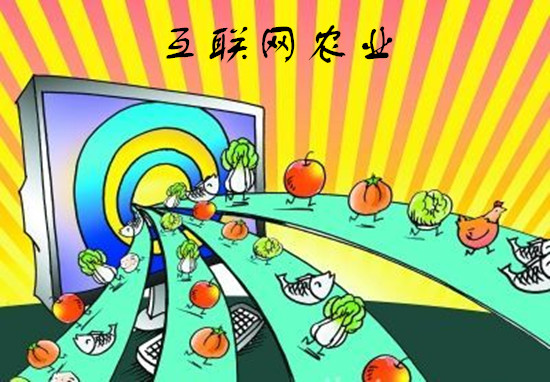
From this perspective, agriculture has enormous room for Internet transformation. The next sweet spot of industrial Internet: agriculture! As China's largest real-economy industry, agriculture, starting in 2015, will undoubtedly see agricultural informatization at the sweet spot. Now, the threads of the Internet have finally reached agricultural stocks, and a few agricultural pig stocks at the sweet spot have also begun to gather strength from multiple sides.
It is worth noting that major ministries and commissions are also brewing policies and plans for release. On the 17th, Ministry of Commerce spokesperson Shen Danyang revealed at a regular press conference that the Ministry of Commerce is working with relevant departments to study and formulate guiding opinions on accelerating the development of rural e-commerce, focusing on four aspects: informatization transformation of traditional rural circulation networks, building e-commerce platforms for agricultural production materials, developing agricultural product e-commerce, and expanding the scope of rural e-commerce services.
On the 16th, Xinwen Lianbo also reported that the Internet of Things, big data, online shopping, and e-commerce, these new terms spawned by the Internet, are being more closely integrated with traditional agriculture and rural areas. The upgrading of agriculture and improvement of farmers' lives driven by Internet technology are opening up new space for entrepreneurship for more and more young people.