Raising sea-running ducks for 6 years: escaped poverty and built prosperity
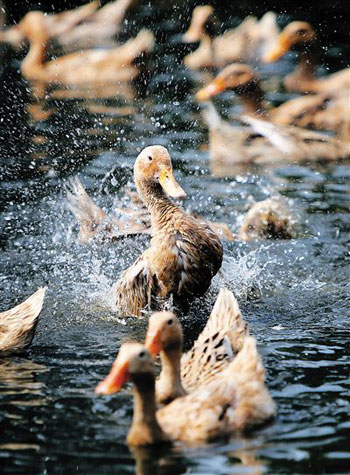
A flock of sea-running ducks foraging in the water.
Sea-running ducks raised by villagers.
An elderly woman in Wangwu Town, Danzhou, is curing sea-running duck eggs with salt-mixed red clay.
Sea-running duck eggs sell well both on the island and beyond.
From an inexperienced young man to now a "Model Worker of Hainan Province," Chen Hanzhou's calm tone barely conceals his high spirits and inexhaustible drive.
Chen Hanzhou is currently the Party branch secretary of Hefeng Village, Paipu Town, Danzhou City. Through growing specialty vegetables and raising sea-running ducks, over 6 years he has helped surrounding villagers escape poverty and become prosperous, making him a widely known leader in specialty agriculture and wealth creation.
During his working years, he pondered how to become a boss
"I studied economic management at Hainan University. Going out into the world, I mainly wanted to use the knowledge I had gained to make money." In 1995, Chen Hanzhou, then only 28 years old, shouldered his pack and his hopes, and went to work in Shenzhen, Guangdong.
Over the following three years, Chen Hanzhou worked as a building renovation worker in Shenzhen, Guangdong. He not only worked desperately hard to earn money, but also carefully accumulated experience. When resting at night, he did not go out carousing with his companions, but instead quietly pondered how to start a business and become a boss.
True to his training in economic management, during his three years in building renovation in Shenzhen, Chen Hanzhou often thought about how to be a boss, and what occupied his mind most was Hainan's tropical specialty agriculture.
"Once I have some initial capital accumulated, I will seize the opportunity and start my own business." Chen Hanzhou often encouraged himself this way. In 1998, with some savings, he returned to Hainan and rented 30 mu of land each in Fushan, Chengmai and Wangwu, Danzhou to grow chili peppers, earning 50,000 yuan that year.
Having made a small profit on his first venture as a boss, an excited Chen Hanzhou went to Chunhua Village, Paipu Town in 1999 to rent land, of which 63 mu was planted with chili peppers and 39 mu with cherry tomatoes. However, because there were too many similar products on the market and they did not sell, he lost terribly that year.
However, Chen Hanzhou quickly got back on his feet. In 2000, he returned to his hometown of Hefeng Village to grow facing-heaven chili peppers. Because they suited market demand, he earned 80,000 yuan by the end of the year.
Having made money on land, Chen Hanzhou then set his sights on making money from the sea.
"This is because I discovered that along the northwestern coast of Danzhou, every time the tide goes out, many small fish, shrimp, crabs, snails and other marine organisms remain on the tidal flats." Chen Hanzhou said confidently, "After the sea-running ducks eat these foods, their eggs become very nutritious, so they are sure to fetch a good price."
So, in 2001, Chen Hanzhou cleared rivers, lakes or ponds near the estuary of Hefeng Village and began raising sea-running ducks. That year, the eggs laid by the 3,000 sea-running ducks he raised earned him more than 80,000 yuan in one go.
After becoming a boss, he thought about how to promote shared prosperity
"One flower blooming alone is not spring; only when a hundred flowers bloom together is the garden full of spring." Facing abundant coastal resources, Chen Hanzhou said that making all the coastal fishing villages prosperous is what would make him happiest.
In fact, in Chen Hanzhou's hometown of Hefeng Village, the villagers had lived with poverty for many years. Villager Chen Yijun said with emotion: "Don't let the 'Feng' in our Hefeng fool you; in earlier years we couldn't even fill our stomachs." This is because this coastal place rarely gets rain, which easily leads to poor harvests in the fields.
In order to quickly change this poverty situation, Chen Hanzhou decided to mobilize everyone to strive together, taking "three major steps":
Step one: build and pave the village roads. Before 2007, the roads in Hefeng Village were not paved, and it was often "mud all over in rainy weather, dust all over in fine weather." Chen Hanzhou ran around everywhere, used national policy support, and organized villagers to contribute labor, successively completing the paving of village lanes in 7 village groups, with an area of about 25,000 sq m; and paving 6 village access roads, with a total length of 8.5 km. In addition, he led the villagers in renovating 1,700 mu of standard farmland.
Step two: establish a cooperative to form joint strength. In 2009, the Danzhou Fengqiu Melon and Vegetable Professional Cooperative initiated by Chen Hanzhou absorbed 21 farming households. As of now, the cooperative has 72 members, including 60 large-scale growers, with an annual planting area of more than 1,500 mu of melons and vegetables; and 12 large-scale breeders, raising 120,000 sea-running ducks annually, with average daily egg production of nearly 100,000 eggs. A circular agriculture system has taken initial shape, in which the organic fertilizer provided by the sea-running ducks makes the crops grow more luxuriantly.
Step three: form an efficient new cooperation model. Chen Hanzhou said the cooperative implements a "three provides and one buyback" model, namely providing ducklings (or melon and vegetable seeds or seedlings), providing supplies (feed or fertilizer), providing technology, and guaranteeing product buyback, giving members a "reassurance pill." This model has allowed many villagers who joined the cooperative to taste the sweetness of prosperity. Villager Chen Jingpei said that after joining the cooperative in 2013, he raised about 3,000 sea-running ducks and increased his annual income by more than 80,000 yuan. After villager Chen Yijun joined the cooperative in 2009, he grew chili peppers, watermelons, pumpkins, yellow okra and cherry tomatoes, with a total area of around 400 mu each year. In 2014, he earned 280,000 yuan. This year the crops are growing well, and expected profit is no less than 300,000 yuan.
While promoting shared prosperity, he calculated how to expand the market
This is a kind of duck egg full of dynamism, because the mother ducks that lay them live following the sea tides; this is also a kind of down-to-earth duck egg, because before being sold they must be coated with red clay slurry to extend their shelf life. These are the sea-running duck eggs we saw today in the towns of northwestern Danzhou City. Although the highest selling price has risen to 5 yuan each, they are still regarded as hot commodities by many eager buyers.
How was such a booming market opened up and maintained?
First, the product itself is of high quality. Chen Hanzhou introduced that sea-running ducks that grow up eating marine organisms produce sea-running duck eggs that are highly nutritious: they mainly contain lecithin, which can delay aging, soften and clear blood vessels, and enhance memory, and also contain calcium, phosphorus, iron, zinc, iodine, magnesium, potassium, selenium and many other trace elements beneficial to the human body, as well as multiple vitamins.
Second, plan market outlets in advance. Chen Hanzhou said: "The melons, vegetables and sea-running duck eggs produced by our cooperative sell very well. Besides guaranteed product quality, it is also because we have worked hard on market sales channels." It is understood that the Danzhou Fengqiu Melon and Vegetable Professional Cooperative, which has embarked on the path of circular economy, has 22 duck-raising households, producing about 100,000 duck eggs per day. As a raw material for Danzhou zongzi, the cooperative has now accepted an order for 30 million eggs.
Third, explore deep processing and new operating methods. At present, Danzhou is developing a sea-running duck egg deep-processing industry in Wangwu Town. In addition to using red clay slurry to extend shelf life, it has also begun exploring technology for processing and preserving cooked duck eggs. At the same time, Chen Hanzhou and others cooperated with the Danzhou branch of 121 online store to "move" sea-running duck eggs onto the internet, and the online store sales price has risen to 5 yuan each.
"Years of exploration have made me understand that to avoid 'living at the mercy of the weather' in agriculture, one must not only consolidate the industrial base, but also do a good job in deep processing and market sales channels in advance." Chen Hanzhou said from deep experience. Watching flock after flock of neatly lined-up sea-running ducks coming toward him, his face immediately broke into an understanding smile, as if seeing old friends.