A returnee's yam-fed chicken eggs sell for 5 yuan each
Yam peel processed into feed for chickens, testing reports made for the eggs
A Ruichang woman "returnee" creates a unique way of raising chickens with yam
Yam eggs sell for 5 yuan each
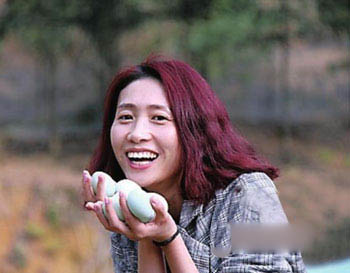
Pictured: Xiong Yaqiu
As more and more young people choose to return to their hometowns to start businesses, traditional farming is showing more and more "variations": some raise chickens in oil-tea camellia groves, and some experiment with raising chickens on Chinese herbal medicine... It is not just farming methods that are changing, but ideas as well. In 2013, Xiong Yaqiu returned to her hometown of Ruichang and also entered the farming industry, taking the high-end route of raising chickens. She not only feeds the chickens yam, but also has the eggs tested for nutrition, and even travels abroad to study technology. Today, Xiong Yaqiu's yam eggs sell for 5 yuan each, and nearly 80,000 yam eggs are sold to Beijing and Shenzhen every month.
Whether feeding chickens yam is really good or not is decided by testing reports
"A returnee girl goes back to her hometown to raise chickens," "yam eggs," "eggs at 5 yuan each"... These are all labels now attached to Xiong Yaqiu. Xiong Yaqiu was once an international student studying in Greece. After returning to China 8 years ago, she worked in Beijing the whole time. Entering the farming industry was an "accident" for her.
"Ruichang yam is famous. Every time I returned to Ruichang, I heard my family talk about how good Ruichang yam was. At that time I thought I should share the good things from my hometown with others. Once, I saw a lot of waste materials such as yam peel piled up in our family's yam processing factory. Something stirred in my heart. Since yam is so nutritious, wouldn't it be too much of a pity to just throw away scraps like yam peel for nothing?" Xiong Yaqiu said. In fact, her family had also been researching how to make yam by-products, and after seeing the discarded yam waste, she felt it was a pity that these nutrients were wasted, and thought it would be better to turn it into feed.
So Xiong Yaqiu returned to her hometown of Ruichang and decided to process waste materials such as yam peel, combining the local specialty Ruichang yam with traditional farming to produce a unique yam feed. She applied for a patent, opened a farm, and produced "yam eggs." These "aristocratic chickens" grown on the nourishing treasure yam lay "yam eggs" that sell for 5 yuan each, mainly to Beijing and Shenzhen. But whether yam eggs are really good, and whether they are worth consumers paying this price, in Xiong Yaqiu's view, is not something that can be achieved just by adding the word "yam," nor is it something publicity can solve. It has to rely on scientific evidence.
Xiong Yaqiu sent the eggs to the Beijing Institute of Nutritional Resources for testing. The testing report showed that this kind of "yam egg" has less egg white, a larger yolk, and high lecithin, among which the beta-carotene content is more than three times that of ordinary eggs. "A scientific testing report not only lets consumers clearly know what they are paying for, but also lets them understand the benefits of yam. Through yam eggs, more people can get to know Ruichang yam."
Traditional farming also requires continuous learning to make up for shortcomings
Raising chickens is a traditional farming activity. In many people's eyes, it is work with very low technical content; as long as the feed is adjusted well and daily feeding is done well, that is enough. But for Xiong Yaqiu, raising chickens also requires management and research and development, and she must constantly learn new technology to make up for shortcomings. "Specific matters such as daily feeding are handled by hired people. I mainly engage in matters such as management and research and development," Xiong Yaqiu said. The farm must take the high-end route; only by using high technology and strict management can high-quality premium eggs be produced.
"In fact, many countries do very well in farming. If you want to make your farm better, you have to keep going out to see the world and learn more new technology. For example, some drug use, storage and preservation technology, as well as farming environments and methods. Only by seeing more can you develop better." At present, Xiong Yaqiu is inspecting Finland, and next she also plans to visit countries such as Japan. "The fresh food market is now becoming segmented, and the market space under segmentation has great potential. I believe that whether for high-quality eggs or other products, there is a lot of room," Xiong Yaqiu said. She is very optimistic about future development.