Growing Red Rice Deep in the Mountains: How Did a Female University PE Professor Do It?
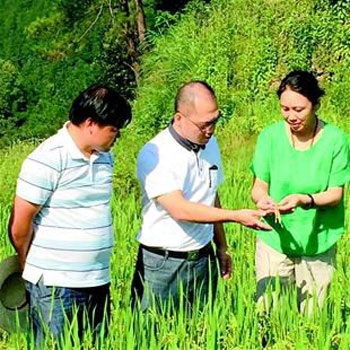
In the photo: Wang Baoxia (first from right) and Xu Bo (center), Party Secretary of Tanlin Town, inspecting the grain-filling of the red rice.
I
Wang Baoxia, past fifty, is a woman who can never sit still. An associate professor in the Physical Education Department of Huazhong University of Science and Technology, she nevertheless spends her free time growing rice deep in the mountains.
That was no small undertaking, and she developed a bond with that landscape. Whenever the weekend comes, she drives her SUV, bouncing along the mountain roads. Even when there is nothing to do, chatting a while with the villagers feels good.
On the 19th, a reporter went to Tanlin Town, Qichun County, for an interview and ran into Wang Baoxia, who had just come again to check on the rice's growth.
60 mu of rice paddies are scattered across the mountainside of Zhengchong Village at elevations from 200 m to 600 m. Down in the valley the rice is already golden, while here it is still all green, having just entered the grain-filling stage.
Looking at the rice growing well across the whole field, Xu Bo, the town's Party secretary who had come along, was especially happy. He is a firm supporter of Wang Baoxia. When he heard early in the year that Wang Baoxia wanted to grow red rice here, he sought out the remote Zhengchong Village and quickly secured 60 mu of abandoned paddy fields.
II
In Qichun, Wang Baoxia is a celebrity.
10 years ago, unable to sit still, she was urged on by an old classmate and went to Tanlin Town to contract mountain land for tree planting.
Tanlin Town borders Yingshan to the north and Anhui to the east, and has plenty of barren hills and forest land. When the locals heard a boss from the city was coming to contract mountain land, they all wanted to contract their hills to her. In one go, she took on nearly ten thousand mu of mountain land.
Through countless hardships, six years of planting and ten years of tending the forest. Tanlin Town's ecological environment has gotten better and better.
But what Wang Baoxia had not expected was that, having invested several million yuan with no return to date, the good ecology could not bring direct prosperity to the local villagers.
No one came to invest in developing tourism, and no one came to spend money at the farmhouse inns. Under the villagers' hopeful gazes, she went out to survey and finally made up her mind to develop specialty agricultural products.
The first things she chose were tea and rice. Last year, she led the villagers in clearing more than 200 mu of tea gardens that had been abandoned for over ten years, to develop high-mountain organic tea. This year the spring tea was an instant hit and broke into the Beijing market.
Early this year, he invited Zhang Sisong, a provincial rice expert, to serve as a consultant to develop red rice. She provides the seeds and pays the labor costs, hiring farmers to cultivate. She agreed with the villagers that when the rice ripens, regardless of whether the harvest is good or poor, she will buy it at the local average yield, and give the villagers an additional subsidy of 200 yuan per mu.
Of course the villagers are willing to do this kind of work. But Wang Baoxia's requirements are also strict: all the paddies must be irrigated with mountain spring water, no chemical fertilizer, no pesticide spraying, ensuring it is green and organic.
Every time she enters the village, this is what Wang Baoxia goes on about, and the villagers have also come to know that this city woman is no ordinary person. The rice she grows is said to be specially for women in confinement, and cannot tolerate the slightest contamination.
III
Early this month, a mother and daughter came to a restaurant in a residential compound in Beijing. Strangely, every time this mother and daughter came to the restaurant to eat, they brought a small bag of rice and asked the chef to cook it for them.
At first the chef refused; with ready-cooked rice available, cooking a separate batch was such a hassle. The mother had to go plead with the owner, and after finding out the reason, the owner cooked rice for them free of charge for a week.
It turned out that Wang Baoxia, staying at her daughter's home during this trip to Beijing, had come specifically to find a team from the Central Academy of Fine Arts to design packaging for her Tanlin red rice. She had carried dozens of jin of red rice to Beijing herself, precisely to let Beijing diners have a taste and see just how good this rice is.
Pink and soft and glutinous, with a rich aroma. Every time a pot was done, Wang Baoxia warmly invited the diners around her to taste it for free, and from everyone's satisfied expressions, she grew even more confident about the organic red rice she had grown herself.
At present, Wang Baoxia has registered two brands: one is "Yuezi Hong" red rice, and the other is "Qihong" red rice. "Yuezi Hong" is positioned high-end, at over 100 yuan per kg, sold exclusively through confinement centers in various places. "Qihong" is positioned slightly lower, going into supermarkets, priced at over 70 yuan per kg. At present, some orders have already been received. It can go on the market in mid-October.
Both are organic rice, so why two brands and two prices? It turns out that "Yuezi Hong" grows above 400 m in elevation, has low yield, is irrigated entirely with mountain spring water, and is grown strictly according to organic requirements. "Qihong" grows at a slightly lower elevation, has high yield, and the irrigation water is somewhat different. "This year is only a trial planting. Once the market approves, we will definitely expand the scale next year, and strive to put all the abandoned paddy fields in Zhengchong Village and neighboring villages to use." Wang Baoxia is full of longing for the future.