Miniature pet pigs sleep on spring mattresses: high price and in high demand
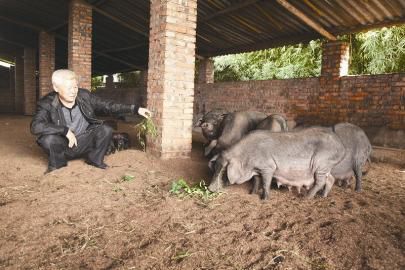
Li Jian comes to the fermentation bed to feed green fodder to the farrowed miniature pet sows.
Location: Pingqiao Village, Dadukou Town, Naxi District, Luzhou City.
Maker: Li Jian, a company employee who returned to his hometown after retirement and built an open-air pig farm.
Innovation: Raising miniature pet pigs with a distiller's grains raised-bed fermentation technique; the pens have no foul smell, and the miniature pet pigs are in short supply. The miniature pet pigs' excrement is converted by the fermentation bed into organic fertilizer, bringing in extra income.
Returning home after retirement to raise miniature pet pigs
In April 2013, after retiring, Li Jian returned to Pingqiao Village in Dadukou Town, planning to develop a livestock business. He considered that raising ordinary commercial pigs would carry too much market risk, and the waste discharge problem would also be hard to solve. After research, Li Jian decided to rely on Pingqiao Village's advantages, such as abundant barren hills and good vegetation, to develop a distinctive ecological miniature pet pig breeding operation.
Through land transfer, he contracted 50 mu of barren hills, invested more than 200,000 yuan to build standardized pig housing, introduced 10 Congjiang miniature pet pigs from Guizhou, and founded the Ningfeng Ecological Agriculture Specialized Cooperative.
Walking into Li Jian's miniature pet pig farm, one sees groups of miniature pet pigs chasing each other and foraging on the hillside; inside the pens, several breeding miniature pet pigs with glossy black hair and short bodies are lying on thick distiller's grains resting. No flies can be seen in the pig housing, and no foul smell can be detected. "Look at these little miniature pet pigs sleeping on the soft distiller's grains; it's about the same as sleeping on a 'Simmons.'" Li Jian said.
"This is not a single layer of distiller's grains. The upper layer contains bacterial strains and biological enzymes, and the lower layer is a fermentation bed equipped with oxygen supply and exhaust facilities." Li Jian explained that raising pigs on a distiller's grains raised-bed fermentation system is a pig-raising technique provided by the technology company cooperating with the cooperative. It not only has sterilizing and deodorizing effects, but can also ensure the health of the miniature pet pigs.
"The reason I chose distiller's grains raised-bed fermentation to raise pigs is that Dadukou Town is vigorously developing its baijiu industry, and the distiller's grains, the waste from baijiu production, are exactly the main raw material for my fermentation bed." Li Jian said. The fermentation bed can also decompose the miniature pet pigs' excrement and convert it into organic fertilizer. At present, two fertilizer companies have signed purchase agreements with him.
The secret of being in short supply
In recent years, although pork prices on the market have fluctuated, the miniature pet pigs raised by Li Jian have always been in short supply. He said this benefits from the excellent quality of his miniature pet pigs.
It is understood that Li Jian's distiller's grains raised-bed fermentation breeding method is basically a "lazy person's management" model; the keepers only need to feed on time every day. Miniature pet pigs are usually fed 4 times a day, with concentrated feed and green fodder twice each. The free-range miniature pet pigs do not need to be called; when the time comes, they will wait on their own at the feeding point for the feed.
"Apart from mealtimes, the miniature pet pigs are kept free-range on the hillside and often run around for exercise, so the meat is not only fine and tender, but also has a moderate mix of fat and lean and tastes good." Li Jian said. The miniature pet pigs on the farm can generally be sent to market at around 80 kg. Apart from a portion recovered by the company and sold to Chongqing, Yibin, Chengdu and other places, the rest are ordered by telephone by nearby enterprises, shopping malls and restaurants.
At present, Li Jian's farm has developed more than 200 breeding miniature pet pigs, with more than 800 piglets on hand, and annual sales of nearly 2 million yuan. Seeing Li Jian become rich by raising miniature pet pigs, villagers come almost every day to visit and learn, and the miniature pet piglets are even more in short supply.
Driving villagers to raise pigs and increase income
"I have lived for decades and have never seen this way of raising pigs, let alone expected the effect to be so good!" said 65-year-old villager Zhang Conggao.
In order to lead his fellow villagers to get rich together, Li Jian not only lets villagers visit the farm, but also explains the key technical points of miniature pet pig breeding for free. In March this year, Zhang Conggao spent 600 yuan to buy two piglets and joined the cooperative. At present, the two miniature pet pigs are growing well and can be sent to market before the New Year, with net income expected to reach about 3,000 yuan.
"Now nearly 100 households of villagers nearby are raising them." Li Jian said. "The specialized cooperative has also specially contacted merchants to implement a 'floor price' purchase of miniature pet pigs. Each piglet sells for 300 yuan, and the price of commercial pigs is about 40 yuan per kg. With order-based purchasing, there is no worry about sales. With the cooperative behind them, villagers are raising pigs with almost 'zero risk.'"
In addition, for farmers with financial difficulties, Li Jian adopts the method of "first giving piglets to raise, then deducting the cost of the piglets at the time of recovery," lowering the threshold for joining the cooperative and letting more villagers participate. "Two years from now, the farm will achieve the goal of 400 breeding pigs on hand and 10000 ten-thousand piglets sent to market." Speaking of the farm's prospects, Li Jian is full of confidence.