Eco-friendly Farming of White Amur Bream: A Post-80s Young Man from Jingshan Sets Out on the Road to Prosperity
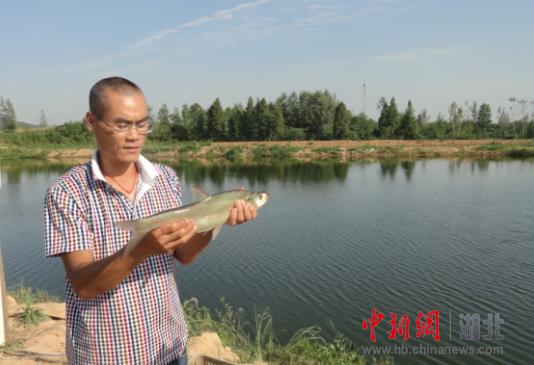
In Daiwangling Village, Yanmenkou Town, Jingshan County, there is a post-80s young man named Huang Bugang. He gave up his farm resort business near the market town that brought in more than 100,000 yuan a year and resolutely chose to return to his village to pursue eco-friendly farming of white amur bream. After nearly 2 years of effort, his annual income now exceeds 200,000 yuan, making him a locally well-known skilled earner.
Why would someone who was already a boss give up an established business to start again? On September 24, this writer interviewed him after hearing of his fame.
It is understood that Huang Bugang graduated from high school in 2000, began working in private transport in 2008, and in 2010 went into partnership to run a farm resort. Because he was hardworking and good at business, he got a taste of sweet success, which further strengthened his determination to start a second business.
"Farm eco-friendly fish, take the path of efficient and distinctive aquaculture, and let eco-friendly fish 'swim onto' ordinary people's dining tables." At the end of 2013, the quick-witted Huang Bugang learned from newspapers, television and other media that, as living standards rise, people increasingly favor eco-friendly aquatic products. He immediately discussed it with his wife and made an astonishing decision: give up the booming farm resort business in the market town, return to the village to invest in aquaculture, and open up a new entrepreneurial path of his own.
In December of that year, Huang Bugang signed fishpond transfer agreements with 4 farming households in the village, transferring 52 mu of idle fishponds in one go at an annual rent of 400 yuan per mu, with a lease term of 10 years.
After signing the transfer agreements with the villagers, Huang Bugang immediately brought in 1 excavator and 2 bulldozers to carry out a comprehensive renovation of the fishponds. A month later, 4 standardized intensive fishponds, along with supporting water, electricity and road infrastructure, were completed one after another.
He invested nearly 300,000 yuan in total. After re-excavating and disinfecting the fishponds, he purchased 50,000 white amur bream fry from Jianli and released them, thus embarking on a new aquaculture path he had never set foot on before. That year, due to high stocking density and a lack of farming technology and experience, the feeding and management of the fish could not keep up, and by the end of the year the adult fish were too small and did not meet market size requirements, resulting in no way to sell them. When the accounts were settled at the end of 2014, he had lost more than 100,000 yuan.
It is not too late to mend the fold after a sheep is lost. Facing adversity, Huang Bugang did not lose heart. In 2015 he began traveling around to visit, study and learn from others, desperately making up for his lack of white amur bream farming techniques. Hard work pays off. A few months later, Huang Bugang's farming skills advanced by leaps and bounds, and the fish also "grew strong and healthy" under his careful cultivation. At the same time, he also sent samples of the water and fish from the ponds to the Hubei Academy of Agricultural Sciences for pollution-free indicator testing, and in July of this year he obtained the pollution-free product origin certification.
Effort always brings rewards. By early August, each adult fish of the branded white amur bream Huang Bugang farmed weighed about 1 jin and was selling very well on the market. In just August and September, more than 20,000 jin of white amur bream were sold to supermarkets and farmers' markets in Wuhan, Tianmen and other places, bringing in more than 200,000 yuan.
However, having obtained the pollution-free product origin certification and earned his first bucket of gold from aquaculture, Huang Bugang was not satisfied with this small success and wanted to extend his farming reach even further.
"Next year I will set up a cooperative, expand the eco-friendly aquaculture water area to 200 mu, and try raising fine varieties such as mandarin fish and sea bass. Through the cooperative, I will develop members and lead my fellow villagers onto the road to prosperity through eco-friendly aquaculture," Huang Bugang said full of confidence.