Heilongjiang Tiandi Renhe raises geese in cornfields
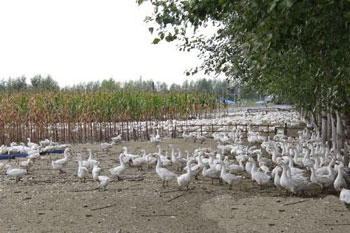
Bayi Agricultural University breeding goose farm.
Goose paths in the field.
On September 24, the reporter followed the science and technology service team of Heilongjiang Bayi Agricultural University to the Northern Breeding Goose Farm located in Datong District, Daqing City. This breeding goose farm is the university's demonstration breeding base for geese. According to Qin Zhiwei, president of Bayi Agricultural University who led the team, the focus of this visit was not the new breeding goose varieties bred at the base, but a brand-new ecological farming model.
Guided by researcher Zhou Ruijin of Bayi Agricultural University, the group arrived at a cornfield. The cornfield before the reporter's eyes was very different from the neighboring plots. The lower halves of the corn stalks were completely bare, without a single leaf, and the overall height was taller than other plots. The furrows and ridges were completely free of weeds, and the field was surrounded by a half-meter-high wire fence. The most eye-catching sight was a large flock of white geese, which quickly darted into the corn thicket as the group arrived, moving through the rows like a white comb, refusing to leave no matter how people chased them, pecking at corn leaves at will as they ran, as if they were the masters of this territory.
"This is our new farming model, characterized by being green, ecological and environmentally friendly." Faced with the reporter's surprise, Zhou Ruijin explained that this field had more than 1,000 geese, using this method of natural free-range rearing in the cornfield.
President Qin Zhiwei skillfully took a tape measure and, together with everyone, measured the height at which the geese fed and the height at which the corn ears set. "The feeding height is close to 1 m, and the ear-setting height is 1.3 m." He inserted a tree branch into the soil to compare the depth of the loose topsoil layer, saying, "The loose topsoil layer in the free-range goose area is 11 cm, and 7 cm where no geese were released." He pulled hard on a corn stalk but could not "shake" it, then turned to ask Zhou Ruijin about last year's corn yield and the price of geese.
The reporter also observed that these large white geese were fat and strong, agile in movement, and very fast runners. Given the current state of the corn leaves being pecked, they could still reach the higher leaves by stretching their necks.
According to Zhou Ruijin, in 2010 the state issued a grazing ban policy. That year, after ruling out pen raising and woodland farming methods, he and his research group colleagues began trying to release geese in silage fields, and that very year they achieved unexpectedly good results. Through three years of experimentation and promotion, the research group summarized management standards for the farming model, including stocking density, release age in days, growing season, release time, return-to-shed time, supplementary concentrated feed, and supplementary roughage, as well as technical standards for disease prevention and control, including immunization procedures, disease prevention, and diagnosis and treatment of common goose diseases, along with low-cost feeding techniques using silage corn stalks.
In 2013, Bayi Agricultural University began implementing the Ministry of Science and Technology's agricultural science and technology achievement transformation fund project "Integration and Demonstration of Low-Cost Ecological Goose Farming Technology in Northern Cold Regions," mainly promoting "cornfieldgoose raising," "family ranch grassland rotational grazinggoose raising," and "silage corn stalk barn goose raising," three low-cost ecological farming technologies for commercial geese for demonstration and promotion. In comparison, the first had the most notable effect.
The advantage of this "corn + geese" planting-and-raising combination model is that the geese walk in the field and deposit manure, increasing soil fertility and improving the soil into organic land in 3-5 years; the geese eat old corn leaves and weeds, increasing ventilation in the cornfield and basically eliminating weeds and insect pests in the later stage of corn growth; the geese eat the fibrous roots of the corn, causing the corn to extend deeper into the soil, absorb more nutrients, promote taller plant growth and fuller kernels; both corn and geese become raw materials for green organic food, and after harvest the stalks are fed to geese through silage fermentation, reducing the accumulation of stalks after harvesting, reducing carbon emissions from stalk burning, and lowering environmental pollution, forming a virtuous-cycle ecological agricultural production model.
The economic and ecological benefits brought by the "corn-goose planting and raising model" can be summarized as "three reductions, two increases, one improvement," namely reducing the use of chemical fertilizers and pesticides, reducing carbon emissions from stalk burning, and reducing labor costs; increasing income from geese and increasing corn yield; and improving corn quality and soil fertility. It avoids factory farming that fatten geese with feed, and also resolves the harm caused by pesticide and fertilizer residues to crops and land.
According to the research group's statistics and measurements over three consecutive years, each year the direct economic benefit brought by goose farming reached 450-700 yuan per mu; corn yield increased by 5-10%, increasing income by about 100 yuan per mu; in terms of chemical fertilizers, pesticides and labor, expenses could be saved by 20 yuan per mu; and each mu provided 600 kg of organic goose manure fertilizer. Since 2013, this farming model has been promoted through technical training in places such as Hongguang Farm in the Heilongjiang reclamation area, and has won widespread praise from farmers.