Wild leeches are becoming increasingly scarce, and special breeding in Haiyu has turned them into a treasure for making a fortune
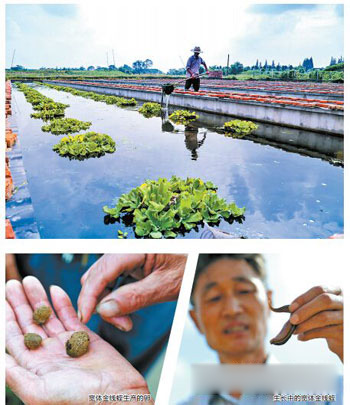
Leeches, also known as bloodsuckers, are very common in the paddy fields of the Jiangnan region. Because they like to suck human blood, when farmers work in the fields, their leg areas often become ideal targets for attack, and a careless moment can bring a vicious bite. At this point, if you pull it directly with your hand, it is generally very hard to pull off; you can only pat it gently and let it slowly release its grip, but the wound still bleeds steadily. This little worm that people once hated and feared has now become a treasure at the Changshu City Sanxing Leech Breeding Professional Cooperative in Qifeng Village, Haiyu Town.
It turned out that local farmer Liu Genhua and two other people learned that dried leech products can be steeped and used in traditional Chinese medicine. However, due to the use of pesticides and various other factors, wild leeches are not plentiful, so they have become a scarce product. Many people began leech farming. Liu Genhua and the others already had rich experience in agriculture and breeding. After multiple preliminary investigations, they invested more than 700,000 yuan to set up the Sanxing Leech Breeding Professional Cooperative, becoming Changshu City's first farm specializing in artificial leech breeding. The cooperative covers 15 mu and has about 20 stocking ponds, each about 155 sq m. In the first half of this year, they purchased seedlings, and the breeding base was officially put into production. The species currently stocked is the broadband gold-thread leech, a variety that does not suck human blood and feeds on snails, aquatic plants and so on.
Artificial leech farming must also follow the leech's natural growth patterns and create conditions to meet their daily living requirements. Wang Jinlong, a technician at the breeding base, said: "Leech farming generally has two seasons a year, spring and autumn. Based on our existing conditions, we generally only farm in spring. After overwintering leeches mate, they begin laying eggs in mid-April, around Qingming. After laying eggs, it is estimated that they can hatch in 20 to 25 days. After hatching, around June 1, they can basically be put into the ponds." Observing carefully by the breeding ponds, you can find some earthy-yellow, fluffy small balls near the roots of the aquatic plants in the ponds. Wang Jinlong said these are the eggs produced by the broadband gold-thread leech. At a suitable temperature, the small leeches inside will break out of the eggs and live for a period in a special "nursery." When the outdoor water temperature reaches 15°C, they can be stocked into the ponds. Before stocking, the water environment in the ponds also needs to be properly managed. The water hyacinths and other aquatic plants in the ponds are there to purify the water quality and also provide some protection from direct sunlight. Decaying root matter can also become food for the small leeches.
The broadband gold-thread leech grows to a relatively large size, but the breeding process must go through a hot summer. Wang Jinlong said that on the one hand, high temperatures make leeches grow quickly, but on the other hand, the mortality rate is also high, so the farm needs to control temperature and water level well and prevent pests and diseases.
At present, the market price of dried leeches is 1,100 to 1,200 yuan per kg. The entire growth period of the broadband gold-thread leech at this farm has been fully completed, and the first large-scale trial breeding is in sight of success. But this year, cooperative head Liu Genhua still cannot bear to sell these "treasures." He plans to let the leeches grow a bit more to prepare for egg-laying and reproduction next spring.