A post-90s girl balances school and cattle raising
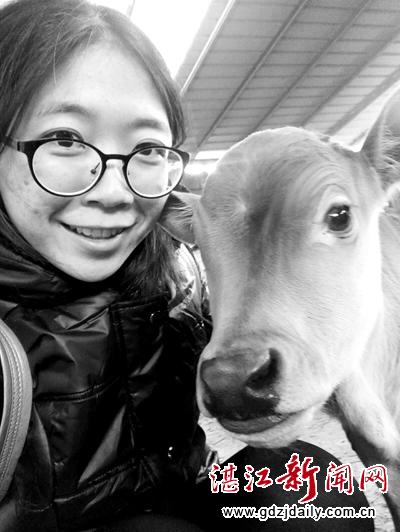
Wang Jiawen inspects the growth of calves at the cattle farm.
Born in 1993, Wang Jiawen has a special identity: she is both a senior marketing major at Guangdong Peizheng College and the chairman of an agricultural company. While other classmates are worrying about finding jobs, the "cattle kingdom" she founded in Lianjiang already had sales exceeding 5 million yuan in 2014. Through the business model of "company + farmers, internet + company," she not only helps farmers get rich, but also opens up an ecological circular economy industrial chain integrating planting, breeding, production, processing, sales and catering.
During the National Day holiday, Wang Jiawen, who rushed back to Lianjiang from Guangzhou, was busy handling various affairs at the company and planning to further improve the company's sales terminals. "Recently I've been looking for partners, preparing to launch our branded beef offal cart in Lianjiang."
A visit home sparks the "cattle-raising dream"
"Before college, I had never thought about starting a business, let alone becoming a 'cowherd.' Speaking of raising cattle, I have to start from my visit home during the Spring Festival in 2014." Despite meeting for the first time, the well-behaved and delicate-looking Wang Jiawen has a poise rarely seen in other girls, and she clearly recounted her entrepreneurial history to the reporter.
Although her parents are native Lianjiang people, Wang Jiawen grew up with them in Zhuhai from childhood. In her impression, farmers sweat profusely every day but live a rather hard life, so she had never imagined that one day she would have anything to do with agriculture or cattle raising. In 2014, Wang Jiawen returned home during the Spring Festival to visit relatives, and she found that most villagers in Shicheng Town, Lianjiang City, went out to work to make a living, while quite a few stayed home to raise cattle. Using the traditional model of free-range grazing, slaughtering and selling on the market, profits were meager, and a slight misstep could lead to losses. Wang Jiawen's uncle, Wang Peiqin, was a typical cattle farmer who had raised cattle for years but found it hard to get rich.
While chatting with her uncle, Wang Jiawen discovered that Lianjiang has good water and heat conditions and abundant pasture, and the beef produced there is of good quality and tastes great, but limited by the traditional breeding model, it was hard to achieve scale. "You are the scholar in our family, and you major in marketing. Can you think of a way for your uncle to get rich?" Wang Peiqin joked. But it was precisely this remark that sparked Wang Jiawen's idea of innovating the breeding model and leading the villagers to get rich by raising cattle.
Innovating the model to build a "cattle kingdom"
With her family's help, Wang Jiawen registered and established a company. Wang Jiawen said she hopes her company can give traditional agriculture a different meaning, and help farmers get rich together through assisting cattle raising.
There are many migrant workers in rural areas, and those left behind are mostly the elderly, the young and small individual households. There is surplus scattered labor, but it is difficult to form large-scale breeding. How can rural surplus labor be fully utilized while also helping the company expand quickly? Wang Jiawen, a marketing major, thought of using the "company + farmers" model. The company first sets up a cow breeding farm to breed calves in a centralized way. Since small households lack the ability to bear risks, the calves are sold to them at a certain price per jin, and when the cattle reach the marketing period, the company buys them back. On the other hand, for small households that want to raise cattle but have no capital, the company first signs a grassland free-range contract with the farmers, and when the cattle reach the marketing period, the company purchases them uniformly, with profits from the cattle's weight gain split equally between the company and the farmer.
Under the two assistance models, the company is responsible for guidance and professional veterinary services to ensure that no hormones are added during the breeding period, and after the cattle are bought back, the company uniformly conducts 4 months of fattening and breeding, and only after uniform inspection by the company can they go on the market. Today, the annual marketing volume of yellow cattle cooperated on by the company and farmers exceeds 1,500 head. "Calculated according to this model, for each cow raised, you can earn more than 10 yuan a day, and there's no need to worry about risks. For farmers, this model couldn't be better." Farmer Wang Bo adopted 2 cattle, and now he not only has work to do every day, but his income is also guaranteed.
In addition to using the "company + farmers" model for cattle raising, Wang Jiawen also "puts to use" the pasture. Apart from planting a small portion of pasture itself, the company purchases all other pasture from villagers at 0.2 yuan per jin, allowing many villagers to make full use of their spare time to supplement their household income.
A cow breeding farm, breeding calves in a centralized way.
"Internet + company" guarantees sales channels
Once the breeding model was established, how could the cattle be sold? Relying on traditional slaughtering to flow to the market made it hard to guarantee sales channels, so Wang Jiawen began exploring the "internet + company" marketing model.
"Lianjiang is the hometown of fruit, with good water and heat conditions, and the pasture grown there is of good quality. Cattle raised through the 'company + farmers' model are guaranteed to be healthy, and the beef is more tender and fatty." Wang Jiawen told the reporter that in addition to being sold on the market, the company's beef also builds a brand on Taobao and large e-commerce websites, selling vacuum-packed beef and beef balls, and ensuring delivery to Pearl River Delta cities within 12 hours by express delivery. "Unlike the visibility of traditional market sales, e-commerce sales require more brand building and word of mouth. We have stricter requirements for products sold online, ensuring the pure taste of the beef and beef balls sold."
Wang Jiawen said that now online e-commerce has begun to take shape and has also attracted many repeat customers. The next step will be to establish the company's official website and a Weidian store to build an e-commerce brand, so that more people can taste authentic local Lianjiang beef.
To extend the industrial chain, Wang Jiawen then set her sights on the catering industry, using hot pot to make use of beef, beef bones, beef blood and beef offal. Because the beef is fresh and tastes fragrant and refreshing, diners praise it endlessly.
Helping more farmers get rich together
"My goal is to be able to make a profit from every link of breeding, processing, sales and catering, and also be able to help farmers. This has now been initially achieved." Wang Jiawen said that the next step is to further replicate the company's business model, expand into the western Guangdong region, and help more farmers get rich together.
At present, the company has replicated the business model of "company + farmers, internet + company" and established a cattle farm in Maoming, which has been welcomed by local farmers. "Western Guangdong has a culture of eating beef, and cattle relying on rural free-range grazing are far from enough to supply the market. Beef from confined cattle brought in from elsewhere has poor taste because the cattle's growth cycle is shortened, so raising cattle is a 'big undertaking.'" Wang Jiawen said that from a frail girl to a "cattle boss," having dealt with farmers and cattle raising for a long time, she has grown more and more attached to the "cattle kingdom" she has built.
"Being able to combine a career with helping villagers is the happiest thing. Every time I see the joy of farmers receiving money after bringing their cattle to the company for buyback, my heart is also full of happiness." Wang Jiawen said that at present, in addition to balancing the company's business, she also has to study hard at university, so that after graduation she can better carry out the next goal.