Fierce Bees Still Brew Sweet Wealth
Highlights: In the evening, 200 beehives await more than 7 million bees starting to return to the hive. In this spectacular scene, people face a life-threatening danger if they are not properly protected. Zuo Fenglong, a young man from Heze, Shandong, discovered a business opportunity in bees. But his actions were not understood by others. At the most difficult time, he borrowed money from more than 30 relatives and friends and struggled to get by. See how Zuo Fenglong changed his fate through bees.
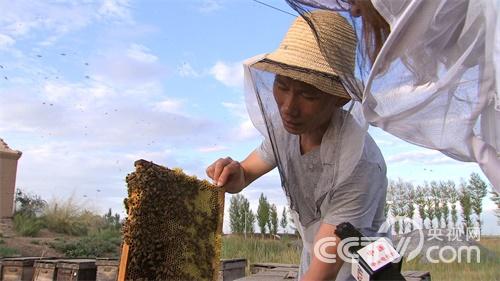
Entering August, the sunflowers on the Horqin grassland usher in the most brilliant days of the year, which also draws countless bees attracted by the fragrance.
Millions of bees have already stayed here for more than 20 days. As the sunflower flowering period ends, these bees will also head to the next place. Zuo Fenglong starts busying himself; he must load these bees onto the truck within 2 hours.
Zuo Fenglong: Within 2 hours, that is, before dark, you absolutely must load all these beehives onto the truck. Once it gets dark, you cannot load them anymore. Then if the bees crawl on you, they sting; if they crawl on you, they sting.
The seemingly simple task of moving beehives is often the beginning of a crisis.
Bees are usually kept in hives placed in fixed positions. When the hives are moved, the bees sometimes cannot find their own home. Bees do not usually sting people. If they cannot find the hive, they become very agitated and sting when they bump into people. If a person is stung by 100 bees, it can be life-threatening. Here there are a total of 200 hives, each with 35,000 bees, and the total number of bees is more than 7 million. If these more than 7 million bees are not smoothly allowed to find their home, the consequences would be unimaginable.
Smoke is lit here to fumigate the bees in order to prevent them from stinging people.
Lin Weihua, a beekeeper in Hangzhou, Zhejiang: After fumigating them a bit, they are less likely to sting people.
Reporter Bi Yue: Are they afraid of this smoke?
Lin Weihua, a beekeeper in Hangzhou, Zhejiang: They are afraid of smoke, the bees.
Moving must be done in the evening, when the bees have returned to the hive. In addition to continuously burning fires to fumigate the bees, everyone has taken strict protective measures. Although they wore protective suits, before long the people surrounded by the swarm on site were still stung.
Lin Weihua, a beekeeper in Hangzhou, Zhejiang: It stung my hand, stung here, stung me twice.
The reporter was stung on the hand twice by bees.
Reporter Bi Yue: That sting needle just now, my hand has no strength at all, and then with any movement it hurts terribly.
Zuo Fenglong said bees like to target black things. During the filming, bees circled around the camera once, and suddenly the camera reporter said he had been stung.
Reporter Bi Yue: Tears are coming out.
Camera reporter Li Long: They just flow on their own, from the pain they flow on their own, it hurts, it really hurts, really, wait a moment, I cannot sit still.
Beekeeper: What is going on, are you uncomfortable?
Zuo Fenglong: No, he was stung above the lip.
Reporter Bi Yue: Is your mouth swollen? Swollen.
Camera reporter Li Long: I can feel it, it is swollen, I do not dare move, my upper lip is swollen, I do not dare move, it hurts like crazy.
The camera reporter's experience made the truck driver who came to transport the bees extremely nervous. He picked up a military coat from the ground and put it on, and fled the moving site.
At 7 p.m., after two hours of busy work, several people were stung, and Zuo Fenglong finally finished loading the truck for his partner before dark. The beekeepers would travel overnight to their hometown in Zhejiang, 2,600 kilometers away, preparing to collect tea flower honey.
Lin Weihua, a beekeeper in Hangzhou, Zhejiang: Then we are off.
Zuo Fenglong: Goodbye.
After seeing off his partner, the next day Zuo Fenglong took us to another place where he collects honey.
Zuo Fenglong is from Juye County, Shandong Province. Now 34 years old, Zuo Fenglong has gone out with his father to keep bees since he was 14. After more than 10 years of hard work, he earned an average of 20,000 to 30,000 yuan a year. But in 2013, Zuo Fenglong unexpectedly discovered a business opportunity in bees, and two years later his annual sales actually exceeded 6 million yuan.
From a hardworking beekeeper to someone determined to become a leader in getting rich in the honey industry, Zuo Fenglong's change began with his father's tears.
This is Zuo Fenglong's father, Zuo Yawei. He is 60 years old this year and has been out collecting honey for more than 40 years. But one day in 2006, Zuo Fenglong discovered his father secretly wiping away tears. When this matter was mentioned during the interview, Zuo Fenglong's father became emotional again.
Zuo Fenglong's father Zuo Yawei: Because of the bees. They selflessly dedicate themselves to humanity. People should not misunderstand them. People should not throw dirty water on them. Now this treatment they get, what people say about them, this unfairness, every time I think of it I shed tears.
Zuo Fenglong: That time, I felt it was a reason for me to firmly do this thing.
Only after Zuo Fenglong asked his father did he learn why his father had cried. It turned out that some time earlier, his father had taken honey to sell, but a customer said that the honey he took directly from the beehive was not safe to eat.
Zuo Fenglong's father Zuo Yawei: Honey cannot be eaten without disinfection. This is an insult to the bees. You say bees are selfless, dedicated and hardworking. I feel wronged on behalf of the bees.
Reporter Bi Yue: Wronged on behalf of the bees?
Zuo Fenglong's father Zuo Yawei: Yes.
Zuo Fenglong: What makes him feel most wronged, and also what most beekeepers feel wronged about, is what? It is consumers not understanding us.
Zuo Fenglong could not forget the scene of his father shedding tears. He later learned that many consumers were unwilling to buy honey, and people did not trust honey. When mentioning the public's prejudice against honey, one cannot fail to mention mature honey and immature honey.
This is a bee that has just finished collecting nectar, and its belly is crystal clear.
After bees collect nectar, they repeatedly eat and spit it out in the hive, brewing it over and over, and use their wings to fan away excess water in the honey. Then the bees use beeswax secreted by themselves to cap the honey. Honey naturally matured in this way is called mature honey, also called capped honey. This requires the bees to work for more than 7 days.
Immature honey is honey that has been brewed by bees for only a day or two and is taken away by humans before it has matured. It is also called water honey. Immature honey must undergo high-temperature dehydration before it can be sold.
Chen Lihong, Secretary-General and Vice Chairman of the Apicultural Science Association of China: High-temperature concentration for a long time will destroy the nutritional components in honey, especially vitamins, enzymes and active substances, which cannot be retained. The aromatic flavor will be lost, and the color will also change.
Zuo Fenglong had always wanted to make mature honey, but in 2005, the mature honey he made was rejected by buyers. The buyers were unwilling to take it and told him to add water to the honey to make low-concentration water honey.