Mastering the "refined" approach, he found a path to wealth earning 800,000 yuan a year
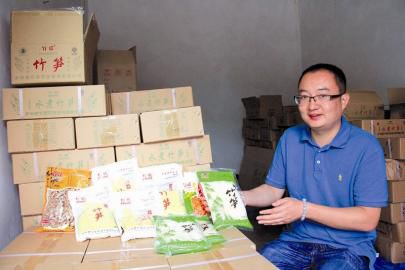
Dai Xiaoyu shows off his premium green bamboo shoots.
Raising green-shell laying hens under ma bamboo; changing the selling method adds value to fresh shoots
Transferring land to plant bamboo, selling bamboo shoots in season, and raising free-range chickens in the open spaces under the forest... This practice is already very common in rural areas of our province. However, Dai Xiaoyu, a large-scale ma bamboo grower in Quba Town, Naxi District, Luzhou City, has created an annual net profit of 800,000 yuan from his 150 mu of ma bamboo forest, making the local villagers deeply envious. Dai Xiaoyu says that he can achieve such a high return because he has mastered the "refined" approach.
Raising premium laying hens turns the ma bamboo forest into a "treasure bowl"
Recently, walking into Dai Xiaoyu's ma bamboo planting base in Group 3 of Shuangxin Village, Quba Town, Naxi District, the lush ma bamboo blots out the sky, the cement paths in the forest wind through secluded spots, small groups of black-feathered silkie chickens chase and forage in the forest, and among the fallen leaves on the ground one can occasionally spot a green-shell egg. "This open space under the forest is simply a 'treasure bowl.' In a single day I can collect several hundred green-shell eggs, which sell for over a thousand yuan." Dai Xiaoyu says excitedly.
In 2007, when Dai Xiaoyu was 29 years old, despite his family's opposition, he gave up his stable, well-paid job in Shanghai and returned to his hometown to rent nearly 150 mu of land in Quba Town, Naxi District, Luzhou City to plant ma bamboo. After 4 years of careful management, in the early summer of 2011, Dai Xiaoyu's ma bamboo shoots began to appear on residents' dining tables.
Once the ma bamboo began to pay off, the empty land under the forest could not be left idle either. Dai Xiaoyu chose to raise free-range chickens under the forest. However, unlike other growers, he did not raise ordinary free-range native chickens for sale. Instead, he did something unconventional and invested more than 100,000 yuan to introduce over 2,000 black-feathered silkie laying hens for scientific rearing. "Raising chickens under the ma bamboo forest does not take up space. Herbaceous plants provide natural feed for the chickens, and only a moderate amount of corn and rice needs to be supplemented. This not only saves costs, but the poultry manure also fertilizes the forest land. The most important thing is that I chose black-feathered silkie laying hens specifically to produce especially nutritious green-shell eggs. This kind of egg sells for 3 yuan each on the market." Dai Xiaoyu told this writer that this black-feathered silkie laying hen is relatively small in size, and the eggs it lays are slightly smaller than ordinary chicken eggs, but its laying rate is high, with an average of 110 eggs per chicken per year.
In order to ensure the quality of the green-shell eggs, Dai Xiaoyu uses round-the-clock video surveillance in raising the black-feathered silkie laying hens, ensuring the hens lay eggs healthily. As soon as his green-shell eggs hit the market, although each sold for 3 yuan, most could only be bought by pre-order or by visiting in person. Dai Xiaoyu can profit 300,000 yuan a year from this.
Selling premium bamboo shoots: changing the method triples the price
Dai Xiaoyu's under-forest chicken raising is different from others, and his way of selling ma bamboo shoots is likewise different from others. Each year he sells fresh ma bamboo shoots for only 1 month, and during the remaining months of the shoot-producing period, he finely processes all the shoots before selling them, and their value immediately increases 3 times.
Naxi District is a key production area among the country's 13 major miscellaneous bamboo counties. Bamboo shoots are the hope for local farmers to get rich. However, compared with other agricultural products, bamboo shoots have a major "stubborn problem" in sales. It turns out that bamboo shoots have tender tissue and vigorous metabolism, and combined with the warm climate during the harvest period, they are extremely prone to aging after harvest, quickly showing phenomena such as the shoot flesh turning yellow, texture becoming fibrous, shoot shells wilting, and browning. "Generally, after one day of storage, 60% becomes lignified, and after two days they have almost completely lost all edible value." Dai Xiaoyu says. Because bamboo shoots have a short shelf life, they generally can only be sold nearby. In addition, the marketing time for bamboo shoots is relatively concentrated, the rot loss rate in the production area is large, and the processing period is short, all of which greatly reduces the economic benefits of bamboo shoots.
"If you want to maximize the returns from bamboo shoots, the only way is to change the selling method and carry out fine processing." Dai Xiaoyu told this writer that starting in 2011, he began research and experiments on fresh bamboo shoot preservation technology. From the very beginning, in order to ensure ecological greenness, Dai Xiaoyu abandoned the method of preserving with preservatives and uniformly adopted steps such as boiling, slicing, and blanching, then used salt for preservation. Because this kind of product mostly has a shelf life of only one year, Dai Xiaoyu always set production according to volume.
After more than two years of effort, Dai Xiaoyu's independently developed "green process treatment for bamboo shoot preservation" gradually matured, and in 2014 it also won the "Luzhou City Science and Technology Achievement Award." His preserved ma bamboo shoots can be eaten within one year, and their quality and flavor are no different from fresh bamboo shoots, providing more possibilities for the sale of ma bamboo shoots.
Since 2013, the 50 tons of finely processed bamboo shoots produced each year from Dai Xiaoyu's 150 mu of ma bamboo forest land have sold well in East China and been in hot demand in Chengdu, Chongqing and other places, and all were sold out before April of the following year. Processing 1 jin of premium bamboo shoots requires only 4 jin of fresh shoots, with a cost price of 3.2 yuan, but the selling price is 10 yuan. While satisfying people's ability to eat green bamboo shoots in all four seasons, Dai Xiaoyu also earns 500,000 yuan in profit each year.