Wuchuan's grass-growing and sheep-raising becomes a fine example for industry development
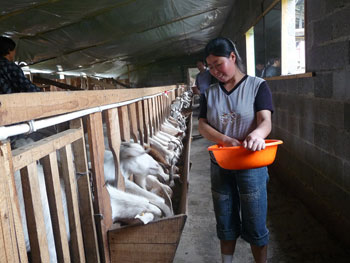
Along the expressways from Guiyang City, Guizhou Province, to various parts of Zunyi, the billboard reading "Wuchuan Riding on the Sheep's Back" that can be seen every so often along the drive deeply caught the reporter's attention.
"Wuchuan? Raising sheep? And you can ride on a sheep's back?" These questions kept swirling in the reporter's mind.
Adapting to local conditions becomes the industrial choice of a large poverty-stricken county
Standardized goat breeding farms one after another, rows of handsome building-style sheep sheds, patches of verdant grass-growing bases... After eating a bowl of piping-hot clear-soup mutton rice noodles in the morning, the reporter could not help but exclaim: "Green grass covers the hills, and the fragrance of mutton fills the air."
"You are right to feel that way, because the goats in our county are generally not raised in open grazing. They live in 'hotels,' eat 'set meals,' and are even assigned full-time 'health doctors,'" said Liu Zhimo, deputy secretary of the Wuchuan County Party Committee.
This is absolutely true. These handsome sheep sheds have skylights and temperature regulators on the roof and air inlets on the floor. Even if the outside temperature is 30°C, once you walk inside, you do not feel hot at all.
In the past, goat farming in Wuchuan was mainly household open grazing and had long failed to reach scale. In the process of open grazing, vegetation was severely damaged, further worsening the degree of rocky desertification in the karst region. At the same time, diseases spread easily among openly grazed goats; if one goat in a flock became sick, it would infect the others within a few days.
How to carry out large-scale breeding while protecting the ecology? In recent years, Wuchuan has successfully explored a new goat farming model that shifts from hillside open grazing to grass-growing and confined rearing.
In Wuchuan Autonomous County, with a population of 450,000, ethnic minorities account for 96.6% of the county's total population. For a long time, owing to constraints such as geographical and transportation conditions, poverty has been a pain in local people's hearts. At present, the county still has 78,900 poor people.
In 2010, the Guizhou Provincial Party Committee and Provincial Government proposed the "10 Million Quality Mutton Sheep Project" and designated Wuchuan County as a county for the province's grassland ecological animal husbandry industrialization poverty alleviation project, a county for the province's 10 Million Quality Mutton Sheep Project, and one of the province's 10 major grassland ecological animal husbandry sheep-raising counties, increasing support for goat farming.
Riding the momentum of the province's "10 Million Quality Mutton Sheep Project," Wuchuan County issued policies in succession, integrating no less than 25 million yuan each year from agriculture-related funds in development and reform, transportation, water conservancy, forestry, agricultural machinery and other fields for loan interest subsidies, disease prevention and control, breed improvement, breeding subsidies, scientific and technological extension and infrastructure construction; organizing 25 million yuan in credit funds for the purchase of improved livestock and poultry breeds and the construction of sheds; arranging no less than 3 million yuan from the county finance for working funds and rewards; allocating 1 million yuan to increase the pay of village-level epidemic prevention workers, with animal husbandry regulatory fees used in full for the development of grassland ecological animal husbandry production and disease prevention in each township; and issuing policies to support and encourage cadres, staff and capable members of society to lead or undertake breeding bases. At present, the county has 380,000 mutton sheep on hand, and 13,000 poor farmer households have benefited from the poverty alleviation results of grassland ecological animal husbandry.
Behind the growth of economic benefits is the manifestation of ecological benefits
"The method of growing grass and raising sheep can not only reduce soil erosion, but also reduce the incidence of disease in goats and promote rapid fattening of goats," introduced Ma Hua, deputy director of the Publicity Department of the Wuchuan County Party Committee.
The traditional sheep-raising industry is regarded as an industry that pollutes and damages the ecology. However, Wuchuan's sheep-raising industry adheres to the principle of unifying economic benefits with ecological benefits, organically combining the development of the mutton sheep industry with soil and water conservation, rocky desertification control, and returning grazing land to grassland, and implementing ecological breeding. At the same time, it vigorously promotes the large-scale housed feeding model. All sheep sheds are built to the "building-style slatted floor" zero-emission standardization standard, with key promotion of the "sheep-biogas (organic fertilizer)-crops (fruits and vegetables)" circular model, and large-scale farms are prohibited in environmentally sensitive areas. At present, the 200,000-mu project of returning grazing land to grassland is being implemented, 100,000 mu of high-quality forage such as forage sweet sorghum and ryegrass are growing vigorously, and 5,200 mu of improved natural grassland covers the jagged rocks of the karst landform, achieving a win-win for ecological construction and mutton sheep industry development.
Industrialized production of feed and forage has become an important means for Wuchuan's sheep industry to achieve a win-win in both ecological and economic benefits. Wuchuan actively promotes a mechanism separating grass growing from breeding, guiding forage planting enterprises, large households and specialized cooperatives to carry out "order-based" production with breeding communities and breeding enterprises; vigorously promotes straw ammoniation, micro-storage, silage and haylage technologies, and firmly advances the development and application of concentrated feed for mutton sheep.
The paper mulberry originally used for papermaking has now made its way onto the sheep's "dining table." At present, through experimental demonstrations of paper mulberry planting and seedling cultivation, Wuchuan County is building a 100-mu high-standard hybrid paper mulberry seedling base, first launching trial production of a 30,000-ton ecological organic paper mulberry feed production line, raising 1,000 paper mulberry-fed sheep, gradually establishing a forage and feed system, and striving to build the Wuchuan paper mulberry ecological organic sheep brand.
Breed improvement creates an industry brand
In order to promote the development of the sheep industry, Wuchuan County persists in following the path of diversified development of mutton sheep breeds. On the basis of selecting and breeding local fine breeds such as white goats and black goats, it vigorously introduces fine breeds, achieving self-breeding, self-cultivation and self-sufficiency of improved breeds, and attaining the goals of diverse breeds, excellent quality, controllable disease and orderly management. At present, 80,000 breeding sheep can be self-bred each year; the mutton sheep breeding rate reaches more than 220%, and the survival rate reaches more than 93%.
At the same time, the county has built a four-level management network and epidemic prevention network of "county grassland ecological animal husbandry development center-township animal husbandry station-breeding community-farmer households," explored a development model of "county-level original breed farm-township expansion breeding farm-community breeding households," changed hillside open grazing across the mountains into a breeding method of "grass growing + confined rearing + supplementary feeding," embarked on a new path of "leading enterprise + cooperative + breeding households," built and improved the sheep industry chain, created the "Wuchuan White Goat" brand, effectively protected the ecological environment, promoted agricultural structural adjustment, and increased farmers' incomes and prosperity, forming a situation of administrative promotion, enterprise-driven development, farms leading households, and thousands of households developing the sheep industry.
Yang Youming, secretary of the Wuchuan County Party Committee, believes that to build a complete sheep industry chain and create the "Wuchuan White Goat" brand, it is necessary to carry out park-based layout, enterprise-driven development and large-scale development, form a development model of "large households leading small ones, scattered households banding together, and scale through associations," and ensure that every large enterprise becomes a "complex" integrating planting, breeding, processing, cold storage, transportation and sales.
"This is the breeding sheep farm, this is the bio-organic fertilizer plant, this is the organic greenhouse vegetable experimental base, and this is the specialty food processing plant..." Walking into the Jiangyi Animal Husbandry Ecological Science and Technology Park, the company's person in charge introduced that the breeding sheep produced by the company are used to develop large-scale sheep-raising households through the method of "company + cooperative + farmer households," and each breeding household is assigned a full-time technical cadre, allowing breeding households to raise sheep with zero risk. Over 5 years, 100 standardized large-scale sheep-raising communities will be developed throughout the county, achieving 520,000 goats on hand annually and 200,000 commercial sheep sold, driving an average household income increase of more than 150,000 yuan.
Today, Wuchuan has explored a path for the ecological sheep-raising industry from scattered household open grazing to centralized large-scale breeding, ecological breeding, high-quality breed propagation, enterprise-driven development and park-based layout, and has blazed a new path for characteristic agriculture in poverty-stricken mountainous areas to increase income, achieve prosperity and attain moderate prosperity in step.