Free-range chickens get QR codes, new ways to start a business in the remote mountains
Original headline: A post-90s young man from Longquanyi, Chengdu returns to his hometown to raise chickens and tags every chicken with a "QR code"
At 8:00 a.m. on October 19, the warm autumn sun shone through the thin mist onto the mountain forests, farmhouses and small paths of Jinlong Village, Luodai Town; the yellowing woods gave the remote mountain autumn even more flavor.
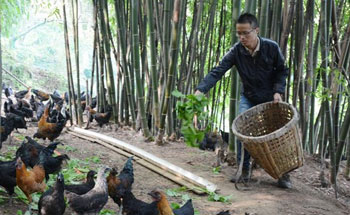
In Group 3 of Jinlong Village, as morning smoke rose from the farmhouse tile roofs, Lai Qingli was already back at his own chicken farm from the fields with a full basket of green vegetables on his back. "Taking advantage of the early morning, I pick some green vegetable leaves so the chicks can eat more fresh green feed." Lai Qingli's face was full of smiles. He squatted among the bamboo grove and gave a whistle, and the flock of chickens slowly gathered around him. Lai Qingli scattered the vegetable leaves, drawing over a dense black mass of chickens.
Since quitting his job and returning home in June this year to join the Chengdu Xiang Gege Farmers' Professional Cooperative to raise chickens, Lai Qingli had not slept in. At 25, his face was full of youthful energy, and his words revealed drive. "No matter how wonderful the outside world is, it is not as good as home. The mountains and rivers of my hometown are all treasures, and these are my resources for starting a business." As Lai Qingli spoke, he threw the remaining handful of vegetable leaves toward several black free-range chickens standing on a tree fork. The chickens flapped their wings and deftly pecked at the vegetable leaves hanging on the branches.
Determined
Post-90s young man quits his job to start a business in the remote mountains
The first crow of the chickens every morning was Lai Qingli's alarm to get up.
Lai Qingli is a post-90s young man. He studied design in university. After graduation, he worked in Beijing, Jiangsu, Shenzhen and other cities. His last job was at Foxconn. After working away from home for many years, Lai Qingli's biggest feeling was: "Life in the big city looks beautiful."
Lai Qingli did the math: he and his wife both worked at ordinary companies, and after deducting rent and living expenses from their combined monthly wages, there was almost nothing left over.
"We are still so young, we cannot keep drifting outside like this forever. I still want to build a career of my own." Lai Qingli thought it over again and again. Rather than struggle in a foreign place, it would be better to return home and start a business. However, although he had the idea of returning home to start a business, turning the idea into reality still required a lot of courage.
What should he do after returning home to start a business? The first things that came to Lai Qingli's mind were the stretches of green mountains in his hometown, the idle land, and the free-range chickens scattered around the houses.
"City people have money but still cannot buy free-range chickens and free-range eggs. Authentic free-range chickens definitely have a market, so raising chickens may be a good project." Lai Qingli's idea won his wife's support, and also drew a reminder from his parents: "You need to think it through. Starting a business is not simple, and this road is not easy to walk."
Having made up his mind, in June this year this young man, who had been to many big cities and experienced modern urban life, resolutely gave up the prosperity of the city and willingly returned to his hometown. He cleaned up the old house that had been vacant for many years, built chicken coops, and devoted himself single-mindedly to being a "farmer" deep in the mountains.
Not afraid of hardship
Going up the mountain every day to gather medicinal herbs for the free-range chickens
"These medicinal herbs are all gathered on the mountain. After the chickens eat them, they clear heat and are less likely to get sick." Lai Qingli carried a basket of medicinal herbs out of the old house, grabbed a handful and threw it to the free-range chickens foraging in front of him. "A few months ago I knew nothing about raising chickens. Now I have even learned to gather medicinal herbs to feed the chickens. Every day I go up the mountain to gather several large baskets for these chicks."
After returning home, Lai Qingli bought 800 Wuhai chicken chicks in one go. This kind of chicken has black feathers, a black comb and black feet, and even its internal organs are black. Its meat is more delicious than that of ordinary free-range chickens.
"What I feed them is all green vegetable leaves and coarse grains. These chickens do not touch a single pellet of feed." Lai Qingli planted green rapeseed, pumpkins and other crops in his own fields and in the idle land of his uncles. Every day he drove the flock into the vegetable fields to peck at the green vegetables. After it rained, there was mountain spring water on the mountain, so Lai Qingli used a hose to pipe the mountain spring water to the chicken coops for the free-range chickens to drink.
Lai Qingli treated these 800 chickens as treasures. Apart from going out to buy grain for the chickens, he rarely left the mountain forest. "These chickens are very timid, but they are also very wild and like to climb trees. Once more than ten chickens stood on one branch, broke the branch, and scared some chickens so much that they did not dare climb the tree trunk again." Lai Qingli already understood the living habits of these free-range chickens very well.
Loves to use his brain
Every free-range chicken has a "QR code"
"Every chicken wears a leg band, and a QR code is printed on the band. By scanning the code, you can check each chicken's feeding and epidemic prevention information." Lai Qingli walked gently toward a free-range chicken, grabbed it in one motion, and showed the reporter the leg band on the chicken's foot. "This is like the golden headband. Once it is put on, it cannot be taken off."
Lai Qingli loves to use his brain when raising chickens. In order to raise chickens better, he moved broadband to the woods of his hometown so that he could look up chicken-raising knowledge online at any time. In addition, under the guidance of the cooperative, he studied breeding technology and epidemic prevention knowledge, and often went out to learn advanced feeding experience from farmers in other places.
Through studying online, Lai Qingli also formulated a new "recipe" for the free-range chickens himself. He mixed the common ground beetles from rural stoves with wheat bran and other ingredients for the chickens to eat. "Using the egg shells after ground beetles hatch as a feed additive for chickens can make the laying period start 20 days earlier, and the laying rate will also be higher." When it came to how to raise chickens scientifically, Lai Qingli could already explain many principles.
These were the first batch of free-range chickens raised by Lai Qingli, and he was very confident. In another two months, the free-range chickens would begin to lay eggs. The cooperative had already helped him solve the sales channel, so he was not worried about the market. As a next step, Lai Qingli also wanted to use the recovered funds to expand the breeding scale and take the entrepreneurial path of integrating specialty breeding with ecological planting.
"You see that stretch of land is all empty. It is a pity that no one plants it. Next, I want to make use of all the wasteland in the village, and then this whole mountain will be my chicken run." Lai Qingli pushed up the broken glasses frame wrapped with transparent tape, his young face full of confidence.