Ostrich farming attracts children for sightseeing, using tourism to support breeding has a promising future
Original title: A new path for ostrich farming: using tourism to support breeding and breeding to promote tourism
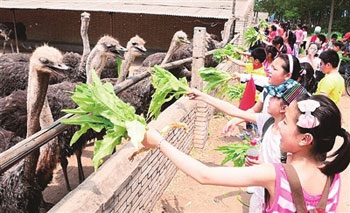
Tourists are feeding ostriches (photo)
Nowadays, rural development cannot achieve comprehensive benefits by relying on a single industry. Therefore, it is necessary to adjust the industrial structure and realize cross-type industrial integration. Guided by consumers' demand for rural leisure tourism and related experiences, and with the concept of linkage and cross-integration of the three industries, a industrial system spanning the primary, secondary and tertiary industries in rural areas and integrating production, living, experience and ecological functions should be built, ultimately driving the expansion of consumer demand related to agricultural multifunctionality and increasing the value-added links and space of agricultural development. Henan Jinlu Special Breeding Co., Ltd. takes ostrich farming as its foundation, integrates the primary, secondary and tertiary industries, improves comprehensive benefits, and promotes the formation and development of the ostrich industry chain. Its approach is worth learning from.
At the end of the last century, as a directly affiliated enterprise of the Henan Provincial Supply and Marketing Cooperative, the provincial cotton and hemp company, in order to expand its business operations and find new economic growth points, began to set its sights on the ostrich farming industry, which was rarely heard of in China at the time, and established Henan Jinlu Special Breeding Co., Ltd. In 1998, Jinlu Company purchased 240 ostriches from South Africa at 60,000 yuan each, opening the road of special breeding.
“The output value of ostrich by-product processing far exceeds the output value of ostrich meat. A farm household raising 10 ostriches can earn tens of thousands of yuan when they are ready for market.” said Xia Shilong, general manager of Jinlu Company. Ostrich farming does not compete with agriculture for arable land or with humans for food, and it helps develop and utilize sandy wasteland, improve non-arable land, and achieve the return of land to grass and grazing. “It not only fills farmers' pockets but also straightens farmers' backs.” It is not only a full practice of the circular economy and ecological economy, but also a bold and beneficial attempt to explore the adjustment of the agricultural industrialization structure, realize service to “agriculture, rural areas and farmers,” and help farmers increase income.
Using tourism to support breeding: opening up industry chain projects
“Although ostriches have high economic value, from the perspective of food alone, the vast majority of domestic people still have very limited acceptance of ostriches.” said Xiong Xiangqian, Party secretary and deputy general manager of Jinlu Company. In order to increase the visibility of Jinlu ostriches, the company's management, after careful consideration, decided to use the unique landscape of ostrich flocks and the high ornamental value of ostriches to develop eco-tourism. “For urban residents, they may not be able to accept eating ostrich meat for the time being, but their enthusiasm for seeing the elegance of an exotic species is very high; and for the company, the cost of developing an ostrich amusement park is relatively low, but the results are very good. It can not only increase the company's income and promote the Jinlu brand, but also open up a channel for the company to transform from the primary industry to the tertiary industry.”
In April 2000, Jinlu Company officially opened the Jinlu Ostrich Amusement Park to the public. At first, it was indeed a “hit” in Henan Province and became the first choice for many urban residents in Zhengzhou and surrounding areas for outings in the suburbs. However, due to a single ornamental project and a lack of amusement facilities, the ostrich amusement park also experienced a period of downturn after its rise. “Where you fall, get up from there. Since urban residents feel that coming to the amusement park and only playing with ostriches is boring, then we will develop more projects to meet their diversified needs.” Xia Shilong said. By chance, he heard that a Canadian company was holding a dinosaur culture exhibition at the Bird's Nest in Beijing. Associating this with the fact that many scientists had argued that the ancestor of the ostrich was very likely a small sauropod dinosaur, he immediately set off for Beijing and found Mr. Bao, president of Canadian Dinosaur King Co., Ltd., which was holding the dinosaur culture exhibition.
Through on-site inspection, Canadian Dinosaur King Company decided to cooperate with Jinlu Company and jointly invest 5 million US dollars to build the largest dinosaur culture science popularization base in China at present. In order to quickly turn around the company's economic situation, the employees of Jinlu Company carried forward the “shoulder pole spirit” and completed the project construction that was originally scheduled to take 1 year in only two months. On October 1, 2010, the ostrich park with a completely new look opened to welcome visitors. More than 60 large dinosaur models in the park automatically shook their heads and tails and raised their heads to roar as visitors approached, making the ostrich park “turn things around” and once again become a tourism hotspot, receiving more than 50,000 visitors on that day alone.
Guided by this approach, the park successively invested in the construction of a horse riding arena, a racecourse, a grass skiing field, a fishing center, an aerial ropeway, a water park, standard rock climbing, as well as a hundred-mu orchard, a leisure snack street, Jinlu Resort and other tourism and entertainment projects and supporting service facilities. It gradually developed into a comprehensive eco-tourism scenic area integrating ostrich viewing, agricultural eco-tourism, ostrich banquet culture-themed dining, ostrich handicraft exhibition and sales, science popularization education, and dinosaur culture inheritance. Through a series of activities such as spring flower viewing, summer water play, autumn picking, and winter dinosaur culture festival, it continued to ignite tourism hotspots in the province and embarked on a new path of using ostrich farming to drive tourism development and using tourism development to drive product sales.
Using breeding to promote tourism: consolidating the foundation of the industry chain
Because the ostrich industry is a high-investment, high-risk and high-return industry, relying solely on the enterprise's own strength to engage in ostrich farming is costly and risky. Through continuous exploration and practice, Jinlu Company creatively proposed a new business model of “company + base + standardization + specialized cooperative.” That is, farmers do not need to consider market sales; they only need to follow the company's requirements and use crop straw and grass resources to raise young birds into commercial birds, and then the company buys them back according to contracts signed by both parties under the ostrich contract-raising system.
This farmer contract-raising model, with the company as the axis and promoted through base radiation and large-household driving, not only uses idle land in front of and behind rural houses and mobilizes a large amount of surplus rural labor, but also reduces enterprise production costs while increasing farmers' income, which can be described as killing two birds with one stone. Among this, in order to ensure the survival rate of chicks and the health of adult birds, Jinlu Company implements a “five unified” management model for contract-raising households: unified provision of ostrich chicks, unified feeding management, unified disease prevention and control, unified feed, and unified buyback and processing. In order to ensure the production quality of ostrich meat products, Jinlu Company formulated relevant documents such as Good Manufacturing Practices (GMP) and Sanitation Standard Operating Procedures (SSOP) for frozen boneless cut ostrich meat, providing a demonstration sample for promoting standardized production in the ostrich farming industry. Up to now, Jinlu Company's ostrich contract-raising scale has reached more than 8,000 birds, driving more than 500 farm households in total and achieving cumulative income increases for farmers of more than 46 million yuan.
“Deep processing of ostrich products is the ultimate development direction of ostrich products and the fundamental basis for maximizing the benefits of ostrich products. Relying on ostriches to develop tourism is an effective way to promote the Jinlu brand, but as an enterprise, only by doing a good job in the production and processing of ostrich products, building a cold-chain logistics network for ostrich products, and forming a chain network for the production, processing, storage and sales of ostrich products, can the truly effective circulation of ostrich products be realized, thereby truly achieving ‘no off-season in the off-season’ for ostrich sales and ensuring the normal development of the ostrich product business chain.” explained Wang Yanhong, deputy general manager of Jinlu Company.
For this reason, Jinlu Company did not expand its breeding scale when the park's development momentum was strong. Instead, it controlled the number of ostriches raised through predicted sales quantities, continuously reduced feeding costs, improved ostrich output and quality, and invested greater energy in increasing the development of ostrich products, enriching ostrich product varieties, improving product types, and raising product technical content and added value to meet diversified consumer demand. In addition, Jinlu Company also insisted on giving play to the advantages and role of its ostrich export foreign exchange-earning base, further improved slaughtering production facilities, equipment and technical standards, actively carried out ostrich meat export and trade agency business, and established cooperative relations with foreign businessmen from multiple countries, making beneficial explorations and attempts to achieve direct export.