Ten jin of Alishan cherry seeds paint a lonely half-mountain village red
Original title: Ten jin of Alishan cherry seeds paint a lonely half-mountain village red
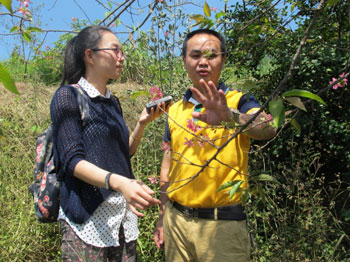
Strait Voice reporter Hong Mei interviews Huang Biyong, the first cherry grower in Banshan Village
Cherry blossoms planted by Huang Biyong on Bijia Mountain
Cherry blossoms on Bijia Mountain
Viewing cherry blossoms in the rain during the 2015 Spring Festival, at Bijia Mountain in Hua'an
"Yesterday snow was like blossoms, today blossoms are like snow; mountain cherries are like beauties, whose rosy faces fade too soon." Banshan Village in Huafeng Town, Hua'an County was originally a small mountain village both remote and inconvenient to reach, yet in recent years it has become widely renowned because villagers introduced large quantities of Alishan cherry trees from Taiwan, China. Not only do many people travel a long way to buy saplings here, but during every flowering season the place is always swarming with visitors.
Huang Biyong, 40 this year, is the first person in Banshan Village to grow cherry blossoms, and he has already toiled on this stretch of hillside for a full 15 years. When talk turns to how his connection with cherry blossoms began, Huang Biyong remembers it vividly. In 2000, a Taiwanese flower grower surnamed Zhu came to Hua'an to invest in flowers and nursery stock, and through a friend's introduction Huang Biyong got to know him. At that time, whenever this Taiwanese flower grower came to Hua'an, Huang Biyong treated him warmly, and when going out sightseeing he was always the one to accompany him and act as guide, so the two gradually built a deep friendship. Huang Biyong said: "That Taiwanese friend gave me ten jin of cherry seeds at the time and repeatedly urged me to plant them for sure. At the time I didn't know these varieties at all, so the Taiwanese friend encouraged me, saying that in another five or ten years these cherry blossoms of yours would be something remarkable, and the business would surely 'take off.'"
It is understood that at the time Banshan Village had plenty of land resources, with an acre of land costing only a few yuan, so Huang Biyong followed his Taiwanese friend's suggestion and began planting cherry blossoms. Everything is hard at the beginning. When Huang Biyong poured large amounts of time and energy into labor in the mountains, his wife and children began to not quite understand him and complained from time to time, and many villagers often poured cold water on him too, but Huang Biyong always maintained a calm and down-to-earth attitude, working diligently. "At the time many people were not optimistic about it; they thought the saplings I planted could only be cut down later for firewood," Huang Biyong said. "I told them it didn't matter; at least we'd have beauty, and with a better ecology we'd feel comfortable just looking at it."
The cherry seeds from Alishan in Taiwan, China indeed did not disappoint Huang Biyong; the survival rate was very high and the growth was fast. He said: "Our altitude, humidity and climate here are the same as Taiwan's. Big Red, double-petaled, Yaezakura... most Taiwanese cherry varieties we can grow here. For another example, because Japan's climate is too cold, the Japanese Big White variety cannot be grown here."
Cherry blossoms red, business "hot." Just as his Taiwanese friend predicted, starting from 2006 Huang Biyong's cherry business in recent years has indeed developed quite well: orders increased, sales channels improved, and his planting scale grew larger and larger. Besides the more than 20 mu of cherry orchard here in Banshan Village, at Bijia Mountain on the Taikou Farm in Shajian Town he also rented more than 700 mu of land to plant cherry blossoms and other trees. Over five or six years he has also planted more than 10 kinds of Taiwanese nursery stock, including Beauty Tree, Golden Shower Tree, Golden Trumpet Tree and small-leaf dyed kernel. But Huang Biyong frankly admits that what sells best is still cherry saplings. He said: "This year I cultivated more than 1 million cherry seedlings, and recently one customer immediately reserved 200,000 to 300,000 of them for me; the volume is still quite large."
"Constantly updating varieties is the key." Besides cultivating cherry seedlings, Huang Biyong now also actively updates and introduces more cherry varieties, and promotes local eco-tourism and farmhouse tourism. When drinking water, remember the source. Although Huang Biyong has succeeded, he often fondly remembers the Taiwanese friend who brought him the seeds and has always kept in touch with him, exchanging what each has. He said: "Without the Taiwanese friend bringing these varieties over, there would be no prosperity or renewal here for us."