Raising hairy crabs under solar panels: a good startup project that does not occupy farmland
Original headline: British media says China's solar industry has found a new source of revenue: raising hairy crabs under solar panels
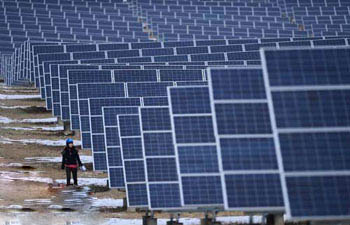
File photo: a technician inspects a hydro-solar hybrid photovoltaic power station at Longyangxia of Huanghe Hydropower Development Co., Ltd.
British media report that this year China will overtake Germany to become the country with the largest installed capacity of solar panels in the world. However, as companies find it increasingly difficult to obtain the huge land reserves needed to build solar power plants, they are turning to an innovative solution: developing various types of planting and breeding under the solar panels, including raising hairy crabs. This helps them circumvent government restrictions on changing the use of agricultural land, wins the support of local farmers, and brings in additional revenue streams.
According to a report on the website of the British Financial Times on October 30, Yang Lizhi, an energy analyst at Hong Kong brokerage CLSA, said: "This approach is very reasonable, because it can integrate solar power generation into agricultural land very effectively without encroaching on the space for agricultural production."
The report says that at the Xicun power station in Yunnan Province, Hong Kong-listed CLP Group has already cooperated with local farmers to grow the traditional Chinese medicinal herb honeysuckle under the solar panels. In this mountainous region, rows of solar panels cover one hilltop after another.
Ms. Yang Xinfeng, a farmer who is weeding the young honeysuckle plants, said: "In the past I did not understand this crop, and looking after them was not easy. But now I earn much more money." Since Ms. Yang began working for the honeysuckle contractor introduced by CLP Group, her income has tripled to 3,000 yuan (US$473) per month.
CLP Group has doubled the installed capacity of the Xicun power station to 100 megawatts, enough to supply electricity to thousands of households in the nearby city of Dali. At present, the group is also building a similar project elsewhere in China, raising the distinctive aquatic product hairy crabs in ponds under solar panels.
Yang Mingcai, senior vice president of CLP Group's China new energy division, said: "Solar power stations need to occupy a lot of land, and a major challenge we face is how to obtain land close to major population centers. Integrating food production can help us persuade farmers to lease us land at a reasonable price and can win government support."
The report says that as solar panel prices plummet due to oversupply, more and more Chinese companies see an opportunity - to make money while gaining political credit by helping the government achieve its ambitious renewable energy targets.
At the same time, more companies across China are launching photovoltaic projects combined with agriculture, intending to develop various types of planting and breeding under the solar panels, including mushroom cultivation.
The report says that, as in most countries, China's solar power stations are profitable only with government subsidies. However, new power stations currently need to spend a year or even more to obtain the necessary approvals and receive the first payment.
Yang Lizhi of CLSA said that despite the possibility of funding problems in the short term, China's huge investment in the solar industry will reduce costs and thereby change the face of the global solar industry. At present, the cost of solar power generation is about 60% higher than that of thermal power.