Yang Limin and the Indissoluble Bond with Chinese Kiwifruit
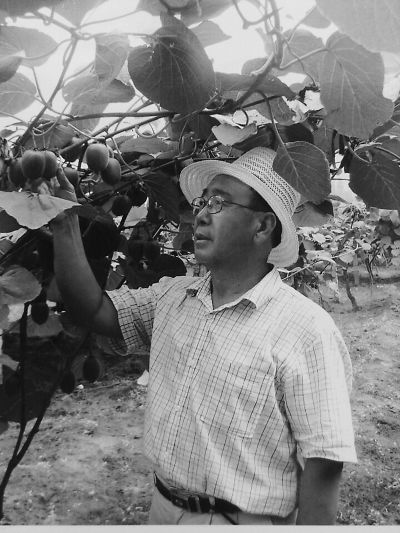
Yang Limin inspecting the growth of the kiwifruit.
This year, the Chinese kiwifruit in Zhangfang Town, Fangshan District, has once again yielded a bumper harvest, with abundant fruit and a steady stream of customers. But Yang Limin, the owner of the largest orchard in the area, still harbors a regret. What exactly is going on?
The story dates back more than 30 years. Kiwifruit got its name because macaques like to eat it. Rich in vitamin C and containing 17 kinds of amino acids needed by the human body as well as nutrients such as phosphorus, calcium, iron and magnesium, it is known as the "king of vitamin C" and the "king of fruits." In 1984, relevant departments of the municipal and district governments brought in "distinguished yet delicate guests" from Chang'an District, Xi'an City, Shaanxi Province - Chinese kiwifruit seedlings.
"The 5,000 kiwifruit saplings introduced that year were planted on a trial basis in 4 townships, with 250,000 yuan allocated for support. Unfortunately, they all died. If it weren't for the 2 jin of seeds that remained, this whole endeavor would have fallen through," Yang Limin said. In the spring of 1985, under the guidance of technicians from Shaanxi Province, Xibaidai Village in Zhangfang Town sowed the seeds in the ground and continued to introduce and cultivate kiwifruit. However, the results were still very poor. The survival rate of the kiwifruit planted that year was less than 10%. On the same tree, the fruit on one side grew normally, while on the other side the fruit varied in size. The young trees grew all their leaves and looked as if they had survived, but for some unknown reason, the leaves turned from green to yellow, fell off and the trees died. Some trees grew vigorously but bore no fruit...
Faced with one problem after another, the villagers were not intimidated. They looked for causes, came up with solutions, and spent almost every day and night in the fields. In order to build up this industry and help the villagers get rich by growing kiwifruit, the village cadres led more than a dozen women and delivered the saplings to each household, 3 trees per household, one household at a time. In 1989, the kiwifruit produced by Xibaidai Village was exhibited at the National Agricultural Exposition and won a gold medal. In 1990, Xibaidai Village was jointly named a "Chinese Kiwifruit Commodity Base" by the Ministry of Agriculture and the Ministry of Finance. Later, the whole town learned from Xibaidai and further promoted kiwifruit cultivation.
Just when the villagers thought they had succeeded, a cold snap in the autumn of 1999 nearly froze to death all the kiwifruit saplings that had been planted across 1,000 mu, leaving only 53 mu.
The villagers' enthusiasm was once again dealt a blow. "As a Communist Party member, I could not stand by and watch the kiwifruit industry die." It was also at this time that Yang Limin contracted 100 mu of land to continue planting kiwifruit saplings.
Yang Limin said that the soil in Xibaidai Village is fertile and there is nothing that cannot grow there. The failures happened because people had not mastered its patterns. With such a mindset, Yang Limin studied painstakingly and devoted himself for ten years, becoming proficient in the growth patterns of kiwifruit. He also took the lead in establishing a farmers' professional cooperative and built the largest kiwifruit plantation in the suburbs of Beijing, with a yield of 2,000 kg per mu and a market price of 60 yuan per kg, far higher than the price of kiwifruit in other regions, and still in short supply.
His family became wealthy and life improved, but Yang Limin still harbors a regret today. He said: "The kiwifruit cultivation technique does not belong to me. It is the result of support from the Party and the government and embodies the painstaking efforts of my fellow villagers over 30 years. Making only my own family rich means little. My wish is to spread it across the entire Fangshan District, and even the entire city, so that more farmers can increase their incomes and become prosperous."