Mushroom King Leads More Than 8,000 Farming Households onto the Road to Prosperity
In Lijin, when the name Wang Zhongchun comes up, everyone knows he is the widely renowned "Mushroom King." For more than thirty years, he has devoted himself single-mindedly to developing the mushroom industry. Under his leadership, the edible mushroom industry in Lijin County has grown from nothing, and today there are 25 specialized edible mushroom villages, more than 8,000 farming households have taken the road to prosperity by growing mushrooms, and a large number of processed mushroom food products have also made their way onto ordinary people's dining tables.
Setting up a small arched greenhouse on the kang
Mushrooms growing out of tin cans
Wang Zhongchun was born in Beiling, Lijin, into an ordinary farming family with many sisters, but having graduated from high school, he was not content to farm for the rest of his life. In 1982, when he was not yet 20, he saw an advertisement in Rural Masses about a mushroom cultivation training course held in Shandong Province, and Wang Zhongchun felt this was a golden opportunity to change his fate.
"At the time, the 10-yuan training fee was obtained by trickery, and my parents did not support it either," Wang Zhongchun said, yet he firmly boarded the bus to Jinan with his bedding. The month-long training gave Wang Zhongchun a preliminary understanding of edible mushroom technology, but when he excitedly brought the spawn home to experiment, he was ridiculed by the villagers. "Mushrooms are shaken out by thunder, how can you grow them?" Such voices of opposition were endless, so he chose to return to his small room and silently took the first step into edible mushroom cultivation.
Wang Zhongchun finally cultivated his first generation of spawn, but a problem arose: edible mushrooms need suitable temperatures to grow, and at the time there were no temperature-control conditions. He relied on the residual heat of the kang and covered them with quilts, adjusting the temperature manually. "The suitable growing temperature of around 25 degrees for edible mushroom mycelium was all estimated by feel," Wang Zhongchun said.
So, around the Spring Festival, Wang Zhongchun set up a small arched greenhouse on the kang; when the temperature was high he lifted the quilt, and when it was low he covered it again. It was by such manual temperature control that a few clusters of mushrooms actually grew out of the tin cans in the cardboard box.
After this initial success, the following year he borrowed thirty or forty yuan and opened up three fen of land in his own yard, producing 1,000 jin of mushrooms. "At the time, selling mushrooms was very difficult," as before artificial cultivation, local people did not know what oyster mushrooms were. To promote them, while growing them he took his mushrooms to restaurants and oilfield construction crews to sell door to door, and because of their delicious taste and rich nutrition, Wang Zhongchun's mushrooms were quickly recognized.
In the summer of 1983, he began to think about growing oyster mushrooms on a large scale, but met his first setback in life. "Two whole beds, and after planting, green mold appeared; according to the reference materials, once green mold appears it means total crop failure." Wang Zhongchun concluded himself that it was still a lack of technology and too little practice. He went to Gudao Town and continued making spawn and cultivating, successfully worked out a method of spawn cultivation, brought the spawn home, restarted artificial cultivation of oyster mushrooms, and harvested his first batch of products.
"Sometimes I felt very content selling just 4 or 5 yuan a day; that would be 120 yuan a month, and over a year I could earn more than a thousand yuan!" Wang Zhongchun said. "At that time the village was encouraging households to reach a thousand yuan, and sometimes after selling mushrooms I would ride my bicycle on the road and think that this thousand-yuan household was not so far away after all."
Teaching techniques hand by hand
Driving 25 villages and more than 8,000 farming households to team up and venture into the market
After several years, Wang Zhongchun's mushroom growing had gained some reputation, and at this point he had a new idea: mobilize farming households, provide the spawn and materials himself, and lead everyone to prosperity together.
At first, when selling spawn, Wang Zhongchun collected only half the fee temporarily, helping farmers with cultivation and management. To conveniently teach villagers to mix the substrate and fill the bags door to door, Wang Zhongchun bought a motorcycle, and as the number of growers grew, he became even busier.
Since their marriage in 1985, his wife Cui Kui had single-handedly taken on the heavy responsibility of caring for the children and managing household chores, and also learned from her husband to manage their own mushroom greenhouse, becoming the woman who silently gave support behind a successful man. By 1994, more than 2,000 farming households had taken up edible mushroom cultivation, and pollution-free edible mushrooms, this newly emerging food, were increasingly welcomed by everyone.
In 2003, Lijin County vigorously developed edible mushroom cultivation, and Wang Zhongchun once again welcomed a springtime for his career. In 2004, he established Shandong Luye Biotechnology Park Co., Ltd., and acquired 40 mu of land in the private enterprise park of Beiling Township to pursue his old trade, engaging in the production, marketing and technical guidance of spawn.
As his business developed, Wang Zhongchun, unwilling to remain satisfied with the status quo, set his sights on research and development of new varieties. "Just doing oyster mushrooms and button mushrooms is already facing obsolescence; we have to start experimenting with other substitute materials." Wang Zhongchun explained that, for example, cotton stalks were all burned locally, which both polluted the air and wasted resources, and during burning also killed some beneficial microorganisms in the soil. In his view, using cotton stalks as a raw material to cultivate edible mushrooms was a path with relatively good prospects.
"At the time we ran many experiments and spent quite a lot of money," Cui Kui told reporters. In order to develop cotton stalk cultivation technology, her husband ran to Jinan countless times to consult experts. Wang Zhongchun said that in the small-scale trials some problems inevitably appeared, so he adopted the method of small-scale trials, then pilot trials, then large-scale extension. For example, after sterilizing cotton stalks and inoculating them directly, the mycelium would not germinate and would not feed on the substrate, but through many experiments, by fermenting the cotton stalks, the waxes inside the cotton stalks were removed during fermentation, and after inoculation the growth became relatively normal. In this way, the country's first cotton stalk cultivation technique for black fungus succeeded, and a national technology patent was applied for.
In 2006, the Municipal Agriculture Bureau established the Dongying City Edible Mushroom Research and Development Center at Luye Mushroom Industry, and right after that Wang Zhongchun established the Tianlü Edible Mushroom Farmers' Professional Cooperative, providing free technical training and guidance to mushroom farmers, guiding the people toward intensive production and scale operation, and teaming up to venture into the market. "After all, one household planting on its own is relatively scattered, and some people, in order to gain small advantages, are rather prone to adulterating and faking. In order to better drive the farming households and also for food safety, I began buying back farmers' products, so that they had a guarantee and product quality was also standardized," Wang Zhongchun said.
Under Wang Zhongchun's leadership, Lijin County currently has developed 25 specialized edible mushroom villages, and more than 8,000 farming households have taken the road to prosperity by growing mushrooms.
Deep-processed mushroom products sold nationwide
Exploring factory-style cultivation of rare wild mushrooms
Wang Zhongchun was not satisfied, and successively developed new cultivation methods for more than thirty famous and superior edible mushroom varieties, including button mushrooms, enoki mushrooms, shiitake mushrooms, lion's mane mushrooms, wood ear mushrooms and reishi mushrooms, innovated ten process flows, and achieved large-scale extension.
As edible mushroom output continued to increase, Wang Zhongchun turned his sights to deep processing of edible mushrooms. In 2009, he began experiments making bagged and bottled spicy enoki mushrooms. Today, a series of deep-processed edible mushroom products such as "Zhongchun" brand spicy enoki mushrooms sell well all over the country, becoming a famous local specialty of the Yellow River Delta.
With economic development and rising living standards, demand for edible mushrooms is growing daily, and the original one-household planting model can no longer remotely meet demand. In 2011, Wang Zhongchun built a factory-style edible mushroom production project. "Its characteristic is that the degree of mechanization is greatly increased, mushroom production is more regular, the sales chain is relatively tight, and efficiency is also high."
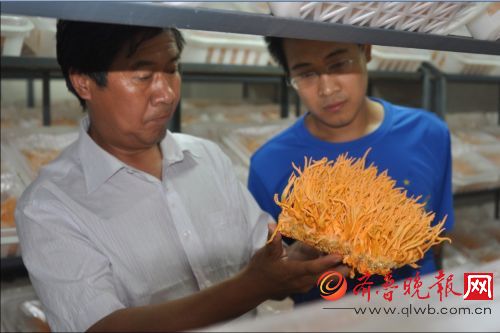
At present, a brand-new year-round, three-dimensional, intelligent edible mushroom cultivation project has already gone into production. The project has seven functional zones, including a scientific research and office area, a raw material storage area, a spawn production and ingredient area, and a deep processing area. While producing rare mushrooms such as king oyster mushrooms and cordyceps in a factory-style manner, it also produces mushroom sticks and organic fertilizer from spent mushroom substrate in large quantities, forming a circular edible mushroom industry chain. A factory-style edible mushroom production base integrating research and development, production, cultivation, processing and cold storage is rapidly rising in Lijin.