Tibetan fragrant pig farming leads mountain village residents to prosperity
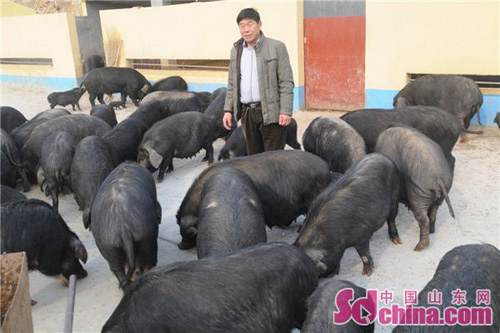
On September 25 this year, Zhang Chenggao's Tibetan fragrant pigs won the gold award at the 4th Zibo Agricultural Entrepreneurship Competition.
Tibetan fragrant pigs are quite wild by nature and require long-term free-range raising, so Zhang Chenggao contracted 4,000 mu of mountain land to raise them free-range.
September 25 this year was a happy day for Zhang Chenggao of Jiejiayu Village, Xihe Town, Zichuan District, as his Tibetan fragrant pigs won the gold award at the 4th Zibo Agricultural Entrepreneurship Competition. Although many are raised in places such as Zhoucun and Huantai, industry insiders know that Zhang Chenggao was the first and only person in Zibo to introduce Tibetan fragrant pigs.
After many twists and turns, Tibetan fragrant pigs successfully settled here
Walking all the way along the 20-li-long mountain gully, I ran into Zhang Chenggao just as I reached the mouth of the gully. After some pleasantries, Zhang Chenggao warmly invited the reporter into his small courtyard. In the room covered with honors, the gleaming gold medal was especially eye-catching. At the mention of Tibetan fragrant pigs, this taciturn rural man immediately opened up: he had learned about Tibetan fragrant pigs by chance, and after carefully considering the village's geographical advantages such as many mountains, high altitude, and good grassy vegetation, and after serious thought and investigations from multiple sources, he decided to raise Tibetan fragrant pigs. He went to Tibet three times. Due to lack of experience, the 29 Tibetan fragrant piglet breeding pigs he bought the first two times all died on the way, and more than 200,000 yuan was lost. But this did not make this stubborn man, who had once been a soldier, retreat. After analyzing the reasons and consulting experts, he drove to Tibet a third time. With 32 pigs, he stopped and went along the way to "relieve stress" for the pigs, and after a month they finally arrived home safely. Due to improper feeding, inability to adapt to the local environment, and other reasons, some died 3 days after arriving home, and in the end 19 piglets survived. After careful raising by Zhang Chenggao and his family, the sows began to give birth after more than a year. Tibetan fragrant pigs have strong reproductive capacity. One sow produces 2 litters a year, generally seven to eight per litter, with a survival rate of over 95%. At present, his scale has reached more than 2,000 head.
Tibetan fragrant pigs are quite wild by nature and require long-term free-range raising, so Zhang Chenggao contracted 4,000 mu of mountain land to raise them free-range. Arriving at the foot of Yueyang Mountain, one can see groups of Tibetan fragrant pigs all over the slopes, strong in build, with thin hooves and hard bones, pointed snouts and long heads... they look similar to domestic pigs but are different from them, grazing and foraging for food. "Tibetan fragrant pigs live by eating grass. On this mountain there are more than 100 kinds of Chinese medicinal herbs such as dandelion and bupleurum. Dr. Wang Fengshan from Shandong Medical University, who studies Chinese medicinal herbs, even came specially to investigate. After eating these grasses rich in Chinese medicinal herbs, Tibetan fragrant pigs never get sick," Zhang Chenggao said in introduction.
Bringing prosperity to the masses and building a regional brand
Because they are raised free-range and grow up eating grass, Tibetan fragrant pigs have low fat content, delicious meat, and rich nutrition. They are highly favored by customers and often in short supply. There are two reasons: first, they are slow to reach market weight; second, the meat quality is good. "Other pigs reach market weight in 4 months, but the Tibetan fragrant pigs I raise take a year and a half to reach market weight. At present, each piglet breeding pig costs 3,000 yuan, and pork is 58 yuan per jin and still in short supply. With my 2,000 pigs, more than 2 million yuan a year is no problem." Tibetan fragrant pig farming has succeeded, but as the village director of Jiejiayu Village, Zhang Chenggao felt that he could not just make money himself; he also had to lead the villagers to prosperity. Therefore, in 2011 he took the lead in establishing the Dongcheng Tibetan Fragrant Pig Breeding Cooperative, which now has more than 200 members, has developed 5 member units, and has a total of more than 8,000 Tibetan fragrant pigs. As its reputation has grown, Tibetan fragrant pigs have also attracted people from Binzhou, Liaocheng, and other places who come because of its fame. Every year at least more than 30 units come to study and learn from the experience.
Speaking of future development, Zhang Chenggao was full of confidence: "At present, we have already established a purebred Tibetan fragrant pig breeding base and are cooperating with institutions such as the Shandong Academy of Agricultural Sciences to research and build the regional specialty brand of Banyang fragrant pigs, striving to become bigger and stronger." He said that they will rely on the "cooperative + base + farmers" production model, with the base providing piglets, breeding technology, and other one-stop services to farmers, and after the Tibetan fragrant pigs reach adulthood the cooperative will buy them back, building a Tibetan fragrant pig breeding brand base integrating breeding, deep processing, and sales, and driving more people to become wealthy by raising pigs.