Deaf female university graduate from Hubei, unable to find a job, goes to the countryside to raise pigeons and build a prosperous business
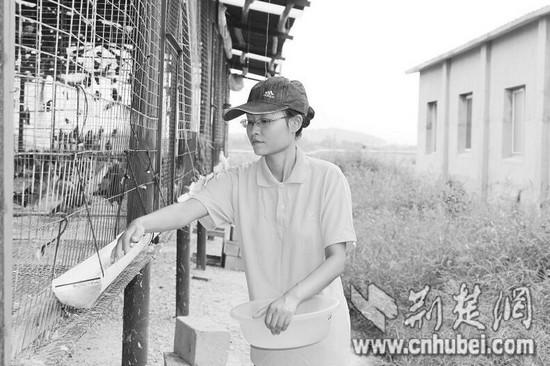
Pictured: Yan Man
Yan Man doesn't talk much and always wears a sweet smile. If not for the hearing aid hanging on her ear, it would be hard to believe that this optimistic, cheerful girl has almost zero hearing in one ear.
Golden autumn has arrived, and Yan Man has also ushered in her harvest season: although she hasn't been in business long, the squabs she raises are in short supply at major farmers' markets and restaurants in Wuhan, and she also provides breeding pigeons to nearby farmers, with annual sales exceeding 3 million yuan.
Since she couldn't find a job, she decided to work for herself --
An art academy graduate chooses to raise pigeons to get rich
In 1989, Yan Man was born into an ordinary family in Hubei. In early childhood, improper medication caused her to lose hearing in one ear. This made her life path one part harder than most people's, but it also forged her tough, never-give-up personality. "Ever since she started school, she put in twice the effort of others. While others were playing, she was reading and doing exercises, and she absolutely refused to fall behind," Yan Man's mother told reporters.
In 2013, Yan Man graduated from Xi'an Academy of Fine Arts. Although her grades were excellent, her job search did not go smoothly. "Many times, when I went to a company for an interview, as soon as they saw my hearing aid, they weren't willing to give me a chance at all." After hitting walls again and again, the stubborn Yan Man made up her mind: since she couldn't find a suitable job, she would be her own boss and work for herself.
What project should she choose? Yan Man planned to go into agriculture and spent half a year surveying the market. "I went to Henan, Hunan and several other provinces, visited local farmers' markets everywhere, and finally decided to raise pigeons."
In 2014, Yan Man, together with a partner from Wuhan Polytechnic, registered and established Wuhan Hongfei Pigeon Industry Technology Co., Ltd. in Qingshan, and built an ecological pigeon-raising base covering more than 100 mu in Luohan Street, Huangpi District.
She can paint a wonderful picture even without a paintbrush --
Plans to build a large-scale pigeon-raising base in Hubei
The hand that once held a paintbrush is now used to raise pigeons. With such a huge leap, Yan Man admits frankly that "I ran into quite a few hurdles along the way."
Because she didn't have enough start-up capital, at first she only bought 1,000 pairs of White King pigeons and Silver King pigeons. "When I went to other places to research the market, I also once went 'undercover' at local farms to secretly learn pigeon-raising techniques. I originally thought raising pigeons wasn't hard, but who knew that after the base was built, despite feeding them with every care, the pigeons kept dying, and more than 400 died in 2 months."
Watching the pigeons decrease every day, Yan Man was very anxious. Should she give up or keep going? In the end, unwilling to admit defeat, she chose to "lose only after understanding exactly why," and was determined to find out where the problem lay.
During that period, Yan Man ate and slept at the pigeon-raising base, slept only a few hours a day, and spent most of her time observing the pigeons' condition. In the end, she discovered that the pigeons were dying because disease prevention techniques were not up to standard. While consulting experts, she also bought large numbers of farming books to teach herself pigeon-raising techniques. In the end, Yan Man, who had switched fields midway, became an expert in meat pigeon breeding.
Yan Man, who loves to use her brain, also dares to innovate. The automated mechanical breeding system she independently developed not only improved breeding efficiency but also reduced labor costs. "With traditional manual breeding, 1 worker can feed at most 14 pairs of pigeons, while with mechanical feeding, one machine can feed 54 pairs of pigeons at the same time. This means 1 machine can replace 4 workers."
At present, Hongfei Pigeon Industry has a year-round inventory of more than 8,000 pairs, and plans to reach an inventory of more than 30,000-50,000 pairs in the next two to three years, filling the gap of Hubei's lack of a large-scale pigeon-raising base.