Xichong, Sichuan Revives Abandoned Land, Boosting Farm Efficiency and Income
Dongdai Township, located to the southwest of Xichong County and 20 km from the county seat, is remote and poor in resources. In recent years, the township has blazed a path of distinctive development by reviving abandoned land, developing family farms, establishing specialized cooperatives, and engaging in specialty farming and breeding.
Running a Family Farm, Growing Green Vegetables
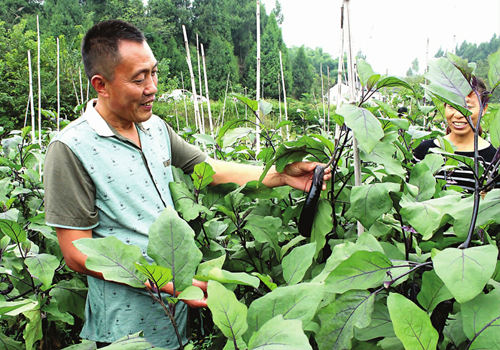
Early on the morning of October 8, Wang Deyang and his wife came to the vegetable plot to pick fresh tomatoes, eggplants and other vegetables (as shown in the photo) before the dew dried. The day before, a buyer from Nanchong had contacted him to come buy a truckload of vegetables. At 8 a.m., the buyer drove his truck right up beside Wang Deyang's plot. Wang Deyang weighed the basketed vegetables in the buyer's presence, then loaded them onto the truck basket by basket. At 8:30, according to the pre-agreed purchase price, the buyer handed the money to Wang Deyang.
Wang Deyang is from Bajiaoting Village in Dongdai Township. He has been growing vegetables for 8 years, but at first he only did it on a small scale and made no money. In 2013, township officials came to the village to mobilize villagers to transfer abandoned land, and Wang Deyang transferred more than 10 mu. In 2014, Wang Deyang expanded his planting scale and transferred more than 140 mu of abandoned land, and with the help of township officials, he established the "Beiyuanchun" Family Farm.
"At the time, the abandoned land was overgrown with weeds, and it was heartbreaking to look at," Wang Deyang said. He and his wife cleared the land and planted vegetables hoe by hoe. Through the couple's hard work, rows of lush green vegetables replaced the weeds, and their wallets gradually grew fuller. "This year's net income is expected to reach 300,000 yuan," Wang Deyang said. Developing the family farm has received strong support from the Dongdai Township Party Committee and government. Township officials actively coordinated with relevant departments to provide support in planting techniques, farming equipment, sales channels and other aspects. Today, the "Beiyuanchun" Family Farm employs more than 10 villagers year-round, each earning more than 10,000 yuan a year.
"The vegetables are all grown with farmyard manure, so there's no problem selling them," Wang Deyang said. "I sell at most 3 baskets of vegetables to each vendor, because there are too many vendors who want to buy my vegetables."
Establishing a Cooperative, Raising Trustworthy Fragrant Pigs
Besides growing vegetables, Wang Deyang's family also raises 5 native black fragrant pigs, feeding them vegetables that don't look good enough to sell. "They're mainly fed vegetables and corn, with no additives at all," Wang Deyang said. In Dongdai Township, farmers who raise native black fragrant pigs all adhere to one most basic principle - feeding them purely on grain, without mixing in any additives.
According to reports, last year, Dongdai Township officials visited Bajiaoting Village several times to investigate and discuss with villagers how to develop specialty farming and breeding. In the end, it was decided to pilot the raising of tender, flavorful native black fragrant pigs in the village.
"Native black fragrant pigs don't win by weight, and the breeding period is relatively long, requiring 8 months, so at first many villagers were unwilling to raise them," said Pang Chengjie, director of the Bajiaoting Village Committee. After seeing the first batch of native black fragrant pigs from the village sell for a good price, many villagers joined in. "Live pigs sell for about 30 yuan per kg, and pork for about 50 yuan per kg. Because the meat is good and not greasy, it is very popular."
Pang Chengjie said that 83 households in the village raise native black fragrant pigs. "Before the pigs have even grown up, the village has already received more than 40 orders, so there's no problem selling them."
In April this year, Bajiaoting Village established the Dongdai Taibao Native Black Fragrant Pig Specialized Cooperative, with 5 dedicated teams under it for finance, technology, epidemic prevention, sales and supervision, providing members with services such as live pig purchasing, sales and breeding technique consulting.
"To ensure the quality of the native black fragrant pigs and build a brand, we conduct inspections at irregular intervals once a month to see whether any member is feeding additives to the pigs," Pang Chengjie said. Once anyone is found to have added additives to pig feed, their membership is immediately revoked, "and the 380 yuan subsidy the cooperative gave for each piglet will also be recovered."
Today, more and more farming households want to join the specialized cooperative. Dongdai Township plans to build several villages around Bajiaoting Village into a contiguous native black fragrant pig breeding base. "We also plan to install a monitoring system so that the actual feeding of the native black fragrant pigs can be viewed in real time, letting consumers eat pork they can trust," said Luo Yunbiao, secretary of the township Party Committee.
Reviving Abandoned Land to Achieve Win-Win Results
At present, Dongdai Township has 16 registered family farms, 5 specialized cooperatives and 5 large pig breeding households, with more than 2,000 mu of abandoned land transferred, and 80% of the abandoned land revived. Today, the township has formed advantageous industries mainly based on sericulture, live pigs, rex rabbits and vegetables.
To serve family farms and specialized cooperatives well and ensure villagers escape poverty and become prosperous, the township has established an industrial development leading group headed by the township Party Committee secretary, listing achievements in developing family farms and resolving land abandonment as part of the annual target assessment for township and village officials. It actively guides farmers who are "capable and have capital" to establish family farms, transfer land to develop specialty farming and breeding, promote appropriately scaled land management, and boost agricultural efficiency and farmers' incomes.
Luo Yunbiao told reporters that Dongdai Township will continue to implement the "family farm + specialized cooperative" model, do a good job in cultivating industries, and plans to add 5 family farms and plant 500 mu of potatoes. At the same time, it will vigorously develop the Dongdai native eggs and native black fragrant pig industries, so that every inch of land delivers benefits. In addition, it will establish specialized cooperatives on a village-by-village basis, guide farmers to take land as shares, and set up a profit-sharing mechanism, both reviving abandoned land and enabling the public and business owners to achieve win-win cooperation.