Jiaxing Taiju (unopened chrysanthemum buds) introduced to Qingdao, farmers earn over 10,000 yuan per mu and are overjoyed
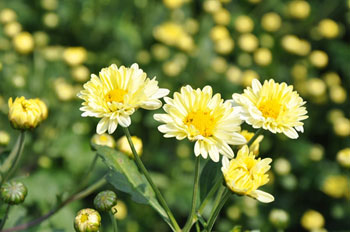
Taiju, also known as sweet chrysanthemum, also called Xiaotaihuang or small white chrysanthemum, was once used as a tribute in ancient times. It is the finest grade of Hangbaiju (Hangzhou white chrysanthemum), and the unopened flower buds are called Taiju. In May this year, 38-year-old Zhu Hong'en, a villager from Yanghe Town, successfully introduced Hangbaiju from Tongxiang, Zhejiang. After 5 months of careful management, it has now entered full bloom, with an estimated benefit of at least 10,000 yuan per mu. At present, Zhu Hong'en, having won the first battle, also has new plans. Next year he intends to expand the planting to 100 mu and lead the villagers to become prosperous together with him.
Joy: 50,000 Taiju plants usher in the picking period
The reporter came to the plantation in Jiangge Village, Yanghe Town, and saw that patches of Taiju had entered full bloom. A delicate fragrance could be smelled from afar. Twenty or thirty villagers lined up in a row in the Taiju field, busy picking chrysanthemum buds. The reporter noticed that each Taiju plant had two or three hundred buds about to open, with a diameter of around 1 cm, while some blooming Taiju were golden in color with plump petals.
"I discovered this business opportunity by chance, and I never expected the planting would succeed," said Zhu Hong'en, the person in charge of the plantation, cheerfully. In April this year, when he and friends were traveling in Jiaxing, Zhejiang, they saw many local villagers busy planting a kind of chrysanthemum. After asking carefully, it turned out that this chrysanthemum was called Taiju. It could not only be made into tea, but also used as medicine. It is the finest grade of Hangbaiju, and the planting benefit is especially high. Because he had just transferred more than 200 mu of land from villagers and was worrying about not having a good planting project, he came up with the idea of planting Taiju. After returning to his hometown, he invited experts from the local agricultural department to test the soil and found that the local soil was very similar to that of the place of origin. He immediately ordered 50,000 chrysanthemum seedlings. Although there was some "acclimatization" later, he replanted in time, and with proper later management, the Taiju he planted grew gratifyingly and finally ushered in the picking period.
Benefit: At least over 10,000 yuan per mu
"The field management of Taiju is rather cumbersome, but after deep processing, the benefit per mu exceeds 10,000 yuan," Zhu Hong'en said. Taiju likes cool or warm climates and cannot tolerate hot and humid weather. The cultivation site needs sufficient sunlight and good ventilation, and the cultivation soil needs good drainage. The soil can be piled high into beds before planting. Taiju is transplanted around "May Day", and because of the climate difference between the north and the south, it is more than ten days later than in the south. When planting Taiju, it is necessary to ensure sufficient water while also ensuring good field drainage to prevent root rot from prolonged waterlogging. In order to make Taiju bloom more, after two months of planting, it is necessary to timely pinch off the tops and encourage branching. Taiju has very high fertilizer requirements. In addition to applying sufficient base fertilizer, timely topdressing is also needed during the growing period.
Zhu Hong'en said that Taiju is the finest grade of Hangbaiju. Taiju is picked when the Hangbaiju flowers are not fully open, and then dried and processed into chrysanthemum tea. The premium grade uses the tender buds of the first flower buds just opening, carefully steamed and roasted. It has a unique taste and is quite precious because of its rarity. In addition, chrysanthemum buds even smaller than Taiju and completely unopened, after processing, are called Jumi. This year, the Taiju he planted can produce 120150 kg of dried product per mu, with a selling price of about 80 yuan per jin. Some Taiju with smaller buds are not wasted either and can be sold as medicinal material, with a benefit of at least over 10,000 yuan per mu.
Plan: Expand to 100 mu and lead villagers to prosperity
"I plan to expand the planting scale, expand to more than 100 mu next year, and lead the villagers to prosperity together." Talking about future development ideas, Zhu Hong'en told the reporter confidently that Jianggezhuang Village is adjacent to the Aishan scenic area, with beautiful scenery and fertile land, and is very suitable for Taiju planting. With this year's successful planting experience, he plans to establish a Taiju planting professional cooperative and expand the planting area to 100 mu. For villagers who want to join the planting, he is willing to provide chrysanthemum seedlings and technology free of charge, driving nearby villagers to become prosperous together.
Plant experts say that Taiju is slightly cold in nature; its taste is pungent, sweet, and bitter. It can disperse wind-heat, calm the liver and improve eyesight, and clear heat and detoxify. Chrysanthemum tea brewed with Taiju has a pure taste, is rich and strong, golden in color, contains the delicate fragrance of nectar, and will not scatter even after being brewed for a long time. Since ancient times, China has had the habit of enjoying chrysanthemums and eating chrysanthemums. There are many ways to eat chrysanthemums: they can be eaten fresh, dried, raw, or cooked, and are suitable for braising, steaming, boiling, stir-frying, roasting, or mixing. In addition, Taiju can also be wholesaled to flower shops, and the market benefit is not low either.