There's an art to raising pigs: let them live in air-conditioned rooms, drink clean water, and eat coarse grains
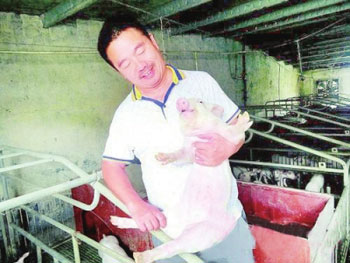
In the photo, Jiang Jiao is holding a healthy piglet, looking very pleased.
Jiang Jiao, a pig farmer in Lingxia Village, Yangcun Town, Boluo County, Guangdong Province, has dealt with pigs since childhood, and he has summed up his experience in raising pigs well: put the pigs first. Jiang Jiao says his pigs enjoy excellent welfare: they live in air-conditioned rooms, drink clean water, eat the five grains and coarse cereals, and breathe the fresh air of the mountains. He believes this is the only way to raise healthy pigs.
Excrement is isolated from the pig pens, and no odor can be detected on the pig farm
Jiang Jiao's pig farm is tucked in a mountain hollow in the village. The site is not large, with only a few rows of buildings. Walking into the pig farm, one basically cannot smell any odor, and each row of buildings is equipped with water-cooling equipment and huge blower equipment. "My pigs live in a 'little Western-style building' and enjoy a constant temperature all year round," Jiang Jiao says cheerfully.
Only after careful disinfection did Jiang Jiao open a small room. Unlike common pig pens, the floor of this pen is made of grating panels. He explains that the pigs actually live on the second floor, and the excrement falls through the grating panels into the water below. The odor of the excrement is separated by the water and does not easily escape, and what remains is blown away by the blowers. That is why the pig pen has no odor.
Since the pig excrement all falls to the lower level, the pig pen is very clean and dry, so there is no need to wash the pen every day, and the labor intensity is reduced considerably. A clean pen also greatly lowers the chance of pigs being infected by pathogens. "If the pig pen is not flushed with water, the pigs will be healthier." Jiang Jiao learned these theories during a special trip to Germany. Whenever a batch of pigs is raised to market weight, he thoroughly cleans and disinfects the pen and waits for the next batch of pigs to arrive.
Grew up on a pig farm since childhood, lost money on his first attempt at pig farming
Jiang Jiao is from Hubei. In the 1970s, his father raised pigs on a state-owned farm in Hubei. As a result, he also grew up on a pig farm and has deep feelings for pigs. Jiang Jiao says that at the time his father alone raised more than 200 pigs, sold exclusively to Hong Kong, China, with very high feeding standards. He stayed on the pig farm all day and helped his father raise pigs after school, so he understood the whole process of pig farming very well.
In 1997, Jiang Jiao followed in his father's footsteps and chose to raise pigs in Huizhou. He felt that Huizhou's climate was relatively good, not as cold in winter as his hometown, so no special insulation measures were needed and the pigs could get through the winter well.
Jiang Jiao's pig farming did not go smoothly. In 2004, the pigs he raised caught "blue ear disease," and most of them died. That outbreak meant Jiang Jiao did not sell a single pig for a whole year, and he did not even know how much money he had lost. Unwilling to give up, in 2009 he came to Lingxia Village and rented 1000 mu of mountain land to continue his pig farming business.
Jiang Jiao's idea of raising pigs well came from something that happened to his classmate. Jiang Jiao's classmate worked away from home, and one year a "problem pork" incident occurred locally. An investigation found that it was caused by too many additives being put into pig feed. The classmate told Jiang Jiao that he wanted to eat trustworthy meat and hoped he could raise some "safe pigs" without added hormones or antibiotics. From this, Jiang Jiao developed the idea of raising pigs well.
Build an excrement recycling system, use biogas slurry and biogas residue as fertilizer
In 2014, Jiang Jiao visited Germany to study and learn how Germans raise pigs. After returning, he followed the German pig farming model and built two-story pig pens and an enclosed pig farm in the mountain hollow. "The cost of building this kind of pig pen is relatively high, reaching 1000 yuan per sq m. An ordinary pig pen costs only a bit more than 300 yuan per sq m," Jiang Jiao says.
Using the techniques learned from Germany, plus his own traditional experience, Jiang Jiao built a recycling system for pig excrement.
In the lower level of the pig pen, the "soaked manure" is fermented for a certain period and then discharged into a biogas digester. The biogas produced can be used for cooking, the biogas slurry can be used to water vegetables, and the biogas residue can also be used as fertilizer. Every year, he pumps the biogas slurry and residue up the mountain to use as fertilizer. "The mountains here are rather barren, and even when the biogas slurry and residue are pumped up the mountain there is not enough to go around; it is all 'digested' on our own land," Jiang Jiao says. With fertilizer, the trees and woods grow lush and green, and the air in the mountains becomes even fresher, which is also a good thing for the pigs.
Selling pork online, with customers as far away as Guangzhou and Shanghai
Besides the high cost of building the pig farm, Jiang Jiao also has very high requirements for pig feed. "The five grains and coarse cereals the pigs eat must meet the standard of what people can eat," Jiang Jiao says. To keep the feed from being contaminated, after the feed is crushed, it is automatically delivered into the pig pens on schedule and no longer passes through human hands. Finding good feed is also what gives Jiang Jiao the biggest headache. He hopes the pigs he raises can eat safe feed. "With good feed, the pigs are in good health and their disease resistance is strong." To take good care of the pigs, Jiang Jiao specially hired a veterinarian. "Do not treat an illness that has already occurred; treat one before it occurs." Jiang Jiao believes that once a problem appears in a pig, it should be brought under control immediately and not allowed to develop, so the pigs will not need antibiotics.
Because of the relatively high requirements for facilities and feed, last year's low prices made him lose a lot of money. "Each pig lost about 500 yuan, more than others lost." Although he made less money, Jiang Jiao insists on going his own way. In addition to conventional sales channels, he also works with friends to sell pork on the internet, delivering the pork to customers' homes within 24 hours. Today, he has customers in both Guangzhou and Shanghai.