Niu Zimian Pioneers the Second Revolution in Apple Production
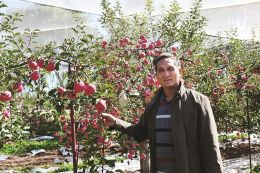
From the countryside to an agricultural university and then to a post in agricultural research, Niu Zimian knows well what agriculture lacks most, what farmers hope for most, and what rural areas need most; as an agricultural researcher, Niu Zimian also knows well the heavy responsibility and sacred mission he bears. For 33 years without wavering, he has never slackened his pace in pursuing scientific innovation, constantly refining and perfecting the fruit tree technology system, striving to present it with the utmost excellence to fruit growers and to the research cause he loves.
A Revolutionary New Technology
In the winter of 1999, researcher Niu Zimian carried out high-light-efficiency tree form restructuring on the more than three-mu orchard of Wang Bin, a farmer in Sanguan Village, Sanguan Town, Linyi County. Amid the skeptical attitude of the local agricultural extension department, which thought it worth a try, the conservative wait-and-see stance of the farmers, and even the quarrels of Wang Bin's uncomprehending wife, the high-light-efficiency tree form restructuring of apple trees began, thus igniting the spark of high-light-efficiency apple tree form restructuring in our province and opening the prelude to the second revolution in apple production in our country.
The high-light-efficiency apple tree form refers to a tree form in which the tree body makes good use of light energy, has high photosynthetic efficiency, and produces fruit of good quality.
At present, the apple area in our province has grown to more than 5 million mu, accounting for 16% of the country's total apple cultivation area, making it truly a major apple-producing province. Apple orchards in our province are mostly located in hilly dry and semi-dry orchards, mainly using the standard vigorous rootstock close-planting cultivation model. After entering the full fruiting period, as the tree body grows larger, production problems commonly arise such as disordered tree form and closed canopy, decreased photosynthetic efficiency, poor fruit quality, and a shortened economic life of the fruit trees, affecting the healthy development of the specialty fruit industry.
In 1993, in response to the prominent problem of closed tree bodies in large-area vigorous orchards in our country, led by the State Administration of Foreign Experts Affairs and the Ministry of Science and Technology, our country began introducing Japan's open-center tree form management technology and established the first apple open-center tree form experimental orchard in Changping, Beijing - the China-Japan Friendship Demonstration Orchard. As the expert stationed by the Chinese cooperating unit, researcher Niu Zimian, together with Chinese and Japanese experts, systematically conducted experiments on structural simplification and rapid formation of the apple open-center tree form in this demonstration orchard, introduced the essence of Japan's apple open-center tree form - the horizontal leaf canopy training technique - into our country, and formed research results on the small-canopy open-center apple tree form.
In 1999, in view of the prominent problem of closed orchards in Shanxi Province, the Shanxi Academy of Agricultural Sciences established a collaborative group for the new apple tree form project, with researcher Niu Zimian, then deputy director of the Pomology Research Institute, serving as project leader, and began implementing systematic research on high-light-efficiency tree form restructuring for apples in the Loess Plateau region of our province. The project received support from the Ministry of Science and Technology's local major project and the Shanxi Provincial Department of Science and Technology's key agricultural research project, and was coordinated by the Yuncheng Municipal Science and Technology Bureau with local science and technology departments, implementing a strategy of cross-regional and cross-departmental coordinated technical research and technical extension. Trials and demonstrations of high-light-efficiency apple tree forms were carried out in the province's key apple-producing areas of Linyi County, Wanrong County, Pinglu County, Ruicheng County, and Yanhu District of Yuncheng City, with 16 high-light-efficiency apple tree form trial demonstration orchards established in the first batch across the 5 counties and districts.
Through the first batch of tree form restructuring trials, Wang Bin's orchard achieved immediate results. The following year, the orchard's average income per mu rose from about 3,500 yuan to over 10,000 yuan. In 2003, after organizing experts for appraisal, the Provincial Department of Science and Technology concluded that this scientific research achievement had reached the international advanced level, and the experts involved commented, "This is the second revolution in apple production in our country."
Benefiting a Million Fruit Growers Across the Land of Shanxi
After the high-light-efficiency apple tree form restructuring technology succeeded in trials, word spread among fruit growers, and growers came in an endless stream to visit and learn from the experience. Many fruit growers from surrounding counties and districts also came to see for themselves. In the demonstration orchard in Sanguan Town, Linyi County, in the earliest years more than 10,000 fruit growers visited each year, and the Linyi County government held on-site observation meetings on tree form restructuring in Sanguan Town many times. In order to promote the high-light-efficiency apple tree form restructuring technology with the greatest effort across the province and bring more fruit growers tangible benefits, over more than 20 years researcher Niu Zimian led the project team deep into all parts of the province to extend the technology, teaching farmers tree form restructuring techniques hand by hand, leaving behind on the land of Shanxi a fine story of the Provincial Academy of Agricultural Sciences serving agriculture, rural areas, and farmers.
"Dr. Niu, your tree form restructuring brought a second youth to my father's orchard, and also brought a second youth to my father. As his children, we hope he will live a long and healthy life and enjoy his later years in peace, but he treats the orchard as his lifeblood and treats fruit tree management as a lifelong cause he will never give up. It is your technology that strengthened his confidence and drive in fruit tree management and gave him experience to harvest. Even if his children brought him to the city to live, that effect could not compare..." This is a letter to researcher Niu Zimian from Wei Jinsheng, son of Wei Zengcai of Xiwei Village, Peizhuang Township, Wanrong County. Old man Wei Zengcai is now over 70 years old, a veteran Party member with more than 40 years of Party membership, and also a fruit tree enthusiast. In 2004, when the Provincial Academy of Agricultural Sciences came to Wanrong County to carry out high-light-efficiency apple tree form trials, he took the lead in handing over his family's 5 mu of mature orchard for the trial despite pressure from family opposition and villagers' mockery. In order to learn and master the high-light-efficiency orchard restructuring technology as quickly as possible, he became friends with the technicians of the Provincial Academy of Agricultural Sciences, set up dormitories for them at home, ate, lived, and worked together with them, climbed more than 5-meter-high trees in the cold of winter and spring each year to shape and prune, and braved the heat in summer to bend branches, thin fruit, and bag fruit in the orchard, strictly implementing every technique. After several years, not only had the orchard's tree forms become neat and beautiful, but the fruit had grown larger, and the fruit's coloring and taste had both improved markedly. The fruit sold for an average of about 6 yuan per kilogram, and the output value per mu approached 20,000 yuan, more than double the output value of surrounding orchards that had not undergone tree form restructuring. The old man was thus full of energy and praised researcher Niu Zimian's superb technology to everyone he met. Under his demonstration and leadership, more than 100 farming households and more than 600 mu of orchards in Xiwei Village have now joined the ranks of tree form restructuring.
In order to allow the technology to take root, blossom, and bear fruit as quickly as possible, researcher Niu Zimian also focused his training on local experts, large fruit industry households, specialized cooperatives, and other "second transmitters" who could play a leading and demonstrative role.
The Wu Zhongding Apple Planting Specialized Cooperative in Linyi County was established in 2009 to support high-light-efficiency apple tree form restructuring. The cooperative currently has an orchard area of 6,100 mu. Its head, Wu Zhongding, is just such a "second transmitter" local expert. Wu Zhongding's apple orchard has old trees and high yield and is one of the best orchards in Linyi County, but as the trees aged, in recent years it suffered greatly from orchard closure. For this reason, he traveled abroad to study and visited orchards inside and outside the province, and found that researcher Niu Zimian's medium-high trunk open-center tree form restructuring technology was most suitable for his orchard, so he resolutely took the lead in implementing high-light-efficiency apple tree form restructuring technology. In the early stage of the project, he cooperated with the Provincial Academy of Agricultural Sciences in conducting trials and demonstrations, enduring the heartache of sawing off one closed large branch after another and digging out one overly dense large tree after another, always worried it would affect the orchard's harvest. By that autumn, not only had the orchard's yield not decreased, but the fruit had grown larger and the fruit surface had better coloring. The improvement in fruit quality far exceeded his expectations, and the orchard's output value per mu increased from 5,300 yuan before restructuring to 10,000 yuan. From then on he threw himself into high-light-efficiency apple tree form restructuring with full confidence, and the orchard's benefits rose year after year, reaching a record 30,000 yuan per mu in 2014. Under his demonstration and leadership, all 6,100 mu of the cooperative's orchards underwent high-light-efficiency tree form restructuring. In 2014, the average yield per mu reached 2,610 kg, the fruit sold for more than 8 yuan per kilogram, the output value per mu exceeded 20,000 yuan, and the fruit was exported to countries such as Australia and the United Kingdom.
In researcher Niu Zimian's memory, such examples are too numerous to count, and they have moved him deeply: in Xiachen Village, Qucun Town, Quwo County, fruit grower Han Bin has kept a photo taken for him several years ago; in Xiwei Village, Peizhuang Township, Wanrong County, a training class expected to have more than 500 people drew more than 2,800; at training in Xi County, the motorcycles of fruit growers coming to listen lined up for more than a kilometer; Xiaofan Township in Taiyuan City invited him through a people's congress proposal to plan and restructure orchards in the village... Over 15 years, researcher Niu Zimian's footprints have covered 7 cities and 33 counties and districts in our province, with cumulative training of more than 3,000 technical second transmitters and more than 100,000 fruit growers. At present, the technology has been extended across more than 1 million mu in our province, increasing orchard income by more than 1.5 billion yuan each year, making a major contribution to rural economic development and farmers' prosperity in our province.