Alfalfa Farming Helps a Freshman Balance Entrepreneurship and Studies
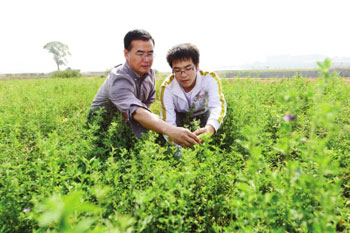
Zhang Zhenhua (right) receives guidance from Professor Zhao Jian in the alfalfa experimental field at Huazhong Agricultural University.
Just after the National Day holiday, the purple alfalfa planted by Zhang Zhenhua welcomed its last harvest of the year, which was sent directly to a dairy farm. "The yield is not bad, and I have now figured out the tricks of growing alfalfa," Zhang Zhenhua said. "I was born on the grasslands and grew up on the grasslands. The vast grasslands have nourished my entrepreneurial dream, and I just want to do something practical on the grasslands."
Zhang Zhenhua is a current student in the "Zhang Zhidong Class" of the College of Plant Science and Technology at Huazhong Agricultural University. After the college entrance examination last year, he became connected with alfalfa and could not stop, beginning his dream of starting a business by growing grass. Over the past two years, he and his family team have planted more than 3,000 mu of purple alfalfa in Saihan District of Hohhot City and Liangcheng County of Ulanqab City in Inner Mongolia. From the more than 1,000 mu planted in May 2014 alone, they earned more than 1 million yuan.
Forage grass is the source of the livestock industry. Purple alfalfa is rich in nutrients and has the title of "king of forage grass." It can effectively increase dairy cow milk production and improve milk quality, and it also has the characteristics of strong regrowth and, as a legume forage, nitrogen fixation by rhizobia that conserves soil and water and improves farmland.
From July 13 to 15, Fu Tingdong, academician of the Chinese Academy of Engineering and professor at Huazhong Agricultural University, Cao Cougui, national-level teaching master, dean and professor of the College of Plant Science and Technology at Huazhong Agricultural University, and other experts, along with teachers from the university's publicity department and youth league committee, made a special trip to Hohhot to inspect Zhang Zhenhua's entrepreneurial project and held discussions with relevant departments including the Inner Mongolia Agriculture and Animal Husbandry Department and Inner Mongolia Agricultural University. The experts unanimously agreed that developing purple alfalfa has great potential, that young people in Inner Mongolia have drive in entrepreneurship, and that Huazhong Agricultural University will continue to leverage its advantages in talent, scientific research and services to guide Zhang Zhenhua's entrepreneurial project.
Appearing on an Entrepreneurship Program and Obtaining 1 Million Yuan in Financing
After entering university, Zhang Zhenhua originally wanted to temporarily set aside his alfalfa dream, focus on studying and do scientific research well, but unexpectedly the university's entrepreneurship publicity and preferential policies once again stirred his entrepreneurial enthusiasm.
"Youth entrepreneurship is the mainstay of the entrepreneurial community, and realizing the entrepreneurial dreams of young students is an important part of entrepreneurship education for college students," said Tang Jun, deputy secretary of the Party Committee of Huazhong Agricultural University. He introduced that the university invests 5 million yuan each year to support student innovation and entrepreneurship, and this year built a 11,000-square-meter student entrepreneurship building. A group of outstanding student entrepreneurial teams such as "Qinqin Orchard" has already emerged.
Going with the trend, Zhang Zhenhua integrated various resources and established Inner Mongolia Huameng Agriculture and Animal Husbandry Development Co., Ltd. at the beginning of this year. With concern for grassland environmental protection and a grasp of the purple alfalfa market, he began the process of studying at school while starting a business growing grass.
March 12 was a date Zhang Zhenhua remembers clearly. CCTV's "Entrepreneurship Heroes" sent him an invitation, asking him to go to Beijing two days later to present his entrepreneurial project.
After making inquiries, he learned that the program team receives many project applications each episode, only more than 200 can get an interview opportunity, and of those only 15 can stay to record the program. Was it really worth going to Beijing? How could he balance entrepreneurship and studies? This made Zhang Zhenhua think about backing out.
Encouragement from Wei Youbo, deputy secretary of the Party Committee of the College of Plant Science and Technology at Huazhong Agricultural University, strengthened Zhang Zhenhua's confidence to give it a try. The college also specially sent Professor Zhao Jian, an expert in legume crops, and counselor Chen Zhiqiang as Zhang Zhenhua's technical consultant and guiding teacher, and together they set off on the journey to Beijing in pursuit of his dream.
"During the interview with the program team in Beijing, I was very nervous. With pressure Q&A and project roadshows, for a whole week in a row I could only sleep four or five hours a day, and finally the project passed!" Zhang Zhenhua recalled. "At the recording site, many CCTV staff members and investors were very interested in the alfalfa project he brought, which has both high economic value and the environmental protection function of preventing wind and fixing sand." Investor Deng Feng favored Zhang Zhenhua greatly and compared him to an eagle on the grasslands. "This young man is smart and courageous, and especially likable."
"From environmental protection and ecological agriculture to a college student returning to the village to start a business and use what he has learned to drive agricultural income growth and help farmers become rich, Zhang Zhenhua talked eloquently on stage, dared to think and act, and moved investors with his persistence." Teacher Chen Zhiqiang told reporters that in the end, Zhang Zhenhua obtained 1 million yuan in financing and on site signed a letter of intent on behalf of his team with the investor.
Only with a Dream Can One Persist
"If agriculture is to be profitable, it must follow the path of large-scale operation. The same is true for growing grass. It requires large-scale land transfer and the purchase of mechanized equipment. A single imported large harvester costs millions of yuan." Therefore, lack of funds was the biggest problem Zhang Zhenhua encountered when starting his business. But things took a turn. After careful consideration, Zhang Zhenhua not only did not take the investor's 1 million yuan in financing, but was not even tempted by the 30 million yuan the investor planned to add.
"Dealing with investors is itself a kind of growth. The project can be affirmed by investors, and now I am even more confident," Zhang Zhenhua told reporters. "The investor hoped to achieve complete control of the company. After discussing with my team, we decided we still want to run our own enterprise."
After appearing on the entrepreneurship TV program, quite a few venture capital firms also took the initiative to contact him. After getting in touch with some investors, Zhang Zhenhua believed that agriculture is not a project for making quick money. Starting a business in his hometown, profit is not the only goal; environmental protection and driving local farmers to become rich are equally important. He now often follows the websites of national ministries and commissions such as the Communist Youth League Central Committee, the Ministry of Agriculture and the Ministry of Science and Technology, and learned that among the special funds for fiscal support for agriculture there is a project for demonstrating high-yield and high-quality alfalfa construction. This summer vacation, he successively went to Shanxi, Tianjin and other places to participate in social practice investigations organized by these departments.
Zhang Zhenhua, whose college entrance examination score exceeded the first-tier line by 58 points, originally had more choices when filling out his application. He was the only one in several generations of his family to be admitted to a "key university," and his family had high expectations for him. "To be honest, at first my family was opposed to me choosing an agricultural university, and my mother cried several times," Zhang Zhenhua said. He had herded cattle in the countryside since childhood and deeply understood the hardships of farming. As he grew older and read more, Zhang Zhenhua also began to think: on one hand, overgrazing has severely damaged the grasslands; on the other hand, safe and healthy milk needs to be guaranteed by high-quality forage grass. The stories of entrepreneurs such as Liu Yonghao and Wang Wenbiao were subjects of his study and admiration. "Doing agriculture and environmental protection can both bring good returns. Agriculture and rural areas need young people with dreams to keep entering and changing things."
Zhang Zhenhua's father, Zhang Quanfa, struggled for more than 30 years in the construction machinery and building materials industries and began raising cattle in 2012. It was precisely from his father's purchase of forage grass for cattle raising that Zhang Zhenhua discovered the business opportunity of planting alfalfa. "Whether it makes money or not is secondary. The most important thing is that my son said he wants to use the knowledge he has learned to return to his hometown to start a business and ultimately drive his fellow villagers to become rich together," Zhang Quanfa said. From his son's words, he saw a heart like gold. If money is gone, it can be earned again, but his son's entrepreneurial confidence and passion must not be crushed.
It was also under his father's influence and support that Zhang Zhenhua actively responded to the national call for "mass entrepreneurship and innovation," opened an agriculture and animal husbandry company in his hometown, applied modern information concepts to pre-production management and post-production sales of purple alfalfa forage cultivation, participated in the transformation project of 30,000 mu of poor-quality forest in the state-owned forest farm in Saihan District, and signed up for the first China "Internet+" College Student Innovation and Entrepreneurship Competition.
Entrepreneurship and Studies Must Both Be Achieved