How can a cattle farm with a recycling model under the forest achieve effective rainwater and sewage separation?
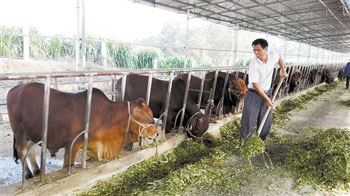
Lu Daoying, who started a new business in his forties, has poured all his energy into the cattle farm.
"In another two months, a batch of beef cattle here will be ready for market." At the three-dimensional circular agriculture demonstration project base in Jiangxi Town, Jiangnan District, Lu Daoying, head of Nanning Xingrong Animal Husbandry Co., Ltd., stood beside the cattle pen, watching more than 300 high-quality beef cattle eating forage, and told the reporter happily. Once this batch of beef cattle is sold, he will have the capital to continue improving his cattle farming business. He hopes to establish as soon as possible an integrated industrial chain from breeding and slaughtering to processing, so as to maximize the benefits of cattle farming and lead the company's employees and cooperating farmers onto the road to prosperity.
Starting a Business in His Forties to Realize a Dream
Cattle farming is not the first business venture for Lu Daoying, who is already in his forties. In the workshop where forage is prepared, Lu Daoying told the reporter about his entrepreneurial journey. In his early years, he did many kinds of work. Through years of small-scale business, Lu Daoying accumulated capital one step earlier than other people in the village, but he had always harbored a dream.
"In my early years, I went with friends to Guizhou to buy cattle and bring them back to sell, and I found that the profits from beef cattle were considerable. A few years later, fewer and fewer households in Jiangnan District raised cattle. After agricultural mechanization, everyone chose to sell their cattle, while the price of beef on the market rose year after year. I thought this was an opportunity, and I wanted to get rich by raising cattle," Lu Daoying said when talking about his original intention for starting the business.
But raising cattle is not an easy task. It has relatively high requirements for site, capital and technology. It was not until last year that Lu Daoying, with the support of the aquatic and livestock department of Jiangnan District, obtained a urban district subsidy of 1.2 million yuan and began his business.
Walking into Lu Daoying's cattle farm, in the standard cattle pen of more than 3,000 sq m, more than 300 beef cattle eat forage in an orderly manner. Company employees carefully observe the condition of each cow and clean the pen, busy all the while... Because he has invested a great deal of effort, Lu Daoying watches over the place every day.
Lu Daoying did the accounts: one high-quality beef cow can sell for up to 10,000 yuan, and 300 beef cattle sold in succession amount to 3 million yuan. After deducting site rent, management fees, feed costs and the money spent buying the cattle, the net income is relatively considerable.
Establishing a Circular Industrial Chain under the Forest
Lu Daoying does not merely raise cattle; he has established a green circular system and developed under-forest economy. Outside the cattle farm, rows of green plants taller than a person grow under the dense forest. Break off a small section and there is a lot of juice inside; lick it and it is quite sweet. This is the forage that beef cattle love most. "We implement the ecological agriculture development strategy of forage (straw) - beef cattle - biogas - earthworms - bio-organic fertilizer - green agricultural products, achieving green, low-carbon and energy-saving operation."
According to the introduction, this model uses under-forest planting of forage, uses the forage to raise cattle, and adopts dry manure cleaning for cattle dung. The cattle dung is collected in the manure house and piled for 15 days before being used to raise earthworms. The cattle farm, in accordance with the requirements of "rainwater and sewage separation," sends all produced sewage into the biogas digester. After fermentation in the biogas digester, the biogas slurry flows into the sewage collection tank, and then the biogas slurry is used to irrigate the surrounding grassland and fruit trees, turning waste into treasure. The biogas produced by the biogas digester is used for the domestic gas of the workers on the farm as well as for the gas use of the surrounding people, saving more than 200,000 yuan in expenses each year.
"Because they basically grow up eating forage, this kind of beef cattle is a truly green product, and its price on the market is also rising," Lu Daoying said.
Improving the Industrial Chain to Lead Farmers to Prosperity
Seeing that Lu Daoying's project has taken off, quite a few nearby farmers and breeders have cooperated with him. Through the business model of "demonstration base + cooperative breeding community + farmers," standardized production is promoted through the "four unifications": unified supply of superior calves, unified breeding technology, unified breeding technical procedures, unified product quality standards, and unified recovery of finished cattle. At present, the number of signed and joined beef cattle farming households has reached 15, and the number of beef cattle raised has reached more than 120.
Not only cooperating farmers, but also the surrounding people benefit. The cattle farm purchases corn stalks, sugarcane leaves, rice straw and so on from the surrounding people, which not only lowers breeding costs but also increases the income of the surrounding people and solves employment problems for quite a few people.
Relevant personnel from the aquatic and livestock department of Jiangnan District told the reporter that Lu Daoying's cattle farm has now been listed as a demonstration base for high-quality beef cattle breeding under the forest in Jiangnan District.
Lu Daoying wants to go further, and he has already begun to expand the scale. Pointing to an empty plot beside the cattle farm, he told the reporter: "This month a cattle shed for transferring pens will be built here. Soon a batch of calves will enter the farm, and they must be observed for two months before they can enter the main farm. The next step is to do breeding and reproduction, and for this technology I still need to find cooperative units. Right now the cattle are all sold through the cattle market in Nanning, and the profit is not high. In the long term, I will work harder on slaughtering and processing, so that the cattle we raise ourselves, after slaughtering and processing, can enter supermarkets and other sales venues, and the profit will be higher. The furthest thing I have thought of at present is to establish a brand, so that in the future when people mention high-quality beef cattle from Nanning, what they think of is our cattle. These are still dreams for now, and the road must be walked step by step."
In recent years, as a brand-new mode of forestry production and an emerging industry that enriches the people, the under-forest economy has been vigorously cultivated by Nanning City through leading industries and leading enterprises, promoting the operation model of "leading enterprise + specialized cooperative + base + farmers" and advancing large-scale, industrialized and standardized operation. In 2015-2016, following the principle of demonstration first and promotion later, Nanning City will take the Municipal Forestry Science Research Institute, the Municipal Dingdang Forest Farm and county-level state-owned forest farms as the main bodies for demonstration and promotion, carry out introduction and trial planting experiments for under-forest economy projects, and explore and promote demonstration models.