How a Large-Scale Whiteleg Shrimp Farmer Makes His Fortune in Suzhou, Jiangsu
Whiteleg shrimp (Litopenaeus vannamei) were introduced in 1988 and farming began in 1992, giving the species a 23-year farming history in China. From 2012 to 2015, the national farming water area stayed basically unchanged, yet yields grew lower and lower. In 2015, only 30% of farmers in the three provinces of Jiangsu, Shanghai and Zhejiang turned a profit from whiteleg shrimp farming. It is a well-known fact that factors such as environment, weather and disease have always affected our farming profits. For farmers who have already entered this industry, how can they obtain satisfactory returns and profits under such conditions?
Now follow the Tongxin Society reporter to the ponds of Jiangsu farming expert Qu Tao, and let him tell us that by changing just a little in their farming habits, farmers can earn profits through their own hard work and improve their lives!
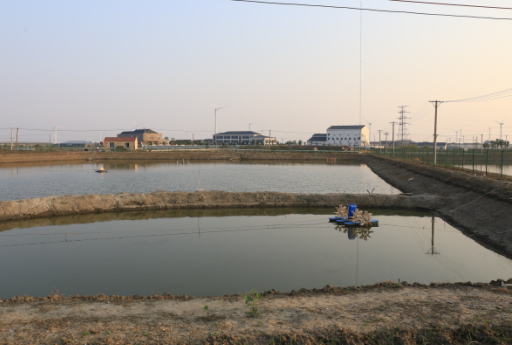
Boss Qu's shrimp ponds
Qu Tao's ponds are right beside Yangcheng Lake. The reporter recently visited his ponds together with a group of farming experts and specialists on an inspection tour. From starting farming on 30 mu in 2012 to 70 mu of ponds today, judging purely by farming time and scale, Qu Tao is undoubtedly a newcomer in the whiteleg shrimp circle, yet he has made money every year for these four years. Apart from choosing to work with Tongwei, a more important point is that Qu Tao himself is good at learning and putting things into practice, and dares to try new things.
"Back then, I was a pig feed salesman, sweating every day, with the goal of earning more money by the end of the month to fill my own pocket; later, after much careful thought, I came to Yangcheng Lake Town in Suzhou and changed from a salesman into a distributor." Recalling his farming experience, Qu Tao said that over these years of farming he has also been constantly thinking and exploring a farming model that suits him, seeking a new way forward for whiteleg shrimp farming.
So what has he done over these years?
Qu Tao explained that before stocking fry, great importance must be attached to treating the bottom soil. After the shrimp are sold and the pond is dried out, measures such as levelling the pond and ploughing are taken, which help decompose organic matter at the pond bottom, restore the bottom and provide natural sterilisation.
Most farmers believe that high density brings high yields, but high density is closely tied to pond conditions and farming management. In today's whiteleg shrimp farming, the biggest bottleneck affecting profits is the farming success rate, and a reasonable stocking density helps raise that success rate.
Checking the farming record book
Take the two ponds in front of Qu Tao's house as an example: each is 10 mu, and on April 16 this year 800,000 desalinated Haiyi fry were stocked into the 20 mu of ponds. By the time they were all sold at the end of August, the whiteleg shrimp output was 14,192 jin, with an average size of 40 head, giving a yield of 700 jin/mu. Although the yield was lower than other ponds at over 1,000 jin/mu, throughout the whole farming process it was easier to manage the ponds and regulate water quality, with lower risk.
At the same time, Qu Tao's shrimp ponds use a model of polyculturing whiteleg shrimp with freshwater prawns (Macrobrachium nipponense). Qu Tao explained that the freshwater prawns are stocked in mid-to-late August; when two-thirds of the whiteleg shrimp have been sold, the stocking density of the freshwater prawns is decided according to the whiteleg shrimp yield. This year, in the two ponds of 20 mu in front of Qu Tao's house, a total of 200 jin of freshwater prawns were stocked, all at a size of 3,000 tails/jin.
The key to successful farming also lies in good aeration of the pond. At Qu Tao's ponds, the reporter saw that 1 microporous aerator, 8 paddlewheel aerators, 2 wave-making machines and 4 impeller aerators were installed. The power configuration of the pond aeration equipment reached 1.05 KW/mu. "Under normal conditions, my microporous aerator stays on all the time; the wave-making machines and paddlewheel aerators run from 11:00 in the morning to 5:00 in the afternoon, and the impeller aerators from 6:00 in the afternoon to 8:00 the next morning," Qu Tao explained.
As for the choice of animal health products, Qu Tao said he only uses products made by manufacturers with guarantees. Under normal conditions, he regulates the water and cultivates algae and replenishes bacteria regularly on a cycle (once every 7 days). In the early stage of farming, he focuses on using Tongwei Vitality Algae Source + Golden Peptide to cultivate algae; in the middle and late stages, he focuses on replenishing bacteria, using Feed Partner 1 + lactic acid bacteria to break down leftover feed and faeces. In terms of feed feeding, besides the same feeding rate and feeding frequency as everyone else, he has long fed Astragalus and Ginseng Immune Powder + Liver and Gallbladder Health + Tongwei Multivitamins; after the Shrimp Liver Strong product was launched, he began feeding Shrimp Liver Strong.
"Before the weather changes, especially when the forecast says rain, I splash Tongwei Multivitamins + Alkali Health Powder in advance to increase water stability; after the rain, I immediately splash anti-stress products, Stress-Relief Detox Spirit or Detox Vanguard. Before the shrimp moult, at around 6:00 in the afternoon, I splash trace elements (Alkali Health Powder), mainly to supplement calcium and magnesium ions in the water. After selling the shrimp, I use Nabit Net, which is highly stable and long-acting, to disinfect, preventing the spread of harmful bacteria and helping the shrimp recover." Qu Tao said that farmers all hope their farming can make money and their investment can bring returns. By combining their own pond conditions, improving the bottom soil environment of the ponds, increasing dissolved oxygen in the ponds, and choosing animal health products with guarantees to regulate the water regularly, only a small shift in mindset is needed and profit is no longer far away.
Today, Qu Tao not only has a local reputation for farming shrimp himself, but has also motivated a large group of farmers to farm shrimp alongside him, helping everyone get rich together. In the process of exchanging farming experience with the expert group members, Qu Tao's spirit of being good at thinking, daring to innovate and brave in trying new things left a deep impression on the expert group.