Li Wenxiang: Cultivating "Yunnan Famous Rice" to Drive Income Growth for the People
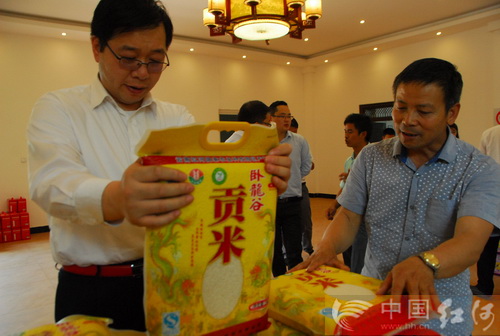
Li Wenxiang (first from right) introducing products to guests
"Our village group used to rely mainly on traditional farming for income. Whenever the weather was unkind, every household would run out of grain and have nothing to eat. The villagers would carry sacks to nearby villages to borrow food, which earned us the derogatory nickname 'Sack Village.' But now, every household grows 'Yunhui 290,' and the former 'Sack Village' has become today's enviable 'Villa Village,' a nationally renowned civilized village." Wei Xianrong, head of the Laoyanzi village group of Wolonggu Village Committee, Yangjie Township, Kaiyuan City, told reporters proudly.
At present, 95% of the farmland in the 7 village groups of Wolonggu Village Committee in Kaiyuan City is planted with high-quality rice. The whole village produces 3.5 million kg of high-quality rice annually, with total economic income of 76.28 million yuan and per capita net income of farmers exceeding 7,480 yuan.
The man who made a single "grain of rice" thrive and led everyone to prosperity through "rice" is Li Wenxiang, director of the Wolonggu Village Committee in Yangjie Township, Kaiyuan City, and general manager of Yunnan Honghe Wolong Rice Industry Co., Ltd. The company he founded, Yunnan Honghe Wolong Rice Industry Co., Ltd., has been recognized as a provincial-level leading enterprise, and its high-quality rice has been selected as one of "Yunnan's Six Famous Rice Varieties," "Yunnan Famous Brand Agricultural Products," and "Yunnan Province Famous Trademark." It has driven more than 30,000 farming households to plant 350,000 mu of high-quality rice, increasing their annual income by 160 million yuan. Li Wenxiang was once selected as a candidate for "National Top Ten Farmers" and has won titles including "Yunnan Province's Second Outstanding Rural Local Talent" and "Honghe Prefecture Model Worker." Not long ago, Li Wenxiang was awarded the province's "Xingdian Talent Award," becoming the first rural "knowledgeable person and leader" in our prefecture to receive this honor.
Recently, reporters approached Li Wenxiang to uncover the secret of his success in leading farming households to grow grain and achieve prosperity, "enriching ten thousand people with a single grain of rice."
The Man and His Story
A Train Runs Fast Because of Its Engine
Born in 1961, Li Wenxiang moved from Qinglong Street Village of Xiaolongtan Office to Wolonggu Village in Yangjie Township in 1982 as a live-in son-in-law. In the mid-to-late 1980s, he successively ran a restaurant, trafficked vegetables, wholesaled goods, and raised Angora rabbits. No matter what he did, business was always booming.
In 1997, Li Wenxiang gloriously joined the Communist Party of China. Shortly after joining the Party, he encountered the village's leadership election, and all the villagers unanimously elected him, the one good at business, as village chief. But on his first day in office, his doorstep was crowded with people complaining about poverty and onlookers. Some cried, some argued. "The village has no 'money' future, the villagers come to suffer poverty, and the village officials have no face." For several days in a row, Li Wenxiang could not eat or sleep well, constantly thinking about how to help his fellow villagers escape poverty as soon as possible.
After much deliberation, a bold idea gradually took shape in his mind: the high-quality rice "Yunhui 290" introduced to Wolonggu Village was very delicious, but the planting area was too small to form a competitive advantage. Although Yangjie Township already had two high-quality rice processing plants, they processed other rice. If the villagers were mobilized to plant "Yunhui 290" and the village built a large rice processing plant with unified packaging and sales, it would not only increase the villagers' income but also drive the development of collective village enterprises. After Li Wenxiang shared his idea with the villagers, every household in the village signed and pressed their fingerprints in full support.
Strike while the iron is hot. The day after the signatures were collected, Li Wenxiang rushed to the provincial capital to buy machines. After much hard work and running around, he built the Rongxiang High-Quality Rice Processing Plant. Li Wenxiang then used more than 8,000 yuan pooled by the villagers to purchase 10,000 packaging bags, a sealing machine, a scale, and 3 sieves, and began processing and producing "Wolonggu High-Quality Rice."
As soon as the Wolonggu High-Quality Rice Processing Plant began production, people who had previously tasted "Yunhui 290" high-quality rice came to place orders. At that time, the total planting area of "Yunhui 290" in Wolonggu was only just over 200 mu. The market price for ordinary rice was about 3 yuan per kg. Li Wenxiang purchased it at 4 yuan per kg, and after careful selection and packaging, sold it at 7.4 yuan per kg, yet it was still in short supply. Over the course of a year, the processing plant made a net profit of more than 10,000 yuan. Although the high-quality rice processing plant achieved some development and occupied a place in the market, because it processed and produced high-quality rice in a small workshop manner, not only was the output low, but the technological content was not high and the scale was small. In market competition, it often felt inherently inadequate and was far from adapting to market development.
In 2006, in accordance with the overall goals of "production development, comfortable living, civilized rural customs, clean village appearance, and democratic management," Kaiyuan City combined local realities and proposed a new socialist countryside construction approach of "blooming and bearing fruit at key points, comprehensively advancing across the board." High-quality rice in Yangjie Township was included as a key cultivated industry on the important agenda of new countryside construction, and the Wolonggu Rongxiang High-Quality Rice Processing Plant, located beside the Kunhe Highway, also welcomed its spring of development.
In 2007, with key support from Party committees and governments at all levels, Rongxiang High-Quality Rice Processing Plant invested 12 million yuan to build a new Rongxiang High-Quality Rice Processing Plant. The plant has a main workshop of 700 sq m, a raw material warehouse of 2,800 sq m, a finished product warehouse and laboratory of 300 sq m, and a product showroom of 150 sq m. It also has a product quality control center, a product research and innovation center, etc. It also introduced the most advanced domestic complete production equipment for refined, clean, wash-free rice processing. Now the processing plant can process more than 30 million kg of high-quality rice annually, driving more than 5,000 farming households to increase their annual economic income by more than 50 million yuan, with annual profits and taxes of more than 1.5 million yuan.
In 2010, Rongxiang High-Quality Rice Processing Plant was renamed Yunnan Honghe Wolong Rice Industry Co., Ltd. In 2010, the company purchased more than 31 million kg of "Yunhui 290" high-quality rice from farming households at 6,100 yuan per ton, with sales of more than 19 million yuan. It drove more than 4,000 households in surrounding areas to plant "Yunhui 290" rice, expanding from just over 200 mu in 2003 to 350,000 mu in 2015.
The Aspiration to "Revitalize Agriculture"
For Farmers to Get Rich, Science and Technology Lead the Way
Science and technology are the primary productive forces. Li Wenxiang deeply understands the truth of this. To make "Yunhui 290" high-quality rice bigger and stronger, it is necessary to arm the "first workshop" with science and technology.
Over the years, Li Wenxiang has deeply felt the farmers' thirst for knowledge of scientific farming. During his tenure as village director, he placed special emphasis on arming new farmers with new technology, giving play to the role of agricultural leading enterprises and professional cooperatives, and driving farmers to increase income and become prosperous. In the past, Wolonggu Village, although it had traditional industries of rice planting and winter early vegetables, the scale was not large, the technological content was not high, and the yield was low, quality poor, and value low, often resulting in increased production without increased income. In response to this situation, Li Wenxiang spent a great deal of time conducting research in the fields and on the ground, extensively understanding what rural people wanted and hoped for in terms of science and technology. He worked hard to cultivate new-type farmers who are educated, technically skilled, and capable of business management. He found ways to raise funds and set up a 70 sq m popular science library in the village for villagers to consult. The village library has a complete collection of various materials. Through various publicity efforts, training, and self-study, the villagers have proficiently mastered the cultivation techniques for greenhouse vegetables and high-quality rice. Every year, professors from the Provincial Academy of Agricultural Sciences and Agricultural University, technical experts from the Municipal Agriculture Bureau, and local skilled growers are hired to teach villagers 2-5 times. In recent years, more than 50 training sessions on high-quality rice and vegetable cultivation techniques have been held, with 3,000 participants. At the same time, he often uses radio, special columns, display boards, and other means to vigorously promote pollution-free high-quality rice and vegetable cultivation techniques, with more than 90% of the main labor force in farming households receiving training. He also organized villagers to visit and learn from other places 10 times, successively going to Tonghai, Chenggong, and other places to learn cultivation techniques, enabling the dominant industries of pollution-free high-quality rice and vegetables to develop rapidly. With the support of the Kaiyuan Municipal Agriculture Bureau, he also trained more than 100 professional planting and breeding technicians in the village.