Raising Earthworms Deep in the Mountains for 17 Years: An Enshi Tujia Man Uses Three-Dimensional Agriculture to Help Villagers Increase Income
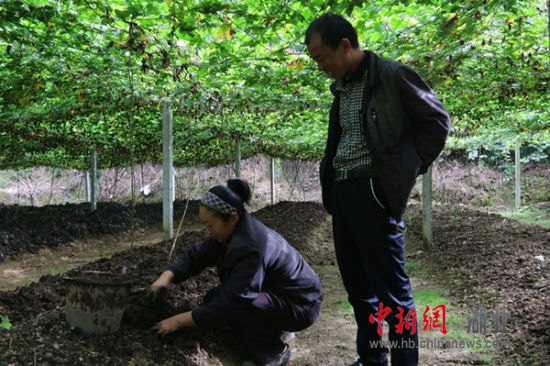
Workers Turning Over the Soil to Pick Out Earthworms
Tan Jiabing's Earthworm Breeding Base
On the 19th, in Lijiaping Tujia Village, Wachangba Village, Baiguo Township, Enshi City, several villagers were busy spreading black mud mixed with pig manure onto the soil beds and placing the earthworms they had turned up one by one into the rows. This is the newly built earthworm breeding base of the Enshi Nongyou Earthworm Breeding Professional Cooperative.
Raising Earthworms Can Also Make Money
"This year I earned nearly 400,000 yuan from the earthworms I raised, and the largest single sale was over a thousand jin. In June, a customer from Dazhou, Sichuan came to the door wanting to buy ten thousand jin in one go, but our current breeding scale is not yet large enough to meet the customer's demand, so we lost this order worth more than 200,000 yuan," base owner Tan Jiabing told this writer with regret.
When talking about earthworm breeding, Tan Jiabing seemed extraordinarily excited. He said that every little earthworm that turned from mere flesh into gold embodied a great deal of his painstaking effort. From purchasing breeding stock to breeding to selling on the market, he personally handled every step, having fully tasted the hardships of starting a business and also felt the joy of success.
Tan Jiabing, a native of Shawan, Wuyang Office, Enshi City, began raising earthworms in 1998. At the time, Tan Jiabing had just turned 22 and heard people say that raising earthworms was a good way to make money. Because this work is dirty and hard, no one was willing to enter this industry at the time.
But Tan Jiabing was determined to carve out a place for himself. After discussing it with his family, Tan Jiabing took 3,000 yuan they had scraped together and went alone to Hebei to conduct on-site inspections and learn from experience, and he bought back 500 jin of "Daping No. 2" earthworm breeding stock, throwing himself wholeheartedly into his earthworm breeding business, and he kept at it for seventeen years.
"At the beginning, because of insufficient experience and lack of understanding of earthworms' living habits, the earthworms I put into the field one day had all run off without a trace by the next day. Not only did I not make money, I even lost the capital I had used to buy the earthworm breeding stock," Tan Jiabing said. At the time, he felt he was simply not cut out for entrepreneurship and business, and wanted to give up breeding and go out to work. After several days of intense mental struggle, he decided he still could not give up halfway and should find out the reasons for the failure.
"Later, by consulting materials and asking experts, I learned that earthworms like warmth and moisture, and like shade but fear light. If you shine a light on them at night, they will obediently burrow into the soil and will not come out and run around. After grasping these basic characteristics, I went to Hebei again and purchased breeding stock for 8 mu in one go. Later, during the breeding process, management became much easier." Tan Jiabing explained.
Regarding how to do a good job in management, Tan Jiabing said: "In actual breeding operations, it is not as simple as you imagine. One year, I found a partner in Shengjiaba to develop earthworm breeding. Because it was far from home, I handed all routine management over to him. One night it was going to rain heavily, and I notified the other party to cover the earthworm beds well with plastic film. At 1 a.m. I was still worried, so I drove over to check, and sure enough, because it had not been handled in time, all the earthworm beds were washed out. One small oversight cost me tens of thousands of yuan."
In the second half of 2014, Tan Jiabing once again faced the difficult predicament of whether to continue or not. As Enshi's urbanization pace accelerated, most of the land in Shawan was requisitioned by the government, and he lost the land support for raising earthworms. For more than half a year, he had no opportunity to raise young earthworms. But this did not stop Tan Jiabing's enthusiasm for breeding.
Raising earthworms requires large amounts of pig and cattle manure as a nutrient source, and choosing a good site is the first key factor. At the end of 2014, Tan Jiabing traveled around and, after much searching, set his sights on Lijiaping Tujia Village, adjacent to Longtanba Village, Baiguo Township, where the pig farm of Enshi Sile Group is located. Here there were both moist and warm environmental conditions suitable for earthworms to reproduce and grow, and an abundant source of pig manure nutrients, making it an ideal earthworm breeding site. After many negotiations with Wachangba Village, Tan Jiabing finally had a stage once again to develop his beloved earthworm breeding business.
You Increase Income, I Develop
"My family's 3 mu of land is mainly used to grow rice and corn. In a good year, the annual income is only four or five thousand yuan. This year the rice suffered severe grain sterility, and the total income was less than three thousand yuan. Growing crops alone cannot support a person. Since the Nongyou Cooperative settled here, I have been working here long term, earning 80 yuan a day in wages. Raising earthworms brings in much more income than growing other crops. I plan to raise one mu of earthworms next year too and work with the cooperative to earn some money." Villager Wang Xiqiong, who was spreading pig manure on the soil beds in the shed, told this writer.
It is reported that five or six people like Wang Xiqiong work long term at the base, and at the busiest times there are about ten. The villagers working here have all earned more than ten thousand yuan in wages this year. It is understood that many villagers, seeing the good prospects of earthworm breeding, have said they will set aside part of their land next year to develop earthworm breeding.
"Once the technology and market are mature, I will bring villagers along to gradually expand the breeding area," Tan Jiabing said. Villagers being willing to follow him in developing the earthworm breeding industry is a very good thing. First, expanding the breeding scale within the region can meet the demand of some large customers in the market in terms of volume, which is conducive to the enterprise's deeper and industrialized development. Second, when villagers make money raising earthworms, their enthusiasm and confidence are higher, and they do not need to go out to work, gathering strength to boost local industry development and forming a win-win situation.
Strengthening the Entity and Extending the Industrial Chain
It is understood that the cooperative has invested 500,000 yuan, built an earthworm breeding base of 22 mu, and developed 15 member households. At present, the cooperative is moving onto a track of efficient operation.
"The base all uses the high-quality improved variety 'Taiping No. 2.' This variety was produced by crossing Japanese flower earthworms with American red earthworms. It has strong adaptability and a high reproduction rate, is suitable for high-density artificial breeding, and can reach an average yield of 1,500 kg per mu. At present, the highest market price is 20 yuan per jin, with an average price of about 15 yuan, and income per mu can exceed 40,000 yuan," Tan Jiabing introduced happily.
At present, the cooperative has more than 60 stable high-quality customer resources both inside and outside the province, including Wuhan, Sichuan and Guizhou. Annual total sales can reach 40 tons, realizing sales revenue of 600,000 yuan. In order to make full use of land resources and improve the comprehensive utilization rate of land, the cooperative has also entered into deep cooperation with Lichuan Tuanbao Farm Medicinal Materials Co., Ltd. to develop medicinal Trichosanthes kirilowii cultivation on the earthworm breeding base. All of its Trichosanthes kirilowii products are purchased on a targeted contractual basis by Nong'an Medicinal Materials Company. This not only increases the medicinal materials company's source of raw materials and market, but also effectively utilizes high-quality organic earthworm manure fertilizer, opening a new path for the cooperative to lower production costs and increase economic income, and building an efficient three-dimensional agriculture chain of pig manure -> earthworms -> Trichosanthes kirilowii.
Now, Tan Jiabing also has a long-term vision: on the one hand, to drive surrounding farmers to join the earthworm breeding industry and expand the scale of earthworm breeding, striving to reach 100 mu of earthworm breeding area by 2016; on the other hand, to make full use of the organic fertilizer formed during earthworm breeding to grow vegetables such as leaf lettuce, simultaneously build an organic vegetable base, maximize the land utilization rate, and extend the industrial chain.