Organic yak farming leads villagers onto the road to prosperity
Before dawn, in the Fengshou group of Gari village, Qiaoqi Tibetan township, Baoxing county, the yak herders were already heading up the mountain. Following the rule of giving salt once a quarter, they carried salt on their backs and walked to the 250,000-mu natural grassland to bring an intestine-soothing "miracle" to the family's 2,000 yaks. Squatting down, scooping out, standing up, the herders repeated their daily movements, scattering salt by the pond and on the flat rocks in the grassland, and the herds of yaks would rely on memory to come to familiar spots and lick up a few mouthfuls.
The owner of these yaks is a young Tibetan man named Yongzhong. Not tall in stature, he runs a yak cooperative in the Fengshou group of Gari village. After raising yaks for many years, this gift from the high mountains has slowly changed his life. Last year, the organic certification he obtained affirmed the quality of his yaks and greatly accelerated the pace of change in his life.
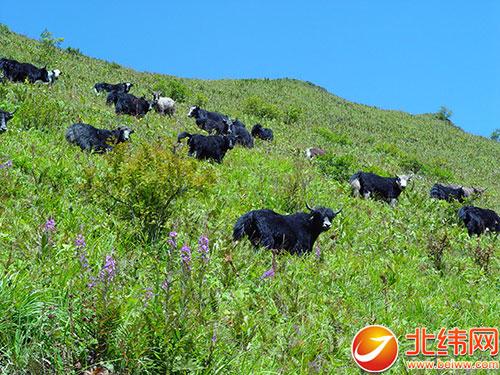
Yongzhong's yaks graze on the hillside
Continuing the ecological farming method
"Yak farming is completely original ecology." Speaking of how his yaks are raised, Yongzhong was full of confidence. The yaks search for food in the natural grassland, and the herders only need to feed them salt once a quarter; the yaks can take care of themselves and grow healthy and sturdy.
The temperature is relatively low at this time of year, and even lower at high altitudes, so the yaks that move in herds often stay in lower-altitude grasslands. With a bit of luck, you can even see a large herd of yaks grazing leisurely on the grassland.
Yongzhong hired 4 herders, and every so often the herders go up the mountain to check where the yak herd is active. The herders are the herd's "locator." The yaks' most recent activity area is something Yongzhong can know just by asking them.
"The yaks are very well-behaved and always move together, but sometimes one or two are naughty and get lost. Once, one went to the other side of the mountain (part of Aba Prefecture) and was only found after it had joined another Tibetan family's herd," Yongzhong said.
The cooperative has more than ten employees in total, engaged in technical work, internal inspection, sales and other tasks. The internal inspectors are the "trackers" of organic farming. Each yak's ear is marked with its own "ID card," and the internal inspectors regularly check and record the physical condition of each yak, while Yongzhong conducts spot checks on the staff's work from time to time.
Organic certification changes life
"Yak meat sells out quickly as soon as it hits the market." Before obtaining organic certification, Yongzhong's sales market was mainly local, and the beef could be sold out the same day. At the nearby Shenmu Lei scenic area, it was even more popular with tourists. After obtaining organic certification last year, many out-of-town merchants came attracted by its reputation to buy Yongzhong's organic yak meat. Without leaving home, his income increased greatly.
At 4 a.m. on the 21st, before dawn, the slaughterer hired by Yongzhong had already gotten up and was sharpening his knife to prepare to slaughter the yaks driven back a few days earlier. At 6 o'clock, the steaming yak meat was "out of the oven." "Now I have to supply 3,000 kg of meat a month," Yongzhong said.
Sales increased, and prices rose as well. Previously, yak meat sold for 20-40 yuan per kg; now it can sell for 70 yuan locally, and 120 yuan to out-of-town buyers. Organic yaks not only made his own life more prosperous, but also helped the surrounding villagers get rich.
As Yongzhong's wallet grew fuller, he began planning for future development. Finding markets, doing packaging... He saw greater business opportunities and longed to integrate with the market to a greater extent. "Recently, I've been working with a software company in Shenzhen to establish a quality traceability system," Yongzhong said. A "window" is needed between organic yaks and consumers. As long as consumers open the "window," they can see the production process of the piece of meat in their hands.
Standing at Yongzhong's doorstep and looking into the distance, you can see yaks grazing leisurely on the grassland, like black pearls dotting a vast green blanket. These black pearls have not only improved the lives of the villagers, but also brought them closer and closer to the outside world.